Saudi Arabia Medical Device Distributor Compliance: Key Regulatory Responsibilities
A medical device distributor in Saudi Arabia needs more than access to authorized products. Compliance also depends on preserving device quality during storage and transportation, maintaining traceable distribution records and ensuring that promotional claims remain within applicable Saudi Food and Drug Authority (SFDA) requirements.
Product authorization, establishment licensing and operational compliance serve different purposes. Approval to market a device does not replace the distributor’s responsibility to control what happens to it throughout the supply chain.
This guide focuses on practical medical device distributor responsibilities, from receiving stock to supporting recalls, without covering licensing applications or product registration procedures in detail.
What rules apply to a medical device distributor in Saudi Arabia?
Saudi Arabia medical device distributor requirements sit within the Medical Devices Law, its Implementing Regulations and the SFDA requirements applicable to the establishment’s activities and products. Use the SFDA’s official regulations and guidance library to identify the current documents governing establishment licensing, storage, transportation, advertising and other relevant activities.
Ready to Streamline Your Regulatory Compliance?
Join hundreds of companies who trust OMC Medical for their regulatory needs. Get expert guidance and ensure compliance across all markets.
Call Now +44 208 066 7260Start by checking that the establishment’s license scope reflects the activities actually performed. Distribution, importing and operating storage facilities should not be treated as interchangeable permissions. Where warehousing or transportation is outsourced, confirm the provider’s applicable regulatory status and define responsibilities in writing.
A licensed establishment and an authorized product are separate compliance checks. Both need to be addressed before stock is released for supply.
SFDA medical device establishment licensing should therefore connect to daily operations: the activities performed, facilities used and products handled must remain consistent with the applicable permissions and conditions.
Verify product eligibility before releasing stock
Receiving goods into a warehouse is not the same as approving them for distribution. Establish a documented release check that connects each product to its lawful Saudi market-access route.
For a medical device distributor in Saudi Arabia, the check should address:
- Authorization status: Confirm the applicable Medical Device Marketing Authorization (MDMA), or retain evidence of another lawful SFDA route where an exception applies.
- Product identity: Match the manufacturer, device name, model and relevant variants against the supporting authorization documents.
- Labeling and condition: Check identification, required labeling, packaging integrity and any applicable expiry information.
- Supply restrictions: Check relevant holds, recalls, safety notices or other conditions affecting distribution.
An invoice or foreign-market certificate alone is not evidence that a device can be supplied in Saudi Arabia. Unclear authorization status should trigger a hold until the discrepancy is resolved.
For the separate authorization process, OMC Medical’s Saudi medical device registration and MDMA guide explains the market-access framework.
How should GDP and quality management work together?
Good Distribution Practice (GDP) provides a practical framework for preserving device conformity as products move through the supply chain. It should operate within a documented quality management system, rather than as a warehouse checklist disconnected from the rest of the business.
Build distribution controls around applicable SFDA requirements and relevant ISO 13485:2016 quality-system requirements. Confirm the certification requirements and certificate scope applicable to the establishment’s licensed activities. A manufacturer’s certificate does not establish compliance for a separate distributor.
The system should define responsibilities, staff competence, supplier and service-provider controls, document approval, equipment maintenance and the handling of nonconforming products. Internal reviews should test whether these controls work in practice.
For a medical device distributor in Saudi Arabia, outsourced activities also need oversight. A logistics contract should specify storage conditions, monitoring arrangements, deviation communication and access to relevant records.
OMC Medical’s overview of SFDA’s ISO 13485 guidance provides further context on aligning quality-system requirements with Saudi medical device rules.
Protect devices during storage and transportation
Maintain the conditions specified for each product
Storage conditions should follow the manufacturer’s documented requirements and any applicable SFDA conditions. Do not assume that every device needs refrigeration or that all products labeled for ambient storage can tolerate the same exposure.
Define appropriate temperature, humidity, light protection and handling controls for the products held. Use suitable monitoring equipment, with calibration or verification appropriate to its purpose. Assess warehouse temperature distribution where necessary to demonstrate that storage locations remain suitable.
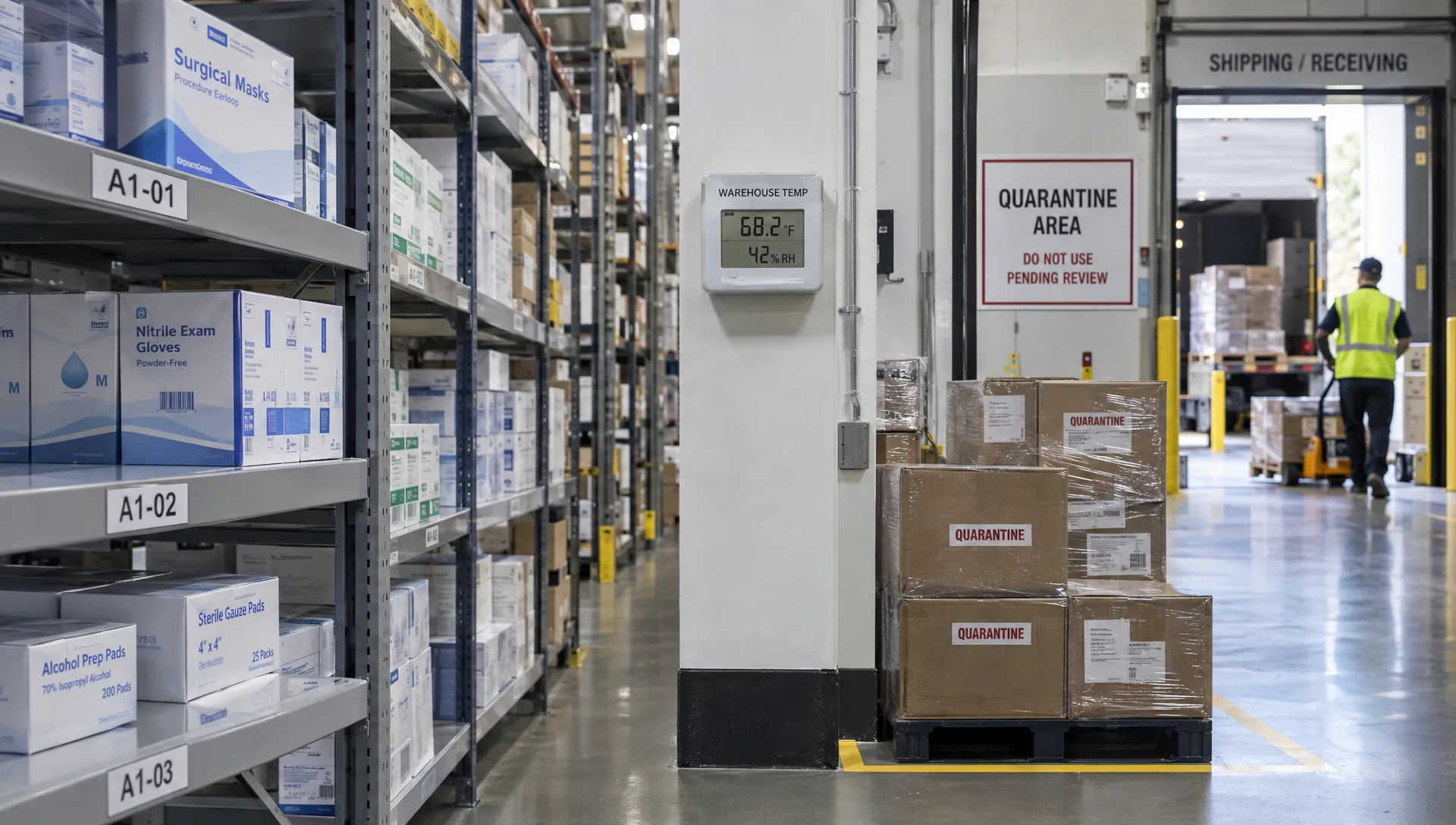
Receiving areas, loading bays and temporary holding locations deserve particular attention. Controlled warehouse conditions offer little protection if sensitive devices remain on an exposed loading dock.
Control transport conditions and excursions
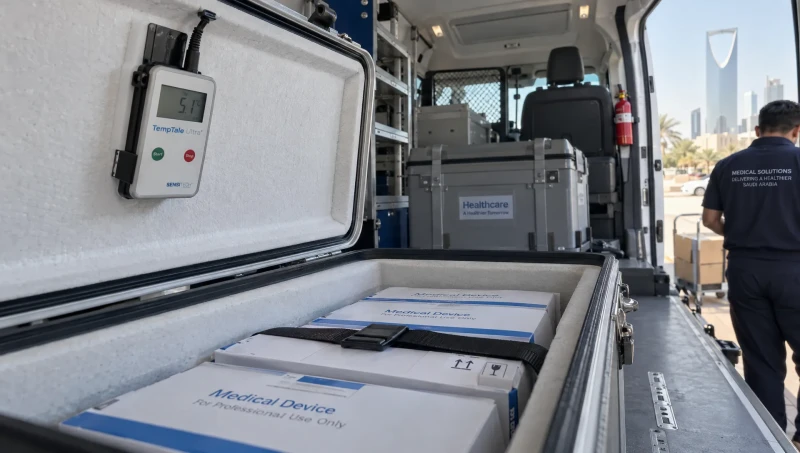
Transportation arrangements should preserve the required conditions until delivery. Consider vehicle suitability, packaging, handling, journey duration and the need for temperature monitoring. Qualification or validation should be proportionate to product requirements and transport risks.
When an excursion occurs, place affected stock on hold and preserve the monitoring evidence. Obtain a documented assessment using the manufacturer’s requirements and relevant technical input before deciding whether the stock can be released.
Medical device distribution in Saudi Arabia should not rely on visual inspection alone to determine whether temperature-sensitive stock remains suitable. An intact carton does not establish that its contents stayed within acceptable conditions.
Manage expiry, damaged products and inventory status
Warehouse controls must distinguish products available for supply from products awaiting assessment. Quarantined, rejected, recalled, expired and damaged stock should have clear identification and effective segregation, supported by inventory controls.
Use first-expiry-first-out allocation for products with expiry dates, unless a justified alternative applies. For products without expiry dates, maintain appropriate stock rotation and identification controls. Returned goods should not automatically re-enter saleable stock: assess packaging integrity, storage history and any product-specific restrictions first.
The following comparison shows how routine warehouse activity becomes auditable evidence.
| Control area | Practical control | Evidence to retain |
|---|---|---|
| Incoming goods | Check identity, condition and authorization evidence | Receiving record and release decision |
| Storage conditions | Monitor conditions appropriate to the product | Monitoring logs and equipment records |
| Expiry management | Identify approaching expiry and block expired stock | Inventory reports and stock-status records |
| Damaged or suspect products | Segregate and prevent unintended supply | Hold record, assessment and disposition |
| Returned goods | Assess suitability before any resale decision | Return assessment and release or rejection approval |
| Inventory accuracy | Reconcile physical stock with recorded quantities | Stock-count results and discrepancy investigations |
For a medical device distributor in Saudi Arabia, the critical test is whether staff can prevent unsuitable stock from being picked and dispatched, including during busy periods or system outages.
Maintain distribution records that support traceability
Traceability should allow the business to establish where a product came from, where it went and what remains in stock. Records must link the physical device to the relevant transaction, not merely show that an order was invoiced.
Capture the identifiers needed for the device and applicable SFDA requirements. Depending on the product, these can include:
- Device name, model and manufacturer.
- Lot, batch or serial number and UDI information where applicable.
- Supplier and direct recipient details.
- Quantities received, supplied, returned and remaining.
- Receipt and dispatch dates, with relevant delivery references.
- Expiry dates and storage or transport evidence where relevant.
Structure records so that a specific lot or serial number can be searched without manually reviewing every invoice. Test this capability periodically by selecting a batch and reconciling receipts, deliveries and remaining stock.
Set retention periods using the current requirements applicable to each record category. Electronic systems should also have suitable access controls, backups and change controls so that traceability records remain reliable and retrievable.
Keep advertising and product claims under regulatory control
SFDA medical device distributor regulations affect more than physical stock. Promotional materials also need review against the device’s authorized intended purpose, supporting evidence and applicable advertising requirements.
Do not assume that MDMA approval authorizes every advertisement. Where SFDA advertising approval is required, obtain it before release and ensure the published material matches the approved version. Check the requirements relevant to the communication channel and intended audience.
A medical device distributor in Saudi Arabia should control website descriptions, social media posts, sales presentations, brochures and other promotional content. Claims should not introduce unsupported indications, imply an unapproved use or misrepresent regulatory authorization as an endorsement of superiority.
If campaigns are developed with a growth marketing and innovation agency such as User Story, provide a controlled claims brief and require regulatory review before publication. External creative support does not replace SFDA requirements or the distributor’s own approval controls.
OMC Medical’s guide to Saudi Arabia marketing and advertising regulation provides additional context for reviewing promotional activities.
Coordinate recalls and corrective actions with relevant parties
Distributors need to be ready to act when a manufacturer or the SFDA identifies affected devices. This requires current contacts, accurate distribution records and a defined method for stopping further supply.
Assign responsibility for coordinating with the manufacturer, the Saudi authorized representative where relevant, customers and logistics providers. When a recall or field safety corrective action applies, identify affected stock and recipients, implement the required distribution hold and follow the applicable instructions.
Document quantities located, communications issued, customer responses and the disposition of affected units. Do not substitute locally drafted technical instructions for manufacturer- or regulator-approved directions.
A mock traceability exercise can expose gaps before an actual action occurs. Test whether the team can locate affected stock, identify recipients and reconcile quantities. Detailed reporting and vigilance procedures are separate obligations and should align with the applicable SFDA requirements.
What operational documentation should be inspection-ready?
Operational documentation should demonstrate both the intended process and what happened in practice. A procedure stating that temperatures are monitored has limited value without usable monitoring records and evidence that excursions were assessed.
For a medical device distributor in Saudi Arabia, the documentation set should connect establishment permissions, product authorization checks, quality procedures, staff training, service-provider controls and warehouse operations.
It should also capture receiving and dispatch decisions, inventory adjustments, equipment checks, nonconforming-product assessments, advertising approvals and recall-related actions. Review controlled documents when products, facilities, responsibilities or regulatory requirements change.
Keep records accessible to authorized personnel and available for regulatory inspection as required. Avoid relying on one employee’s inbox or a logistics provider’s short-term tracking portal as the only evidence of a critical activity.
Frequently asked questions
What Are the Regulations for Medical Devices in Saudi Arabia?
The framework includes the Medical Devices Law, its Implementing Regulations and applicable SFDA requirements and guidance. A distributor must identify the provisions relevant to its activities, products and facilities, including licensing, distribution controls, advertising and cooperation with corrective actions.
What Is SFDA Compliance?
SFDA compliance means meeting the Saudi Food and Drug Authority requirements applicable to the establishment and its products. For distributors, this includes appropriate permissions, checks on product eligibility, controlled storage and transportation, traceability and reliable operational records.
What Are the Regulatory Requirements for Medical Devices?
Requirements depend on the device, intended purpose and the organization’s role. They can include authorization, labeling, quality management and post-market obligations. A distributor should verify the requirements affecting supply without assuming responsibility for every manufacturer obligation or treating manufacturer compliance as a substitute for its own controls.
Is 21 CFR Part 820 Still Valid?
Yes. Effective February 2, 2026, 21 CFR Part 820 became the US FDA’s Quality Management System Regulation (QMSR), replacing the former Quality System Regulation framework. It is a US requirement for covered manufacturers, not a substitute for Saudi SFDA requirements.
What Is the Difference Between 21 CFR Part 820 and ISO 13485?
ISO 13485:2016 is an international medical device quality management standard. The current US QMSR incorporates it by reference while retaining FDA-specific provisions. ISO 13485 certification alone does not establish compliance with every US requirement, and Saudi obligations must be assessed separately.
Is 21 CFR Part 11 Mandatory?
Not universally. 21 CFR Part 11 applies to specified electronic records and electronic signatures within FDA’s regulatory scope. Keeping electronic warehouse records in Saudi Arabia does not, by itself, make Part 11 mandatory. Applicable SFDA recordkeeping requirements still need to be met.
Build compliance into everyday distribution
A medical device distributor in Saudi Arabia should be able to demonstrate that products are eligible for supply, storage and transport conditions are controlled, inventory status is reliable and recipients can be traced. Advertising review and coordinated corrective actions complete the operational picture.
Contact OMC Medical for regulatory support with your Saudi compliance approach, technical documentation and market-access needs. Start by identifying the gaps between your licensed activities, documented procedures and actual distribution practices.