
SFDA warehouse inspection for medical device warehouses in Saudi Arabia: GHAD audit
An SFDA warehouse inspection assesses whether a medical device storage operation meets the Saudi Food and Drug Authority requirements applicable to its licensed activities, premises and products. For manufacturers, importers, distributors and warehouse operators, preparation means demonstrating that devices remain protected, traceable and controlled throughout storage and distribution.
GHAD supports regulatory application workflows, but a portal submission does not establish that a warehouse is compliant. This guide explains how to connect licensing information, facility controls and operational records without assuming that every requirement applies to every site.
What does an SFDA warehouse inspection assess?
The inspection focuses on the conditions and controls relevant to the establishment’s activities. Depending on the applicable process, it may support licensing, regulatory oversight or follow-up on identified concerns.
Inspectors may examine the physical premises, storage practices, personnel responsibilities and records showing how procedures work in practice. The relevant scope depends on factors such as the establishment category, device portfolio, storage conditions and use of outsourced services.
Ready to Streamline Your Regulatory Compliance?
Join hundreds of companies who trust OMC Medical for their regulatory needs. Get expert guidance and ensure compliance across all markets.
Call Now +44 208 066 7260A warehouse holding temperature-sensitive diagnostic products presents different storage risks from one handling devices labeled for ambient storage. Neither should use a generic checklist without checking product-specific requirements.
An SFDA warehouse inspection therefore requires both suitable facilities and evidence that daily operations consistently protect device quality. Use SFDA’s official website to locate current medical device regulations, guidance and service instructions before finalizing your compliance assessment.
GHAD’s role in warehouse compliance
GHAD is SFDA’s electronic platform for medical device regulatory services, including relevant establishment licensing and product authorization workflows. Confirm the current service, submission route and supporting documents for your establishment.
The expression “GHAD audit Saudi Arabia” should not automatically be treated as the name of a separate statutory audit or certification. Clarify whether the requested activity is an SFDA inspection, a review of licensing submissions or an internal readiness assessment.
GHAD information should be consistent with actual operations, including the establishment identity, activities and premises covered by the application or license. For the separate product-authorization workflow, OMC Medical’s GHAD System SFDA Guide: How to Submit an MDMA Application explains the submission context.
Warehouse licensing: confirm the activity and premises
For a medical device warehouse Saudi Arabia has licensed, the approved activities and premises should match actual operations. Do not assume that an importer or distributor license automatically covers every additional location, outsourced storage arrangement or new activity.
When reviewing an SFDA medical device warehouse license, establish which licensing category applies and what the approval actually covers. Check the legal entity, site address, authorized activities, validity and any conditions attached to the approval.
Changes to premises, activities or responsible personnel may require an update or other regulatory action. Verify the current process before implementing a change rather than waiting until the next inspection.
Before an SFDA warehouse inspection, reconcile the license and relevant GHAD information with contracts, site plans and operating procedures. Product authorization and establishment licensing are separate compliance questions; the guide to Saudi Arabia Medical Device approval with SFDA provides broader market-access context.
Facility and layout: protect products and control movement
Verify the SFDA warehouse requirements Saudi Arabia applies to your establishment against the current guidance and licensed scope. Then assess whether the layout supports controlled movement from receipt through storage to dispatch.
The premises should protect devices from contamination, pests, moisture, physical damage and unauthorized access. Examine building condition, cleanliness, lighting, shelving and loading arrangements according to the products handled.
An SFDA warehouse inspection may reveal weaknesses where receiving, released stock, returns and rejected products are difficult to distinguish. Define clearly identified areas or other permitted controls for different stock statuses, with additional protection where products require special conditions.
Storage capacity also matters. A layout that works at low occupancy may fail when aisles become obstructed or stock blocks air circulation. Assess realistic operating conditions rather than an unusually empty warehouse prepared for the visit.
If a project considers repurposed shipping containers, specifications from suppliers such as Outback Shipping Containers can inform the physical design assessment. They do not establish suitability for regulated device storage. A weatherproof unit still requires assessment of environmental control, hygiene, security and permission to use it within the licensed premises.
Storage conditions and environmental controls
Start with the Saudi Arabia medical device storage requirements applicable to the establishment, then connect them to each product’s labeling and manufacturer instructions. Do not impose a single temperature range on all devices without supporting evidence.
Relevant conditions may include temperature, humidity, protection from sunlight, packaging integrity or limits on stacking. Translate those conditions into receiving checks, storage locations, monitoring arrangements and dispatch procedures.
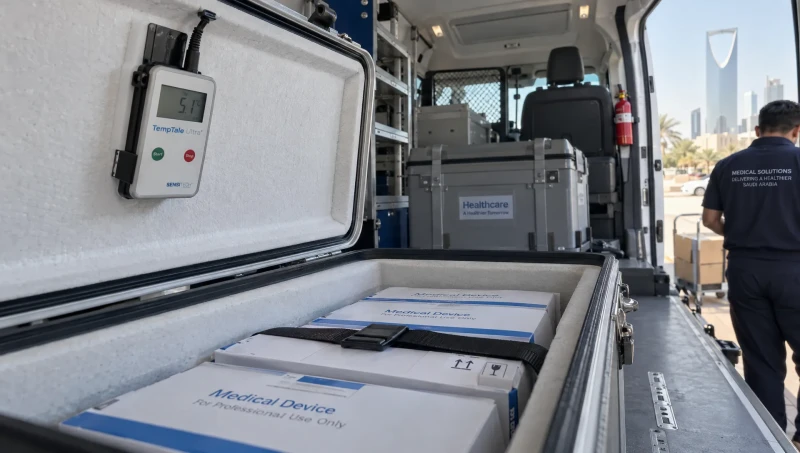
During an SFDA warehouse inspection, environmental records should demonstrate that products remained within their specified conditions, not merely that equipment was installed. Where humidity or another environmental factor is relevant, document how it is controlled and monitored.
Temperature monitoring and mapping where applicable
Determine whether temperature mapping is required by current SFDA requirements for the facility and whether it is needed to substantiate the suitability of storage areas. Mapping evaluates temperature distribution across a defined space; routine monitoring follows conditions over time. One does not automatically replace the other.
Where mapping applies, use a documented protocol reflecting the room or equipment, operating conditions, sensor locations and acceptance criteria. Consider loading, door openings and climatic variation where relevant. Repeat assessment when significant changes could affect the conclusions.
An SFDA warehouse inspection can expose weak monitoring arrangements when sensors are placed only in convenient locations. Use mapping results or another justified assessment to select monitoring positions. Maintain calibration records, defined review responsibilities and an appropriate response to alarms or missing data.
Managing excursions and equipment failures
Define what happens when temperature or another specified condition moves outside its limit. The procedure should address product identification, containment, escalation and a documented decision on disposition.
Do not release affected stock solely because the storage area has returned to normal. Evaluate the exposure against product-specific evidence and obtain manufacturer or qualified quality input where needed. Document contingency arrangements for refrigeration failure, power loss and transfer to alternative storage.
QMS and personnel: show who controls each process
The quality management system should reflect the warehouse’s actual activities. Relevant procedures commonly address receipt, storage, release, dispatch, returns, traceability, complaints, recalls, equipment maintenance and corrective actions.
Assign responsibilities clearly, including who reviews environmental records, controls stock status and escalates potential product damage. Training should cover the tasks employees perform and be supported by records and, where appropriate, evidence of competence.
During an SFDA warehouse inspection, a signed procedure is less persuasive if personnel cannot explain or demonstrate it. Check that approved instructions are accessible and that working practices match them.
Confirm any applicable requirements for responsible personnel and qualifications through current SFDA instructions. ISO 13485 may provide a relevant QMS framework, but certification applicability must be assessed for the establishment category. OMC Medical’s article, SFDA Releases ISO 13485 Guidance for Medical Devices in Saudi Arabia, provides related context without replacing a site-specific assessment.
Documents and records inspectors may review
Prepare an indexed evidence set matched to the inspection scope. Not every document below will apply to every warehouse, and this is not a substitute for the current SFDA checklist.
Potentially relevant evidence includes:
- Licensing information: Current approvals, establishment details, relevant GHAD submissions and records of site or activity changes.
- Facility controls: Layouts, cleaning records, pest-control records, maintenance history and relevant service agreements.
- Environmental evidence: Product storage specifications, monitoring records, calibration certificates, mapping reports where applicable and excursion assessments.
- Quality procedures: Controlled instructions for receipt, storage, dispatch, returns, recalls, complaints and nonconforming products.
- Personnel records: Defined responsibilities, training records and evidence of applicable qualification requirements.
- Traceability records: Receiving and dispatch records, lot or serial information where applicable, expiry controls and stock-status decisions.
Ensure that records are complete, retrievable and consistent across systems. An invoice, inventory entry and dispatch record should tell the same story about a product’s movement.
Select sample transactions before the inspection. Follow a product from receipt to its current location or recipient, then work backward. This checks whether traceability functions beyond the written procedure.
Preparing for an SFDA warehouse inspection
Begin with a scope-specific gap assessment against current requirements, approved activities and manufacturer storage instructions. Prioritize weaknesses that could affect product integrity, release decisions or recall capability.
Walk through the premises under normal operating conditions. Ask staff to demonstrate receipt checks, segregation, monitoring review and dispatch authorization. Test how quickly the team can retrieve records rather than simply confirming that folders exist.
Appoint an inspection coordinator and process owners who can explain their areas accurately. Brief personnel to answer within their responsibilities and avoid guessing when evidence or clarification is needed.
Keep a record of documents supplied, questions requiring follow-up and observations raised. Do not create retrospective records to fill gaps. Identify missing evidence honestly, assess the associated risk and document corrective action.

Common compliance gaps
Recurring readiness weaknesses include a mismatch between licensed activities and actual operations, unclear stock status and incomplete evidence that storage conditions have been maintained. These are useful internal audit themes, not a published ranking of SFDA findings.
Other gaps include monitoring instruments without current calibration evidence, unexplained data gaps, incomplete excursion assessments and staff training that does not cover assigned duties. Returns may also be placed back into saleable stock without a documented assessment of their condition and storage history.
An SFDA warehouse inspection can also expose traceability problems that ordinary inventory checks miss. Knowing how many units are available does not necessarily establish which lot was supplied to a particular customer.
Where third-party storage or transport is used, check that responsibilities, product conditions and access to relevant records are defined. A service contract should not leave critical quality decisions unassigned.
Nonconformities and CAPA: respond with evidence
Record each finding accurately and distinguish immediate containment from corrective action. Moving affected stock into quarantine may control the immediate risk, but it does not explain why the problem occurred or prevent recurrence.
Investigate the cause using evidence. If excursions were not reviewed, examine responsibility, alert handling and escalation arrangements rather than closing the finding with training alone. Assign an owner, completion date and proportionate action for each issue.
After an SFDA warehouse inspection, follow the response instructions and deadlines in the official notice. Do not assume a universal CAPA response period applies to every case.
Closure should include implementation evidence and an effectiveness check. For example, revised monitoring responsibilities can be verified through subsequent record reviews and a practical alarm-response test. Escalate potential product-quality or reporting concerns through the applicable procedures.
SFDA inspection vs internal compliance audit
An internal audit helps identify weaknesses before regulatory review, but it cannot replace an official inspection or grant regulatory approval.
| Aspect | SFDA inspection | Internal compliance audit |
|---|---|---|
| Who conducts it | SFDA inspectors or personnel acting under the applicable regulatory process | Competent internal auditors or an appointed external auditor |
| Main purpose | Assess compliance within the regulatory inspection scope | Evaluate controls, identify gaps and improve readiness |
| Scope | Determined through the relevant regulatory process | Defined by the organization against applicable requirements and risks |
| Evidence reviewed | Premises, operations, personnel and records relevant to the inspection | Similar evidence, with scope and sampling set by the audit plan |
| Findings | May require responses or regulatory action under the applicable process | Lead to internal corrective actions and management follow-up |
| Regulatory effect | Part of official regulatory oversight or decision-making | Does not issue, renew or replace an SFDA approval |
A well-designed internal audit rehearses the evidence needed for an SFDA warehouse inspection while remaining an independent assessment. Auditors should test actual controls and avoid reviewing only documents they helped prepare.
Frequently asked questions
Is a GHAD application the same as warehouse approval?
No. Submitting an application does not itself demonstrate approval or operational compliance. Confirm the application status, the resulting license or authorization and any conditions attached to it.
Does every medical device warehouse need temperature mapping?
Applicability should be checked against current SFDA requirements, the facility and the products stored. Mapping may be necessary to demonstrate suitable storage conditions, but it should not be prescribed or omitted without that assessment.
Is ISO 13485 certification mandatory for every warehouse?
Do not assume a blanket rule. Verify the requirements for the establishment category and activities. Certification, where applicable, does not replace evidence that warehouse operations meet relevant licensing and storage requirements.
Can an internal audit replace an SFDA inspection?
No. An internal audit supports readiness and identifies gaps, but it has no authority to issue an SFDA license or replace an inspection required through the regulatory process.
What happens when inspectors identify nonconformities?
The response depends on the findings and official instructions. Address immediate risks, investigate causes, submit the required response within the stated deadline and retain evidence that corrective actions were implemented and effective.
Prepare with a warehouse-specific compliance plan
Inspection readiness depends on alignment between licensed activities, product storage needs and reliable operational evidence. A portal submission or generic checklist cannot replace that work.
OMC Medical provides regulatory support, registration assistance, documentation preparation and global compliance services. Contact OMC Medical to discuss your Saudi warehouse scope and the regulatory preparation support appropriate to your operation.