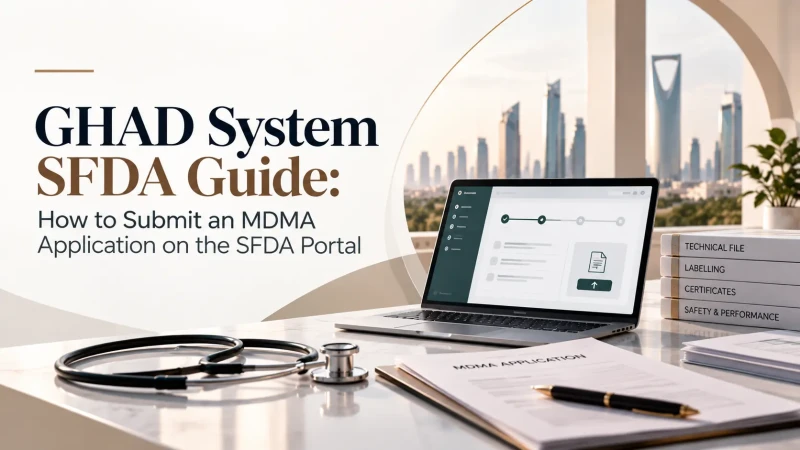
GHAD system SFDA guide: How to Submit an MDMA Application on the SFDA Portal
This SFDA MDMA Application explains how medical device manufacturers and regulatory teams can prepare and submit a Medical Device Marketing Authorization application through the Saudi Food and Drug Authority portal. However, it is not the only step. You may also need a licensed local entity, an authorized representative. The aim is practical: understand what each part of the process means, what documents are normally needed and where delays often happen.
For companies planning Saudi Arabia medical device registration the SFDA MDMA application is a central step. correct device classification, compliant technical documentation and a clear post-market plan.
What is the GHAD System?
The GHAD system is the SFDA’s electronic portal used for several medical device regulatory services in Saudi Arabia. It supports the digital submission and tracking of applications, including establishment related services, medical device registration functions, MDMA applications, payments and application status updates.
For MDMA, SFDA states that applications are submitted electronically through GHAD under Marketing Authorization Services, with the required documents attached. This does not mean that uploading documents automatically results in approval. SFDA still reviews the application, may raise queries and may request clarification or correction before issuing a decision.
Ready to Streamline Your Regulatory Compliance?
Join hundreds of companies who trust OMC Medical for their regulatory needs. Get expert guidance and ensure compliance across all markets.
Call Now +44 208 066 7260GHAD is best understood as the submission and workflow platform. It is not the regulatory approval itself. The approval, where granted, is the MDMA issued by SFDA for the relevant device scope.
What is an SFDA MDMA?
MDMA stands for Medical Device Marketing Authorization. It is the authorization required to place many medical devices and in vitro diagnostic devices on the Saudi market, subject to SFDA requirements.
An SFDA MDMA application normally links together:
The manufacturer and applicant details
The medical device or device family information
The device classification and intended purpose
Technical, quality and safety documentation
Labelling, instructions for use and supporting certificates
Any applicable grouping or bundling justification
Medical device registration is the broader regulatory pathway. MDMA is the authorization outcome within that pathway. GHAD system medical device registration functions help manage data, submissions and communication, but the underlying regulatory responsibility remains with the manufacturer and the local applicant or authorized representative.
If you need a broader view of the full Saudi pathway, OMC Medical has a detailed guide on Saudi Arabia medical device approval with SFDA.
GHAD Functions Compared
This distinction matters because teams sometimes treat “registration” and “MDMA” as the same task. In practice, the MDMA application depends on earlier setup steps being correct, especially applicant eligibility, manufacturer data, classification and document readiness.
Who Can Submit an MDMA Application?
The application is generally submitted through a Saudi based entity with the appropriate SFDA access and regulatory role. For overseas manufacturers, this usually means working through a licensed authorized representative or another eligible local party, depending on the business model and SFDA requirements.
A local manufacturer may submit through its own licensed establishment account when it meets the applicable requirements. An overseas manufacturer should not assume it can submit directly without a valid local regulatory arrangement.
Before submission, confirm:
Who will act as the applicant in GHAD
Whether the authorized representative licence is active and appropriate
Whether manufacturer details are consistent across certificates and technical documents
Whether the device falls within the intended application scope
Whether all documents are current, signed where needed and aligned with SFDA expectations
GHAD system SFDA guide: Prerequisites Before Submitting
Before opening the SFDA MDMA application, prepare the regulatory foundation. Most avoidable delays happen before the first upload, not during the portal steps.
Key prerequisites include:
Device qualification: Confirm that the product is a medical device or IVD under SFDA rules and not a borderline product requiring another pathway.
Risk classification: Identify the correct device class, as this can affect evidence expectations, fees and review depth.
Authorized representative arrangement: Overseas manufacturers should ensure their Saudi authorized representative is properly appointed and licensed where required.
GHAD access: Confirm the correct user account, establishment profile and service access are available before starting.
Technical file readiness: Prepare the technical documentation, including design, safety, performance and conformity evidence.
Labelling and IFU review: Check that labels and instructions for use support the intended purpose and meet applicable language and content expectations.
Device grouping decision: Decide whether devices belong in one application or should be submitted separately.
Bundling is a frequent source of uncertainty. If you plan to include multiple models, sizes or variants in one MDMA, review OMC Medical’s article on SFDA bundling criteria for MDMA applications before submission.
Step-by-Step GHAD MDMA Submission Process
The exact screen layout in GHAD may change, but the practical workflow usually follows these steps. Use this as a working checklist rather than a substitute for current SFDA portal instructions.
Log in to the correct GHAD account: Use the applicant or authorized representative account that is eligible to submit the MDMA application. Confirm the establishment profile is active before starting.
Open Marketing Authorization Services: From the GHAD services menu, select the medical device marketing authorization route. SFDA indicates that MDMA applications are submitted electronically through GHAD under this service area.
Start a new MDMA application: Choose the relevant application type and confirm whether the submission is for a new device, device family or another permitted scope.
Enter applicant and manufacturer details: Add legal names, addresses, contact details and role information. These details should match certificates, declarations and authorized representative documents.
Add device identification details: Enter the device name, model numbers, catalogue references, intended purpose, classification and any required device codes or nomenclature fields.
Define the application scope: Confirm whether the submission covers one device, a device family, variants or accessories. Make sure the selected scope is supported by the technical documentation.
Upload required documents: Attach the technical file, certificates, declarations, labelling, IFU, quality documents and other required evidence in the accepted format and language where applicable.
Review declarations and submit: Check every field before submission. Inconsistent manufacturer names, mismatched model lists and incomplete attachments can trigger queries.
Pay applicable SFDA fees: Once the portal generates the payment request or invoice, pay through the payment channel indicated by GHAD. Keep evidence of payment for internal records.
Track the application and respond to queries: Monitor the application status in GHAD. If SFDA raises a query, respond within the required timeframe with clear, complete and traceable answers.
Submitting the application places it into the SFDA review process. It does not guarantee approval, nor does it remove the need for complete evidence and regulatory justification.
Documents Required for an MDMA Application
The required documents depend on device type, classification, technology, intended purpose and submission scope. In general, manufacturers should prepare a complete dossier before starting the portal process.
Common document categories include:
Application and administrative documents: Applicant details, manufacturer details, authorized representative evidence and contact information.
Quality management evidence: ISO 13485 certificate or other quality system documentation where applicable.
Declaration of conformity: Manufacturer declaration confirming conformity with relevant regulatory and safety requirements.
Technical documentation: Device description, design information, specifications, essential principles or general safety and performance evidence, risk management and verification or validation data.
Clinical or performance evidence: Clinical evaluation for medical devices or performance evaluation for IVDs, depending on the device.
Labelling and instructions for use: Labels, IFU, packaging information and any required Arabic content or user information.
Certificates and market history: Existing regulatory approvals, free sale certificates or other market evidence where available and relevant.
Special process evidence: Sterilization validation, biocompatibility, electrical safety, software validation, cybersecurity or usability evidence where relevant to the device.
Post-market documents: PMS plan, vigilance process and complaint handling information.
A weak technical file often leads to multiple SFDA questions. For preparation details, see OMC Medical’s guide on how to prepare a technical file for SFDA medical device registration.
 Application Review and SFDA Queries
After submission, SFDA reviews the application for completeness, consistency and compliance with applicable medical device requirements. The review may include administrative checks, technical assessment and verification of uploaded evidence.
SFDA may raise queries if information is missing, unclear or inconsistent. Typical queries relate to classification rationale, model lists, certificates, clinical evidence, labelling, IFU content, software documentation or the proposed grouping of devices.
When responding to queries:
Answer each question directly
Upload revised documents with clear version control
Explain changes made since the original submission
Keep model names and references consistent
Avoid partial responses that require SFDA to ask the same question again
A practical query response should make the reviewer’s job easier. If the answer is in a large file, identify the exact section, page or table where the evidence appears.
Payment and Processing
SFDA fees may apply to MDMA applications and related services. The amount can vary depending on the application type, device classification and current SFDA fee schedule. Because fees can be updated, applicants should confirm the current amount in GHAD or through SFDA’s published fee information before payment.
Payment is normally part of the workflow after the relevant application or invoice is generated. Do not treat an unpaid or pending payment application as fully submitted for review unless the portal status confirms it.
Processing time depends on several factors, including:
Device class and complexity
Completeness of the initial submission
Quality of technical documentation
Number and complexity of SFDA queries
Speed and quality of applicant responses
Whether the application scope or bundling needs clarification
Plan enough time for review and possible query cycles, especially for higher risk devices, SaMD, sterile devices, active devices and IVDs with complex performance claims.
Common Mistakes That Can Delay an Application
Many MDMA delays are avoidable. The most common problems are not caused by GHAD itself, but by inconsistent preparation before submission.
Watch for these issues:
Wrong applicant role: The entity submitting in GHAD does not match the regulatory arrangement or authorization documents.
Inconsistent device names: The trade name, model number or catalogue reference differs between the application, label, IFU and certificates.
Incorrect classification: The risk class is not justified or does not align with the intended purpose.
Weak intended purpose: The intended use statement is too broad, unclear or inconsistent with evidence.
Expired certificates: ISO, conformity, market authorization or other supporting documents are no longer valid.
Incomplete technical file: Risk management, verification, validation or clinical evidence is missing or not traceable.
Poor bundling rationale: Devices are grouped together without meeting the applicable criteria.
Unclear Arabic labelling strategy: Labels or IFU content do not reflect local market expectations.
Late query response: The applicant misses deadlines or submits incomplete answers.
A pre-submission review can identify these issues before they become formal SFDA questions.
What Happens After MDMA Approval?
If SFDA approves the application, the device may be marketed in Saudi Arabia within the approved MDMA scope and conditions. The manufacturer and local regulatory party must continue to meet ongoing obligations after approval.
Post-approval responsibilities may include:
Maintaining valid manufacturer and authorized representative information
Supplying devices that match the approved application scope
Keeping technical documentation current
Managing complaints, vigilance and field safety corrective actions
Updating SFDA where changes require amendment, variation or renewal
Ensuring importers and distributors follow applicable requirements
Monitoring expiry dates for certificates and authorizations
If a device design, intended purpose, manufacturing site, label or certificate changes after approval, assess whether SFDA notification, variation, amendment or renewal action is required before continuing supply.
Conclusion: Preparing a Strong MDMA Submission
A successful Saudi Arabia medical device registration project starts before the portal submission. You need the right applicant setup, clear device classification, complete technical documentation, correct application scope and timely responses to SFDA queries.
Use this GHAD system SFDA guide as a practical checklist for planning the MDMA process, but always verify current SFDA requirements before filing. GHAD is the route for electronic submission, while MDMA is the marketing authorization decision issued after SFDA review.
OMC Medical supports medical device manufacturers with SFDA medical device registration, GHAD account and process support, MDMA application preparation, technical documentation and regulatory submission support. If your team is preparing for the Saudi market, contact OMC Medical to plan a compliant and efficient submission strategy.