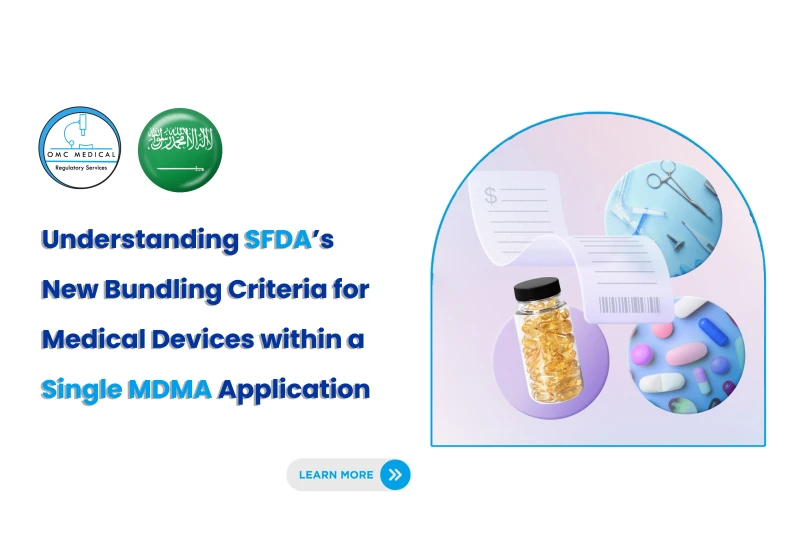
The Saudi Food and Drug Authority (SFDA) released a new guidance document titled “MDS-G-028 – Guidance on Bundling Criteria for Medical Devices within a Single MDMA Application” in May 2026. This guidance replaces Annex 15 of MDS-REQ1 and provides updated criteria for grouping medical devices under a single Medical Device Marketing Authorization (MDMA) application.
The update is important for medical device manufacturers, authorized representatives, and regulatory professionals operating in Saudi Arabia because it clarifies how devices, systems, procedure packs, and IVDs can be bundled together for regulatory submissions.
Background
Previously, manufacturers faced challenges while determining whether multiple products could be included within a single application. Lack of clear grouping criteria often resulted in submission delays, additional documentation requests, or application rejections.
To improve submission efficiency and regulatory clarity, SFDA introduced MDS-G-028 guidance.

What is Bundling?
Bundling refers to the process of grouping multiple medical devices under a single Medical Device Marketing Authorization (MDMA) application when the products meet the eligibility criteria established by the Saudi Food and Drug Authority (SFDA). The grouping criteria are based on factors such as intended purpose, risk classification, technology, design characteristics, and relationship between the devices.
Instead of submitting separate registration applications for each individual device, manufacturers may combine related products into one application if the devices belong to the same device family, system, procedure pack, or IVD category as defined in the guidance document.
The primary objective of bundling is to streamline the regulatory submission process while maintaining proper regulatory oversight and compliance. By allowing related products to be reviewed together, SFDA aims to improve the efficiency of the review process and reduce unnecessary administrative burden for both manufacturers and regulatory authorities.
This approach offers several advantages for manufacturers and Authorized Representatives, including:
Reduction in regulatory workload and repetitive documentation
Simplified submission planning and management
Reduced registration and administrative costs
Better organization of technical documentation
Improved consistency in product registration strategy
Faster review and approval timelines for related devices
Enhanced regulatory compliance efficiency
For Regulatory Affairs teams, proper bundling strategy has become an important part of submission planning, as incorrect grouping of devices may result in delays, requests for clarification, or rejection of the MDMA application.
Therefore, understanding SFDA’s bundling principles is essential for manufacturers planning to market medical devices in Saudi Arabia.
Key Highlights of the New Guidance
The newly released SFDA guidance provides detailed clarification regarding how medical devices can be grouped within a single Medical Device Marketing Authorization (MDMA) application. The guidance introduces structured criteria for different types of product grouping, including device families, medical device systems, procedure packs, and In Vitro Diagnostic Devices (IVDs).
These clarifications are intended to help manufacturers prepare more organized submissions while ensuring regulatory consistency and compliance with Saudi Arabian medical device regulations.
Device Family Criteria
According to the new guidance, medical devices may be grouped together as a “Device Family” when the products share common characteristics and meet specific eligibility requirements defined by SFDA.
To qualify as a device family, the devices should:
Be manufactured by the same legal manufacturer
Belong to the same risk classification
Share the same intended medical purpose
Have similar design principles and manufacturing processes
Operate using the same underlying technology
Differ only in minor aspects such as size, volume, or configuration
The concept of a device family allows manufacturers to combine similar product variants within a single submission instead of preparing separate MDMA applications for each individual model.
Example:
Different sizes or configurations of the same syringe product line may be grouped under one device family if the intended purpose and technological characteristics remain unchanged.
Similarly:
Catheters available in multiple lengths
Surgical gloves in different sizes
Blood pressure cuffs in different dimensions
may also qualify as a device family when they meet the SFDA criteria.
The guidance aims to reduce repetitive documentation and improve efficiency in the regulatory review process while maintaining product traceability and regulatory oversight.
Medical Device Systems
The guidance also provides clarification regarding “Medical Device Systems.”
A medical device system refers to multiple medical devices intended to function together to achieve a common medical purpose. The devices within the system are interconnected or designed to operate collectively as one integrated medical solution.
Examples of medical device systems include:
Endoscopy tower systems
Electrosurgical systems
Patient monitoring systems
Infusion pump systems
Imaging systems with connected accessories and software
For a system to be grouped within a single MDMA application, SFDA requires that:
all devices belong to the same legal manufacturer,
the products share a common intended use,
the devices are designed to function together,
and the technical documentation clearly demonstrates the relationship between the components.
The guidance also introduces specific submission limitations for bundled applications involving systems.
SFDA Submission Limits:
Maximum of 5 Technical Files per application
Maximum of 50 total items, including accessories and components
These limitations are intended to prevent overly complex submissions and support efficient regulatory assessment.
Manufacturers must ensure that all system components are properly documented and that the relationship between the devices is clearly justified within the technical documentation.
Procedure Packs
The guidance further explains the criteria for “Procedure Packs.”
A procedure pack consists of multiple medical devices or products packaged together for use during a specific medical procedure or clinical activity. Unlike medical device systems, the products within a procedure pack may not necessarily function as one integrated system but are assembled together for convenience and procedural efficiency.
Examples include:
Surgical kits
Dressing packs
Catheterization kits
Emergency procedure packs
Wound care packs
One important clarification introduced in the guidance is that products within a procedure pack may originate from different manufacturers. This distinguishes procedure packs from device families and systems, which generally require a single legal manufacturer.
The manufacturer or assembler responsible for the procedure pack must ensure:
compatibility of included products,
proper labeling,
packaging integrity,
and compliance with applicable regulatory requirements.
The guidance also emphasizes the importance of clearly identifying:
included devices,
intended procedural use,
and associated accessories or components.
This clarification helps manufacturers and Authorized Representatives better determine whether their products qualify as procedure packs and how they should be submitted under the SFDA framework.
IVD Grouping Requirements
The guidance includes dedicated criteria for the grouping of In Vitro Diagnostic Devices (IVDs), which are medical devices used to examine samples derived from the human body for diagnostic purposes.
Examples of IVDs include:
Blood glucose test kits
COVID-19 diagnostic kits
Pregnancy test kits
Laboratory reagents
Molecular diagnostic assays
According to the guidance, IVD grouping eligibility depends on several important factors, including:
intended diagnostic purpose,
technological characteristics,
testing methodology,
assay principles,
and risk classification.
SFDA emphasizes that IVDs grouped together within one application should maintain a clear relationship in terms of diagnostic function and technological platform.
For example:
diagnostic kits using the same testing methodology,
reagents intended for the same analyzer platform,
or assays targeting related clinical conditions
may qualify for grouped submission under specific conditions.
This clarification is particularly important for IVD manufacturers because diagnostic product portfolios often contain multiple variants, reagents, accessories, and testing configurations.
The updated guidance helps manufacturers:
organize IVD submissions more efficiently,
reduce duplication in technical documentation,
and improve regulatory submission planning.
At the same time, manufacturers must ensure that grouped IVDs continue to meet SFDA safety, performance, and labeling requirements.
Important Regulatory Limits
Requirement | SFDA Limit |
Maximum Technical Files | 5 |
Maximum Product Items | 50 |
Highest Risk Class Rule | Applicable |
One System Per Application | Required |
Impact on Manufacturers
The release of SFDA’s MDS-G-028 guidance has significant implications for medical device manufacturers planning to market their products in Saudi Arabia. The introduction of clearer bundling criteria provides manufacturers with a more structured approach for preparing Medical Device Marketing Authorization (MDMA) submissions.
One of the major advantages of the guidance is the improvement in submission planning. Manufacturers can now better evaluate whether multiple products may be grouped together under a single application, helping reduce duplication of regulatory activities and documentation.
The guidance also helps reduce documentation complexity by allowing related devices to share portions of technical documentation when they meet the required grouping criteria. This can significantly decrease the administrative workload associated with preparing multiple independent submissions.
Additional benefits for manufacturers include:
Better organization of product portfolios
More efficient submission management
Reduced registration and administrative costs
Improved consistency in regulatory documentation
Faster review timelines for grouped products
Enhanced regulatory planning for future product expansions
For manufacturers with large product portfolios, particularly those offering multiple variants of similar products, the guidance creates opportunities to optimize regulatory strategies and streamline market entry processes.
However, manufacturers must ensure that all grouped devices fully comply with SFDA requirements. Incorrect grouping or insufficient justification may result in:
regulatory delays,
requests for additional information,
or rejection of the application.
Manufacturers are therefore expected to maintain:
complete and accurate technical documentation,
proper labeling consistency across grouped products,
clear intended use statements,
and scientifically justified grouping rationale.
Careful assessment of bundling eligibility has now become an important part of regulatory submission preparation.
Impact on Regulatory Affairs Teams
The new guidance also has a direct impact on Regulatory Affairs (RA) professionals, Authorized Representatives, and compliance teams responsible for preparing and managing SFDA submissions.
RA teams must now perform more strategic evaluations during submission planning to determine whether products qualify for grouping under:
device families,
systems,
procedure packs,
or IVD categories.
This requires a deeper understanding of:
product intended purpose,
technological characteristics,
risk classification,
labeling requirements,
and technical documentation structure.
Regulatory Affairs professionals are now expected to:
carefully assess grouping eligibility,
organize technical documentation efficiently,
verify consistency across product labeling,
evaluate accessory inclusion,
and ensure full compliance with SFDA bundling principles.
The guidance also increases the importance of cross-functional collaboration between:
Regulatory Affairs,
Quality Assurance,
Product Development,
and Manufacturing teams.
Since grouped applications may contain multiple products and technical files, proper document organization and submission strategy have become essential for maintaining regulatory compliance.
In addition, the updated guidance creates opportunities for more efficient market entry strategies within Saudi Arabia. RA teams can now optimize submission pathways by strategically grouping eligible products, potentially reducing submission timelines and simplifying post-market regulatory management.
For Authorized Representatives operating in Saudi Arabia, understanding these new bundling requirements is especially important when supporting foreign manufacturers during the MDMA registration process.
Recommendations
Manufacturers and Regulatory Affairs teams planning medical device submissions in Saudi Arabia should proactively review the requirements outlined in MDS-G-028 and evaluate how the guidance may affect their current and future registration strategies.
As an initial step, manufacturers should conduct a detailed assessment of their product portfolios to identify products that may qualify for grouping under a single MDMA application. This may help reduce unnecessary duplication of submissions and improve regulatory efficiency.
Key recommendations include:
Review existing product portfolios and categorize eligible devices
Identify opportunities for device family, system, or procedure pack grouping
Verify consistency in intended purpose, labeling, and technical characteristics
Ensure technical documentation is properly organized and up to date
Evaluate accessory and component eligibility before submission
Maintain clear grouping justifications supported by technical evidence
Align internal regulatory procedures with the new SFDA guidance requirements
Manufacturers should also establish internal review processes to confirm that grouped submissions comply with all applicable SFDA criteria before application submission.
Early assessment of bundling eligibility may help manufacturers avoid future submission complications, reduce regulatory delays, and improve overall submission success rates.
In addition, companies operating across multiple international markets should consider how Saudi-specific bundling requirements may differ from grouping approaches accepted in other regulatory jurisdictions such as the EU, US FDA, or Health Canada.
Conclusion
The introduction of SFDA’s MDS-G-028 guidance represents an important regulatory development for the medical device industry in Saudi Arabia. By establishing clearer and more structured bundling criteria for medical devices within a single MDMA application, SFDA aims to improve the efficiency, consistency, and transparency of the regulatory submission process.
The guidance provides manufacturers and Regulatory Affairs professionals with a better understanding of how products may be grouped as device families, systems, procedure packs, and IVD categories while maintaining compliance with safety and performance requirements.
At the same time, the updated framework places greater responsibility on manufacturers to ensure:
proper technical documentation,
accurate grouping justification,
labeling consistency,
and compliance with applicable SFDA requirements.
Organizations that successfully adapt their regulatory strategies according to the new bundling criteria may benefit from:
reduced administrative burden,
improved submission efficiency,
optimized regulatory planning,
and smoother market entry into Saudi Arabia.
As the Saudi medical device regulatory environment continues to evolve, manufacturers and Authorized Representatives should remain informed about emerging regulatory updates and proactively align their submission strategies with SFDA expectations.
Understanding and implementing the principles outlined in MDS-G-028 will play a critical role in supporting efficient and compliant medical device registration activities within the Saudi Arabian market.