Medical supply companies in Kuwait operate within a structured regulatory environment shaped by the Ministry of Health (MOH), the Central Agency for Public Tenders (CAPT), and product-specific rules that vary by device classification. For manufacturers and distributors looking to enter the Kuwaiti market, understanding how suppliers are qualified, what documentation buyers expect, and how tender procedures work is the practical starting point. Kuwait medical device registration requirements depend heavily on the product’s risk class, its intended use, and whether the manufacturer already holds approvals in reference markets such as the EU or the United States.
What Qualification Actually Involves in Kuwait
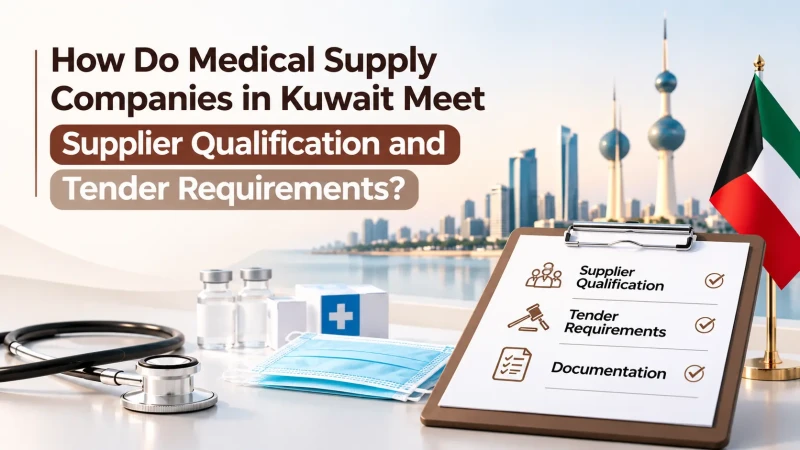
Supplier qualification in Kuwait is not a single certificate or a one-time approval. It is a layered process that combines legal registration, regulatory product compliance, and buyer-specific prequalification. A company may be legally registered to import medical devices yet still need to pass a separate vendor assessment for a specific hospital group or MOH tender. Medical supply companies must understand both regulatory obligations and local procurement expectations before entering the Kuwaiti healthcare market. Understanding the medical supplier qualification requirements helps manufacturers and distributors prepare the necessary documentation and meet the expectations of healthcare buyers.
The distinction matters because many suppliers assume that holding a CE mark or FDA clearance is enough. In practice, Kuwaiti buyers and regulatory authorities also look at local representation, post-market support capability, and the completeness of the technical file.
Core Supplier Evaluation Criteria
Medical supplier eligibility criteria in Kuwait typically cover several areas that go beyond product quality:
Ready to Streamline Your Regulatory Compliance?
Join hundreds of companies who trust OMC Medical for their regulatory needs. Get expert guidance and ensure compliance across all markets.
Call Now +44 208 066 7260Valid commercial license in Kuwait with the correct activity codes for medical device import and distribution
Appointment of an Authorized Representative or local agent where the manufacturer is based outside Kuwait
Evidence of product registration or recognition through the MOH medical device registration pathway
Quality management system certification, commonly ISO 13485 for medical device manufacturers
Technical documentation including labeling, instructions for use, and risk management files
Track record of supplying comparable products to hospitals or healthcare institutions
After-sales service capability, including maintenance, spare parts, and clinical training where relevant
Not every buyer applies all of these criteria uniformly. A private hospital may weigh price and delivery terms more heavily, while an MOH tender will place greater emphasis on technical compliance and documentation completeness.
Documents Commonly Requested in Kuwaiti Healthcare Tenders
The documents required for medical supply tenders in Kuwait vary by tender authority and product category. What follows reflects commonly requested items rather than a universal checklist, and buyers may add or remove requirements depending on the procurement. For Medical Supply Companies, maintaining accurate supplier records and product documentation can help simplify tender preparation and compliance checks.
A useful way to think about the documentation is to separate it into three groups: legal entity documents, product-specific technical documents, and quality or compliance certificates.

Regulatory Pathway and Product Compliance
CE and FDA approval requirements in Kuwait function as a reference point rather than a standalone pathway. Kuwait does not automatically accept a CE mark as sufficient for market entry, but existing approvals in the EU or the United States can simplify the technical review because the MOH recognizes the rigor of those regulatory systems.
Kuwait medical device import permit requirements typically involve submitting the product registration evidence, the local representative details, and import documentation that matches the registered product information. Discrepancies between the import permit and the actual shipment, such as different model numbers or labeling, are a common reason for clearance delays.
Medical device product registration in Kuwait should be treated as a prerequisite for serious tender participation. Buyers routinely ask for proof of registration or a registration acknowledgment before evaluating a bid, particularly for devices that fall into higher risk classes.
Technical Specifications and Quality Certificates in Tender Evaluation
Technical specifications carry significant weight in Kuwaiti public tenders. A bid that is commercially attractive but technically non-compliant will usually be disqualified rather than negotiated. Suppliers should treat the specification section of a tender document as the primary filter and align every claim in the bid with evidence in the technical file.
Quality certificates such as ISO 13485 serve a dual purpose. They support regulatory compliance and act as a signal to procurement committees that the supplier has structured processes for design, production, and post-market activities. For products sourced from multiple manufacturers, buyers may also ask for evidence that the distributor has controls over storage, handling, and traceability.
Practical Points That Are Often Overlooked
One recurring issue is the mismatch between the product name used in the tender and the name on the registration certificate. Even minor wording differences can trigger clarification requests and delay award decisions. Keeping registration details aligned with tender submissions is a simple but high-impact discipline.
Another point is the local agent’s role. The Authorized Representative is not just a paperwork formality in Kuwait. The agent is often the first point of contact for regulatory queries, field safety corrective actions, and post-market obligations. Choosing an agent with genuine regulatory experience, rather than a purely commercial intermediary, can make a measurable difference in how smoothly a product moves through registration and tender processes.
For companies that need structured support with product classification, technical file preparation, or local representation, OMC Medical provides regulatory consulting services that align with the documentation and qualification requirements discussed here. Contact OMC for guidance specific to your device category and target tender authority.