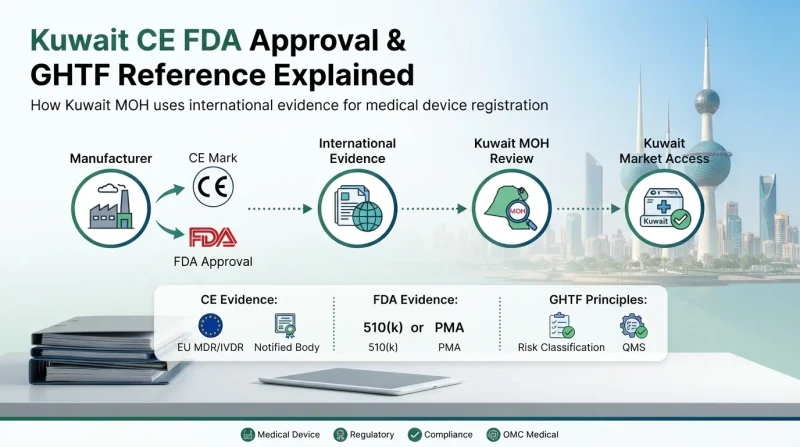
Manufacturers often search for Kuwait CE FDA approval because Kuwait commonly relies on evidence from established regulatory systems when assessing medical devices and IVDs. That approach can make the market entry route more predictable, but it does not mean a product is automatically approved for sale in Kuwait.
For medical device companies, the key is understanding how Kuwait uses reference approvals, what documents are expected and where local Ministry of Health reviews still apply. CE certification, FDA clearance or approval and GHTF based principles can support a submission, but Kuwait remains the final decision-maker for local market access.
Kuwait CE,FDA approval: what the term really means
In practice, this term is a commercial shortcut. It usually refers to a Kuwait registration strategy supported by CE or FDA evidence.
It is not a separate Kuwait license category issued by the European Union or the US FDA. It also does not replace Kuwait MOH medical device registration.
Ready to Streamline Your Regulatory Compliance?
Join hundreds of companies who trust OMC Medical for their regulatory needs. Get expert guidance and ensure compliance across all markets.
Call Now +44 208 066 7260A Kuwait reference approval approach means the regulator may consider evidence from recognized regulatory frameworks to support its local assessment. This can include proof that the same device has been assessed, cleared, approved or certified in another mature jurisdiction.
Kuwait authorities may still check:
Whether the product submitted is the same as the referenced product
Whether certificates and approvals are valid and current
Whether the legal manufacturer and manufacturing sites match the dossier
Whether labeling, instructions for use and claims are acceptable locally
Whether the local applicant, importer or Authorized Representative is properly established
Manufacturers looking for a broader view of current pathways can review OMC Medical’s Kuwait medical device and IVD registration FAQ, which explains registration requirements, reference authorities and common applicant questions in more detail.
Why Kuwait accepts reference approvals from mature systems
Kuwait’s medical device market includes imported devices from many regions. Reviewing every product from the beginning, without considering prior regulatory decisions, would create unnecessary duplication and longer access timelines.
Reference approvals help the Ministry of Health apply a more efficient and risk-based review model.
They provide evidence of prior regulatory scrutiny
When a product has CE certification under EU rules or FDA clearance or approval in the United States, it generally means the manufacturer has already prepared substantial evidence on safety, performance and quality.
That evidence may include:
Device description and intended purpose
Design and manufacturing information
Risk management documentation
Clinical or performance evaluation
Post-market surveillance and vigilance history
Quality management system certificates
This does not remove the need for Kuwait medical device approval, but it gives the local reviewer a stronger evidence base.
They support consistency with international expectations
Medical device regulation increasingly relies on harmonized concepts, such as risk classification, essential safety and performance principles, clinical evidence and post-market monitoring.
By recognizing CE, FDA and GHTF influenced frameworks, Kuwait can align its review expectations with internationally accepted regulatory science without copying another jurisdiction’s decision wholesale.
This is especially useful for manufacturers launching the same device across the Gulf, EU, US and other international markets.
How CE evidence is used for Kuwait medical device registration
CE marking shows that a device conforms to applicable European requirements. For medical devices, this may involve the EU Medical Device Regulation, or MDR. For IVDs, it may involve the EU In Vitro Diagnostic Medical Devices Regulation, or IVDR.
For many medium and high risk devices, a Notified Body assesses the manufacturer’s quality system and technical documentation before issuing a CE certificate. For some lower risk devices, the manufacturer may self-declare conformity.
That distinction matters. A CE mark is not always the same level of third-party review.
For Kuwait, CE evidence may help demonstrate that the device has undergone conformity assessment under a recognized regulatory system. The file may include:
CE certificate, where applicable
EU Declaration of Conformity
Notified Body certificate and scope
ISO 13485 certificate
Technical documentation summary
Instructions for use and product labeling
Kuwait may still review whether the CE evidence applies to the exact device model, intended use, accessories, software version and manufacturing site submitted locally.
A CE-marked device can be a strong basis for Kuwait medical device registration, but CE marking alone does not place the product on the Kuwait market.
How FDA evidence is used, and what manufacturers must not confuse
FDA evidence can also support Kuwait medical device approval, especially where the submitted documents show an actual US regulatory decision.
For medical devices, meaningful FDA evidence may include:
510(k) clearance letters
De Novo grant decisions
Premarket Approval, or PMA, approval orders
Humanitarian Device Exemption decisions, where relevant
FDA correspondence confirming the cleared or approved device identity
Manufacturers should be careful not to confuse FDA establishment registration or device listing with FDA clearance or approval.
FDA registration and listing are administrative requirements for certain establishments and devices marketed in the United States. The FDA explains the process on its official device registration and listing page. Registration or listing alone does not mean the device has been cleared through 510(k), granted through De Novo or approved through PMA.
For Kuwait reference approval, a device listing record may support product identification, but it is usually not the same as evidence of FDA clearance or approval.
This distinction is important because submitting only FDA listing information can lead to questions, delays or requests for additional proof.
What GHTF means in Kuwait reference approval
GHTF stands for the Global Harmonization Task Force. It was a regulatory harmonization initiative formed by regulators and industry representatives to promote convergence in medical device regulation.
GHTF was not an approval authority. It did not issue product licenses, CE certificates, FDA clearances or market authorizations.
Its relevance comes from guidance documents and regulatory principles that influenced many national systems. These include principles around:
Medical device classification
Essential safety and performance concepts
Quality management systems
Conformity assessment
Post-market surveillance and vigilance
The International Medical Device Regulators Forum, or IMDRF, later continued international harmonization work. IMDRF describes this history on its official history page.
When Kuwait refers to GHTF based concepts, the practical meaning is usually that the device may be assessed in line with internationally recognized classification and evidence principles. It does not mean a manufacturer can submit a GHTF approval certificate, because no such approval exists.
CE vs FDA vs GHTF: comparison for Kuwait market access
The table below summarizes how CE, FDA and GHTF evidence differ in a Kuwait submission context.

Why reference approval does not mean automatic Kuwait approval
This is the most common misunderstanding among manufacturers entering Kuwait.
Reference approval can strengthen a submission, but Kuwait still protects its own public health system and controls what enters its market. The Ministry of Health may accept international evidence, yet it retains authority to approve, reject or request clarification.
Automatic approval would be risky because product details can differ between markets. A device sold in Europe or the United States may not have the same configuration, labeling, accessories, software version or intended user population as the product planned for Kuwait.
Local review also checks administrative and market-specific elements, such as:
Correct local applicant or Authorized Representative details
Importer and distributor information
Product labeling and language expectations
Validity of certificates and letters
Consistency between reference approval documents and Kuwait application forms
Fees, declarations and supporting legal documents
In some cases, the import permit stage also matters. OMC Medical’s Kuwait import permit and Authorized Representative guide explains how import controls may connect with product registration and local representation.
Practical documents manufacturers should prepare
For manufacturers, Kuwait CE FDA approval evidence is strongest when the reference documents are complete, current and clearly connected to the device being submitted.
A well-prepared file should make it easy for the reviewer to verify the product identity and regulatory history.
Commonly relevant documents include:
Valid CE certificate or EU Declaration of Conformity, where applicable
FDA 510(k), De Novo or PMA decision evidence, where applicable
ISO 13485 certificate for the manufacturer
Certificate of Free Sale or equivalent market authorization evidence, if requested
Product labels, packaging artwork and instructions for use
Device description, intended purpose and model list
Risk classification rationale
Clinical evaluation or performance evaluation summary
Post-market surveillance and vigilance information
The exact document set can vary based on device type, classification, route and current Kuwait MOH expectations. Manufacturers should verify the latest requirements before submission rather than relying on a generic checklist.
Common mistakes that delay Kuwait MOH medical device registration
Many delays are avoidable. They usually happen when the reference approval evidence is incomplete or inconsistent with the Kuwait application.
Common issues include:
Submitting FDA registration or listing as if it were FDA clearance or approval
Providing a CE certificate that does not cover the submitted model
Using expired certificates or outdated declarations
Mixing manufacturer names, addresses or manufacturing sites across documents
Submitting labeling that includes claims not supported by the reference approval
Assuming a GHTF classification document is the same as a product approval
Failing to appoint or coordinate with the correct local party
A good Kuwait reference approval assessment should happen before the file is submitted. It is easier to correct gaps at the planning stage than after the regulator has issued questions.
How manufacturers should choose the right Kuwait pathway
There is no single pathway that fits every device. The correct route depends on the device risk class, intended use, technology, evidence already available and the manufacturer’s regulatory history.
A low risk device with CE self-declaration may be reviewed differently from a high risk implant with Notified Body certification or FDA PMA approval. An IVD with performance data may also require different evidence from an active therapeutic device.
Manufacturers should assess:
Which reference approvals are available
Whether the approvals cover the exact product and indication
Whether the device classification aligns with Kuwait expectations
Whether technical documentation is complete and internally consistent
Whether the local representative and importer structure is ready
This early assessment helps reduce avoidable questions and supports a smoother Kuwait medical device approval process.
Conclusion: using reference approvals the right way
A Kuwait CE FDA approval strategy can be valuable, but only when it is understood correctly. CE and FDA evidence can strengthen the Kuwait file, while GHTF principles can support classification and harmonized regulatory reasoning.
None of these references replace Kuwait MOH medical device registration. Manufacturers still need a complete local submission, accurate product documentation and a clear link between reference evidence and the device intended for the Kuwait market.
OMC Medical supports manufacturers with Kuwait medical device registration, regulatory pathway assessment, reference approval review, documentation preparation and submission support. If you are planning to enter the Kuwait market, contact OMC Medical to assess your route before submission and reduce avoidable regulatory delays.