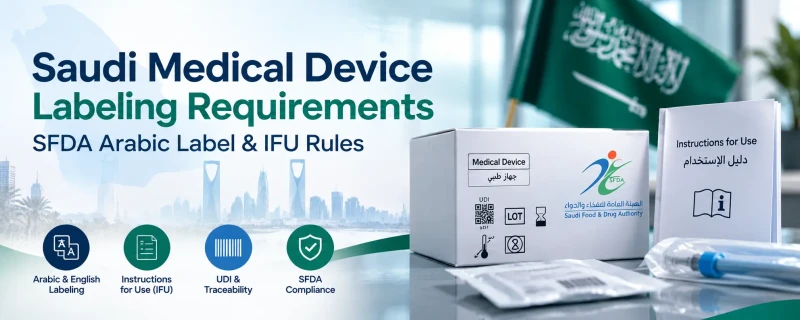
Saudi medical device labeling requirements affect more than the wording on a product carton. Manufacturers must align device labels, instructions for use (IFUs), language versions and traceability information with Saudi Food and Drug Authority (SFDA) requirements. The intended user is particularly important: a device operated by a healthcare professional does not necessarily have the same language obligations as one operated by a patient at home.
This guide explains the main labeling considerations for Saudi market access, including Arabic and English requirements, electronic IFUs and documentation submitted for Medical Device Marketing Authorization (MDMA).
What are Saudi medical device labeling requirements?
Saudi Arabia’s medical device law and implementing requirements provide the regulatory framework for placing medical devices on the market. Manufacturers should consult the current Requirements for Medical Devices Marketing Authorization (MDS-REQ1) and applicable guidance available through the SFDA regulations library.
SFDA medical device labeling requirements cover the information accompanying a device, not just its immediate container. Depending on the product, this can include packaging labels,IFUs, installation instructions and information displayed within medical device software.
Ready to Streamline Your Regulatory Compliance?
Join hundreds of companies who trust OMC Medical for their regulatory needs. Get expert guidance and ensure compliance across all markets.
Call Now +44 208 066 7260The information must identify the device and manufacturer, support safe use and remain consistent with the intended purpose and technical documentation. Particular requirements depend on the device’s characteristics, intended users and applicable regulatory provisions.
Meeting Saudi medical device labeling requirements therefore starts with defining the product and its users correctly. An existing EU or US label can provide a starting point, but it should not be treated as automatically suitable for Saudi distribution.
What are the SFDA Arabic labeling requirements?
The central distinction is between professional-use devices and devices intended for laypersons. Resolve SFDA Arabic label requirements against the documented intended user, rather than relying on the sales channel or the location where the device is used.
What language is required for professional-use devices?
For medical devices intended for professional use, the SFDA framework permits labeling and IFUs in English and/or Arabic. English-only information can therefore be appropriate for a genuinely professional-use device, subject to applicable device-specific requirements.
Professional use must be supported by the intended purpose and user profile. A product sold to a hospital is not necessarily operated only by healthcare professionals. Patients may use a controller, interpret a display or carry out treatment steps themselves.
Likewise, use in a home does not automatically make a device layperson-operated. A trained healthcare professional may operate equipment during a home visit. Document who performs each safety-critical task before deciding which language approach applies.
What language is required for layperson or home-use devices?
For devices intended for laypersons, labeling and IFUs must be provided in both Arabic and English. This distinction is central to Arabic labeling requirements for medical devices, including patient-operated home-use products and self-testing devices.
The Arabic version should communicate the same intended purpose, operating instructions and safety information as the English version. Translation should be technically reviewed, with particular attention to warnings, measurement units, treatment settings and actions following an unexpected result.
For manufacturers working in fields such as neuropsychological testing and cognitive remediation, a clinician-operated assessment system and a patient-operated therapeutic device can involve different user groups. Where such products qualify as medical devices, assess the intended operator rather than assuming that every product within a clinical specialty is professional-use.
How do professional-use and layperson-use requirements compare?
The following comparison summarizes the main language distinction within Saudi Arabia labeling requirements. Product-specific provisions and the current SFDA guidance still need to be checked.
Saudi medical device labeling requirements should be assessed separately for any patient-facing accessory, interface or instruction set. A professional-use designation for the main equipment should not obscure foreseeable layperson interaction.

What information should a medical device label include?
There is no single label template suitable for every device. Use the applicable SFDA requirements alongside the device’s essential safety and performance requirements to determine the necessary content and its placement.
What identification and traceability information is needed?
Labels should identify the device clearly and distinguish the supplied configuration. Relevant information can include the product name, model or catalogue reference, package contents and quantity.
Provide the applicable batch, lot or serial number so that individual units or production batches can be traced. Include manufacturing or expiry information where required and appropriate to the product. Shelf-life statements must be supported by the underlying evidence.
For sterile devices, identify the sterile condition and relevant sterilization information. Single-use status, reuse restrictions and other applicable characteristics must also be communicated accurately.
Unique Device Identification (UDI) is a separate compliance consideration. Check the applicable Saudi UDI obligations, including carrier placement and Saudi-DI database requirements. A commercial barcode is not automatically a compliant UDI, and applicability should not be inferred solely from a device’s packaging format.
Saudi medical device labeling requirements must be reflected consistently across the label artwork, device identifiers and registration records. Different model names or catalogue references can make an otherwise complete dossier difficult to reconcile.
Which manufacturer and Saudi Authorized Representative details matter?
Identify the legal manufacturer by its name and address as required. These details should match the manufacturer identified in the technical documentation and regulatory submission, rather than only naming a brand owner or contract production site.
For an overseas manufacturer, the Saudi Authorized Representative must be correctly designated. Confirm the applicable SFDA requirements for representative identification, contact details and their placement within the labeling supplied for Saudi Arabia.
Do not assume that an importer or distributor is also the Authorized Representative. These roles are distinct, even when one organization performs more than one role under the appropriate arrangements.
Where a supplementary Saudi-market label is used, control its artwork and application. It should remain legible and must not obscure required manufacturer information, identifiers, warnings or expiry details.
Which warnings, precautions and storage conditions belong on the label?
Include safety information needed before opening, handling or using the device. Depending on the product, this may cover damaged sterile packaging, single-use limitations, hazardous materials or restrictions on operation.
Storage and transport conditions should reflect validated product specifications. Temperature, humidity or light restrictions should not be copied from another product without supporting evidence.
Recognized symbols can communicate information efficiently, but their meaning must be clear to the intended user. Provide explanations where required and do not assume that symbols eliminate applicable Arabic text obligations.
A practical review of Saudi medical device labeling requirements should also test readability. A warning that is technically present but illegible on the finished package does not adequately communicate the risk.
What are the SFDA IFU requirements?
Saudi Arabia medical device IFU requirements address the information users need to operate a device safely and achieve its intended performance. The IFU should agree with the label, intended purpose, risk management documentation and supporting evidence.
Depending on the device, relevant content includes installation, preparation, operating steps, contraindications, warnings, troubleshooting, maintenance and disposal. Reusable devices may also require validated cleaning, disinfection or sterilization instructions.
An IFU should not introduce a clinical claim, user group or operating condition that is absent from the supporting documentation.
What should an Arabic IFU contain for layperson-use devices?
The Arabic IFU must convey the necessary instructions and safety information, rather than providing only a shortened summary of the English document.
Use language suitable for the intended user’s knowledge and abilities. Explain unfamiliar terms, make operating steps easy to follow and state what users should do when the device produces an error or an unexpected result.
For self-testing products, applicable instructions should explain specimen collection, result interpretation and relevant limitations. Users should understand when a result requires professional advice and whether confirmatory testing is needed.
Control Arabic and English documents together. When a safety warning or operating step changes, assess both versions and update them through the same document-control process.
What should a professional-use IFU contain?
A professional-use IFU can use technical terminology appropriate to its audience, but it must still describe the training, installation and operating conditions necessary for safe use.
Instructions should address applicable calibration, compatibility, maintenance and performance limitations. For equipment used with accessories or other devices, identify permitted combinations and relevant restrictions.
Where patients also receive safety information, assess their language and comprehension needs separately. Professional training does not replace the need for understandable patient-facing instructions.
Saudi medical device labeling requirements apply to the information supplied with the device as a whole. Any proposed omission of an IFU should have a documented justification under the applicable provisions, rather than being based only on the manufacturer’s view that operation is simple.
What are the SFDA e-IFU requirements?
Electronic instructions can improve access to controlled information, but an online PDF is not automatically an acceptable replacement for a paper IFU. The manufacturer must establish whether its device and intended use qualify under the applicable SFDA electronic-IFU guidance.
Assess the intended users, their access to suitable technology and the conditions in which instructions will be needed. Connectivity failures, unavailable hardware and urgent use can all affect whether electronic delivery supports safe operation.
An electronic-IFU arrangement should address device identification, access instructions, document availability, revision control and the applicable arrangements for obtaining paper instructions. Confirm any required response times and retention periods against the current guidance rather than importing assumptions from another jurisdiction.
For layperson-use devices, do not assume electronic-only delivery is acceptable merely because the product connects to a smartphone. User eligibility and Arabic-language obligations remain separate questions.
OMC Medical’s guide to e-IFU requirements for Saudi medical devices explores this topic further. Assess electronic delivery against the current SFDA guidance before removing paper instructions from the supplied package.
Saudi medical device labeling requirements still govern the content and language of an IFU when electronic delivery is permitted. Changing the delivery format does not remove the underlying safety-information obligations.
How do labeling requirements apply during SFDA medical device registration?
Labeling should be prepared alongside the technical dossier, not left until the product is ready to ship. Submit the labels and IFUs required for the application in the format and language versions specified by the current SFDA process.
Review proposed artwork against the device name, models, intended purpose, manufacturer details and supporting documents. Where Arabic information is required, include the relevant language versions according to the submission requirements and ensure the final supplied product is compliant before distribution.
OMC Medical’s overview of Saudi Arabia medical device approval and MDMA explains the wider authorization process. Labeling is one component of that process, not a substitute for demonstrating device safety and performance.
If a team uses “medical device license” as shorthand, specify whether it means product marketing authorization or an establishment license. These authorizations serve different purposes and should not be treated as interchangeable.
After authorization, assess labeling changes through document control and the applicable SFDA change requirements. A new intended user, revised indication or replacement of paper instructions with an electronic-only IFU may require more than an artwork update.
Embedding Saudi medical device labeling requirements in the release process helps prevent differences between the submitted documents and the product actually supplied.
What should a Saudi labeling compliance checklist cover?
Use this checklist during dossier preparation and again before approving Saudi-market stock. It supports a structured review of Saudi medical device labeling requirements, but does not replace a device-specific assessment.
Confirm intended users: Identify professional, patient and caregiver tasks, including interaction with accessories or software.
Establish the language approach: Use English and/or Arabic for professional-use devices as applicable, and Arabic plus English for layperson-use devices.
Verify device identification: Reconcile names, models, catalogue references and package contents with the registration documentation.
Check traceability: Confirm applicable lot or serial identifiers, date information and Saudi UDI obligations.
Review organization details: Verify the legal manufacturer and applicable Saudi Authorized Representative information and placement.
Validate safety statements: Check warnings, sterile status, reuse restrictions and storage conditions against supporting evidence.
Review IFU completeness: Include applicable preparation, operation, maintenance, troubleshooting and disposal instructions.
Control translations: Confirm that Arabic and English versions convey equivalent instructions and carry consistent revisions.
Assess electronic delivery: Document eligibility, user access, availability and required paper-request arrangements before replacing paper IFUs.
Approve the supplied configuration: Review final artwork, packaging, supplementary labels and IFUs against the authorized device and applicable change requirements.
Keep evidence of the review, including approved artwork and translation checks. This makes discrepancies easier to resolve and supports consistent implementation across manufacturers, representatives and distribution partners.
Conclusion
Saudi medical device labeling requirements should be addressed through a device-specific review of intended users, language, identification, safety information and IFU delivery. Layperson-use devices need Arabic and English information, while professional-use devices follow the applicable English and/or Arabic framework. Electronic-only IFUs require a separate eligibility assessment.
Keep the supplied labeling aligned with the MDMA documentation and control translations and subsequent changes. OMC Medical supports manufacturers with classification, technical documentation, translation and Saudi regulatory market-access preparation.