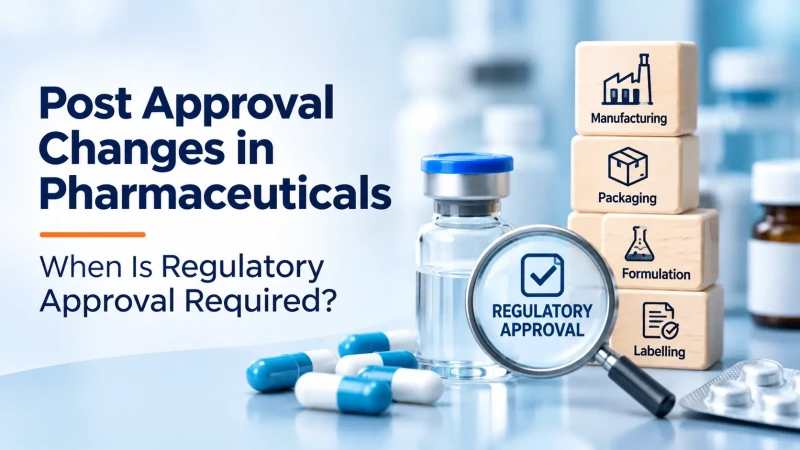
Post Approval Changes in Pharmaceuticals are modifications made to an approved medicine, its manufacturing arrangements or its authorised product information after marketing authorisation has been granted. They may support a new manufacturing site, improve a production process, update safety information or address supply-chain needs.
The regulatory question is not simply whether something has changed. It is whether that change could affect the medicine’s quality, safety or efficacy, and what the relevant authority requires before the changed product can be supplied.
Not every change requires prior approval, but every change needs a documented assessment. FDA, European Union and Indian requirements must be evaluated separately because their reporting categories are not interchangeable.
What Qualifies as a Post-Approval Change?
An approved pharmaceutical dossier describes the product and the conditions under which it is manufactured, controlled, packaged and supplied. Changes to those approved details may require a regulatory submission, even when the company considers the modification an improvement.
Ready to Streamline Your Regulatory Compliance?
Join hundreds of companies who trust OMC Medical for their regulatory needs. Get expert guidance and ensure compliance across all markets.
Call Now +44 208 066 7260Examples include replacing a manufacturing process, transferring production, revising an analytical method or changing the container closure system. Updated warnings, storage instructions and patient information can also fall within the scope of post-approval regulation.
Two related processes must remain distinct:
GMP change control: The internal quality-system process used to assess, approve, implement and verify changes.
Regulatory change management: The assessment of whether an approved dossier, licence or product information needs updating, including the applicable submission route.
A change can require internal change control without requiring a regulatory filing. Conversely, internal approval alone does not authorise implementation when the regulator requires advance approval.
This distinction makes post approval change management a continuing responsibility throughout the product lifecycle, rather than an administrative task performed only when a submission becomes necessary.
Which Pharmaceutical Changes Need Assessment?
How Can Manufacturing Processes and Equipment Affect Approval?
Changes to processing steps, batch size, operating parameters, sterilisation or equipment can alter product quality. The assessment should consider their effects on critical quality attributes and the ability of the process to remain controlled.
Replacing equipment with a genuinely equivalent unit may have a different reporting consequence from introducing a new operating principle. However, describing equipment as “like-for-like” is not sufficient evidence of equivalence. Design, materials, operating ranges and product-contact characteristics may all matter.
Routine building maintenance, including drain repair and waterproofing, is not automatically a dossier change. Work affecting production drainage, clean areas or contamination controls still belongs in the site’s quality change-control process. A general contractor’s service offering does not establish qualification for GMP-sensitive work.
What Happens When the Manufacturing Site or Formulation Changes?
A site transfer may involve manufacturing, testing, packaging or batch release. Its regulatory significance depends on the activity transferred, product characteristics, site authorisation status and supporting validation or comparability evidence.
For sterile products and biologics, a transfer may raise particular concerns about contamination control or process-related differences. A new site should not be treated as a simple address update when manufacturing responsibilities are changing.
Formulation changes require similarly careful assessment. Altering an excipient, its grade or its quantity may affect stability, dissolution, bioavailability or compatibility. Some changes can be handled through a variation or supplement, while others may require a different application pathway.
Why Do Packaging, Specifications and Labelling Matter?
Packaging can directly affect product protection and delivery. A change to primary packaging may require evidence addressing moisture protection, extractables and leachables, container closure integrity or compatibility, depending on the product.
Specification changes also differ in significance. Tightening an acceptance criterion is not equivalent to widening it, removing a test or replacing an analytical procedure. The justification must explain how the revised controls continue to assure quality.
Pharmaceutical labelling changes range from editorial corrections to revised safety warnings, indications, dosing instructions or storage conditions. Their reporting route depends on the content and legal basis of the change, not simply the fact that artwork has been revised.
When Is Regulatory Approval Required for Post Approval Changes in Pharmaceuticals?
The reporting route generally reflects the potential impact of the change. A substantial risk may require approval before implementation or distribution. A lower-risk change may qualify for notification, a defined waiting period or periodic reporting.
These are jurisdiction-specific legal mechanisms. “Notification” does not always mean immediate implementation is permitted, and an annual reporting route is available only when the applicable rules allow it.
Assess the precise change against the current regulations, classification guidance and conditions attached to the product’s authorisation. Do not assign a category solely from a general risk score.
How Do the Main Reporting Routes Compare?
These categories provide a starting point, not a substitute for product-specific classification. Several linked modifications may also need assessment together rather than as separate low-risk changes.

What Does the FDA Require for Approved Drugs and Biologics?
How Are Changes to NDA and ANDA Products Reported?
For products approved under a New Drug Application or Abbreviated New Drug Application, 21 CFR 314.70 establishes the principal reporting framework.
A prior approval supplement (PAS) is required for major changes. Examples can include significant changes to manufacturing methods or controls with substantial potential to affect product quality. Distribution of products made using the change must wait for approval.
A changes-being-effected supplement with a 30-day waiting period (CBE-30) generally applies to moderate changes. The relevant waiting period runs from FDA receipt, subject to the regulation and any FDA action. This is not the same as receiving affirmative approval.
Certain specified changes qualify for a CBE submission without that waiting period. Eligible safety-related labelling changes, for example, must meet the relevant conditions, including requirements concerning newly acquired information where applicable.
Minor changes may be described in an annual report. Supporting FDA guidance, including applicable SUPAC guidance, helps determine the route for particular dosage forms and modifications, but should be used within its stated scope.
What Are the FDA Requirements for Biologics?
Changes to products licensed under a Biologics License Application are governed principally by 21 CFR 601.12.
The regulation distinguishes major, moderate and minor changes, with prior approval supplements, changes-being-effected supplements and annual reporting routes. The detailed requirements should be applied directly to the licensed biological product rather than inferred from small-molecule guidance.
For biologics, a manufacturing change may affect structural characteristics, biological activity, purity or immunogenicity. Comparability evidence therefore has an important role in showing that the change does not adversely affect quality, safety or efficacy.
The evidence needed depends on the product and the change. Analytical and functional comparisons may be central, but additional nonclinical or clinical evidence can be necessary when remaining uncertainty cannot be resolved adequately.
A change to a cell substrate, purification process or manufacturing site should therefore be evaluated against both the reporting requirements and the scientific comparability strategy. No single example automatically determines the category for every biological product.
How Are Post Approval Variations Managed in the European Union?
The EU uses Type IA, Type IB and Type II variations, together with a separate extension category. The legal framework is Commission Regulation (EC) No 1234/2008, as amended, supported by applicable classification and procedural guidance.
Type IA variations generally follow an implement-then-notify approach. Some require immediate notification after implementation, commonly identified as Type IA immediate notification, while others are reported through the applicable annual update arrangements.
Type IB variations follow a notify-and-wait procedure. They generally involve a 30-day assessment after a valid notification, subject to the procedure’s rules and any requests or objections. They should not be treated as equivalent to the FDA’s CBE-30 mechanism.
Type II variations require a more substantive assessment. The point at which implementation becomes permissible depends on the procedure and the change, including whether a positive opinion or a subsequent decision is required.
Certain changes, such as specified strength, pharmaceutical-form or administration-route changes, may fall within the extension provisions rather than an ordinary variation category.
The EMA guidance on variations for human medicines is relevant to centrally authorised products. National competent authorities and the relevant coordination procedures must also be considered for nationally authorised, mutual-recognition and decentralised products. EMA is not the receiving authority for every EU variation.
What Are the CDSCO Requirements in India?
Indian requirements should be assessed independently of FDA and EU classifications. The applicable route depends on the product, the nature of the approval and the proposed change.
The Drugs and Cosmetics Act, the Drugs and Cosmetics Rules and the New Drugs and Clinical Trials Rules provide relevant parts of the legal framework. Central permissions and state manufacturing-licence requirements may both need consideration.
For biological products, CDSCO has published guidance addressing post-approval changes and their quality, safety and efficacy implications. The applicable guidance classifies changes based on their potential impact and specifies the required technical documentation and reporting expectations.
Major changes generally require prior approval. Moderate changes must follow the specified submission and permission requirements rather than an assumed FDA-style waiting period. Minor changes may qualify for notification or periodic reporting only when the applicable guidance permits that route.
For chemical drugs, a company should establish the legal basis for its specific modification rather than assume that the biological-products framework applies. Certain changes to composition, indication, dosage form or route may trigger new-drug requirements instead of being managed as routine variations.
Use CDSCO’s official guidance publications alongside the applicable rules, approval letters and licence conditions. Where classification is unclear, obtain regulatory clarification before implementing a change that could require permission.
An overseas approval does not itself authorise implementation in India. Indian dossier commitments, manufacturing permissions and labelling requirements remain separate obligations. Companies planning to enter the Indian pharmaceutical market can also refer to the requirements for India drug product registration
How Should Companies Prepare and Implement a Change?
What Evidence Supports Pharmaceutical Product Variations?
Start with a clear comparison between the approved state and the proposed state. Proper eCTD lifecycle management helps companies maintain an organised record of regulatory submissions, amendments, variations and post-approval updates. Identify the affected dossier sections, markets, sites, products and batches before deciding what evidence is necessary.
The supporting package may include:
Scientific justification: The reason for the change and its potential effects on quality, safety or efficacy.
Qualification and validation: Relevant equipment, process, cleaning, sterilisation or analytical-method evidence.
Comparability and stability: Data addressing product performance, shelf life and storage conditions, as applicable.
Updated documents: Revised specifications, manufacturing descriptions, packaging information or product information.
Implementation controls: Effective dates, batch traceability, inventory arrangements and post-implementation monitoring.
Preparing and maintaining the required supporting documents is an important part of pharmaceutical dossier filing for regulatory submissions. The package should be proportionate to the change, but proportionate does not mean unsupported. A lower reporting category still requires a defensible technical assessment.
Where an approved change-management protocol or another established regulatory mechanism applies, confirm that the proposed modification remains within its scope and conditions.
How Can Teams Coordinate Drug Product Variations Across Markets?
Maintain a country-by-country assessment rather than a single global classification. Record the local submission category, evidence requirements, permitted implementation point and any associated licence updates.
This is especially important when the same product is supplied through different national authorisations. Teams maintaining pharmaceutical registrations in Argentina or drug registrations in Nigeria need separate local assessments rather than assuming an FDA or EU decision applies worldwide.
Regulatory affairs should agree the implementation plan with quality assurance, manufacturing, supply chain and pharmacovigilance. The plan should distinguish permission to perform validation or engineering activities from permission to distribute commercial products incorporating the change.
After implementation, verify that the change achieved its intended outcome. Review relevant process performance, stability commitments, complaints, safety information and pharmacovigilance activities, and retain evidence linking the approved change to the affected batches.
Why Must Compliance Continue Throughout the Product Lifecycle?
A medicine’s approval establishes an ongoing regulatory baseline, not a permanent exemption from further assessment. Effective change management connects scientific evidence, local submission requirements and controlled implementation.
OMC Medical supports pharmaceutical registration and documentation activities across international markets. For each proposed change, the priority is to establish the correct regulatory route before implementation and maintain evidence that the product continues to meet its approved quality, safety and efficacy requirements.