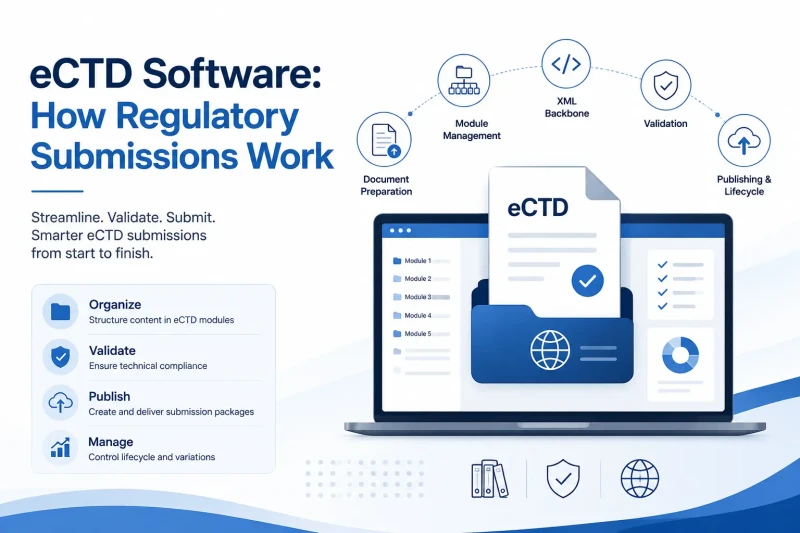
eCTD software helps regulatory teams prepare, validate and publish submissions in the Electronic Common Technical Document format required or accepted by many health authorities. In simple terms, it turns a large set of regulatory documents into a structured electronic submission package with the correct folders, XML backbone, navigation, hyperlinks, lifecycle sequences and technical checks.
For pharmaceutical companies, biotech organizations, CROs and regulatory consultants, this matters because a submission is not just a collection of PDFs. It must follow specific technical rules and regional expectations before it can be reviewed by agencies such as FDA, EMA and other national competent authorities. The right regulatory submission software reduces manual work, improves consistency and helps teams manage submissions across the product lifecycle.
Ready to Streamline Your Regulatory Compliance?
Join hundreds of companies who trust OMC Medical for their regulatory needs. Get expert guidance and ensure compliance across all markets.
Call Now +44 208 066 7260What Is eCTD Software?
eCTD software is a regulatory technology solution used to create, manage, validate and publish submissions in the Electronic Common Technical Document, commonly called eCTD, format.
The eCTD is the electronic version of the Common Technical Document structure developed through the International Council for Harmonisation. The ICH eCTD specification defines how regulatory information is organized electronically so health authorities can navigate, review and maintain submissions efficiently.
In practice, eCTD software supports regulatory teams by arranging submission content into the required modules, generating technical files such as the XML backbone and helping ensure the final package follows applicable regional guidance.
The standard CTD structure includes five modules:
Module 1 is region-specific, which means requirements may differ between FDA, EMA, MHRA, Health Canada and other authorities. Modules 2 to 5 follow the harmonized CTD structure, although regional technical requirements can still apply.
Why Is eCTD Software Important?
Regulatory submissions can involve thousands of files, complex document relationships and repeated updates over several years. Managing this manually creates a high risk of broken links, incorrect folder placement, inconsistent naming, version confusion and failed technical validation.
An eCTD submission is expected to be structured, traceable and technically reviewable. eCTD software helps teams meet these expectations by providing a controlled environment for building the submission package.
Key benefits include:
● Document organization: Files can be arranged according to the required eCTD module and section structure.
● Reduced manual work: Repetitive publishing tasks such as folder creation, XML generation and hyperlink checks can be automated or standardized.
● Submission readiness: Teams can perform technical checks before sending the package to a health authority.
● Complex package management: Large applications, variations, amendments and responses can be managed more consistently.
● Lifecycle control: Later sequences can be connected to earlier submissions so reviewers can understand what has been added, replaced or deleted.
Health authorities increasingly expect electronic submissions in specific formats. For example, FDA provides detailed guidance and resources for electronic submissions in eCTD format, including technical specifications and submission standards. EMA also maintains electronic submission guidance for human medicines in the EU regulatory environment.
How Does eCTD Submission Software Work?
Although platforms differ, most eCTD submission software follows a similar workflow. The aim is to move from source documents to a technically compliant submission package that is ready for agency delivery.
Document preparation
Regulatory, clinical, quality and nonclinical documents are collected, finalized and converted into acceptable formats, commonly PDF for many submission documents. Teams check document titles, versions, metadata, pagination, bookmarks and internal references before publishing.
Good preparation matters because eCTD publishing software cannot fix poor document control. If the source document is outdated, mislabeled or inconsistent with the submission strategy, the final package may still create regulatory review issues even if it passes technical validation.

Module and structure management
The software helps users place documents into the appropriate eCTD modules and sections. This ensures the package follows the CTD structure and the applicable regional table of contents.
For example, a clinical study report would generally sit in Module 5, while quality documentation would sit in Module 3. Administrative documents belong in the relevant Module 1 structure for the target region.
XML backbone creation
An eCTD submission relies on XML backbone files that describe the submission structure and document relationships. The XML backbone allows reviewers and agency systems to navigate the submission electronically.
An eCTD publishing tool typically generates the XML backbone based on the content placed into the submission structure. This reduces the need for manual coding and lowers the risk of structural errors.
Hyperlinks, bookmarks and navigation
Submissions should be easy for agency reviewers to navigate. eCTD software can support the creation and checking of hyperlinks, bookmarks and cross-document references. These navigation elements help reviewers move between summaries, reports, appendices and referenced documents.
Broken hyperlinks or missing bookmarks may not always determine the scientific acceptability of a submission, but they can delay review, trigger technical questions or create avoidable friction.
Validation and publishing
Before submission, the package is validated against applicable technical rules. These checks may include XML structure, file naming, folder structure, file formats and hyperlink integrity.
After validation, the software publishes the final package for transfer through the relevant electronic gateway, portal or submission route used by the health authority.
Lifecycle and sequence management
An eCTD application is maintained through sequences. The initial application may be sequence 0000, followed by additional sequences for amendments, responses to questions, variations, renewals or safety updates, depending on the region and procedure.
The software helps track these sequences and manage the lifecycle status of documents, such as whether a document is new, replaced, appended or deleted.
Key Features of eCTD Software
The best eCTD software for regulatory submissions is not only a publishing utility. It should support the practical needs of regulatory operations, document control and submission lifecycle management.
The exact configuration depends on the organization’s submission volume, target regions, internal processes and document management environment.
What Is eCTD Validation?
eCTD validation is the technical checking process used to identify whether an eCTD package follows applicable formatting and structural requirements. It helps confirm that the submission can be processed by agency systems and reviewed electronically.
Validation may check items such as:
● XML backbone structure and references
● File names and folder paths
● Accepted document formats
● PDF properties, bookmarks and hyperlinks
● Correct module and section placement
● Regional technical requirements
● Lifecycle operation accuracy
Validation is critical because technical errors can lead to rejection at the gateway stage, requests for correction or delays in the review process.
However, technical validation does not guarantee regulatory acceptance or approval. A submission can pass technical validation and still receive scientific, clinical, quality or administrative questions from the health authority. Validation confirms that the package is technically fit for processing, not that the data are sufficient.
eCTD Lifecycle Management
Regulatory submissions rarely end with the first sequence. Products evolve through agency questions, labeling updates, manufacturing changes, safety reports, variations, renewals and post-approval commitments.
eCTD lifecycle management is the process of maintaining the regulatory history of an application across these sequences. It shows what has changed, when it changed and how the current application differs from previous versions.
This is especially important for:
● Responses to health authority questions
● Amendments during review
● Post-approval variations or supplements
● Labeling updates
● Safety-related updates
● Renewals and annual reporting activities where applicable
● Corrections to previously submitted content
Without lifecycle control, teams may lose track of document status. A reviewer may see duplicate documents, outdated content or unclear replacement logic. eCTD software helps maintain a cleaner regulatory history by linking each sequence to previous activity.
eCTD Software vs. eCTD Publishing Tool
The terms eCTD software, eCTD submission software, eCTD publishing tool and eCTD publishing software are often used interchangeably. There is overlap, but they do not always mean exactly the same thing.
A dedicated eCTD publishing tool may be sufficient for organizations that already manage documents and workflows elsewhere. A broader eCTD software platform may be more appropriate when teams need integrated submission planning, document control, validation, publishing and lifecycle management.
The right choice depends on the organization’s process maturity, regions served and submission complexity.
Who Uses eCTD Software?
Many life sciences organizations rely on eCTD software to support regulatory submission activities.
Common users include:
● Pharmaceutical companies preparing marketing authorization applications, variations, supplements and responses.
● Biotech organizations managing development-stage and registration submissions.
● CROs supporting sponsors with document preparation, publishing and regulatory operations.
● Regulatory affairs teams coordinating cross-functional input from clinical, nonclinical, quality and safety groups.
● Regulatory consultants assisting with submission strategy, formatting, publishing readiness and agency responses.
● Organizations with frequent or complex submissions that need repeatable workflows and stronger lifecycle control.
For smaller companies, eCTD software can help reduce dependence on manual assembly. For larger organizations, it supports consistency across products, regions and teams.
eCTD vs Paper Submission
The difference between eCTD and paper submission is more than the delivery method. eCTD changes how the submission is structured, navigated, maintained and reviewed.
Paper-based processes may still exist in limited contexts or regions, but many major health authorities now require or strongly encourage electronic formats for applicable submissions. Teams should always verify the current requirements for the specific product type, application type and target region.
How to Choose eCTD Software
Selecting eCTD software should begin with regulatory and operational needs, not vendor marketing claims. The most suitable system is the one that supports the organization’s target regions, submission types and internal review process.
Important selection criteria include:
● Regulatory-region support: Confirm support for the technical specifications used in your target markets.
● Validation capability: Ensure the software can check applicable eCTD validation criteria and generate usable reports.
● Usability: Regulatory teams should be able to build and review submissions without unnecessary complexity.
● Publishing workflow: Look for controlled assembly, review, approval and final package preparation.
● Lifecycle management: Confirm that the system can manage sequences, replacements, deletions and regulatory history.
● Document organization: Assess how well the system handles module placement, metadata, naming and version control.
● Integration needs: Consider whether the software must connect with document management or regulatory information management systems.
Organizations should also evaluate internal governance. Even strong software needs clear procedures, trained users and defined quality control steps.
eCTD Submission Best Practices
A strong eCTD submission process combines technology, regulatory knowledge and disciplined document management. The following practices help reduce avoidable issues:
● Organize documents according to the required module and section structure before publishing begins.
● Use consistent file naming, document titles and version control.
● Validate early, not only at the final publishing stage.
● Review hyperlinks, bookmarks and cross-references carefully.
● Maintain a clear sequence strategy for amendments, responses and updates.
● Confirm regional eCTD submission requirements before finalizing the package.
● Follow applicable health-authority guidance and current technical specifications.
● Keep records of validation findings, corrections and final quality checks.
Regulatory teams should treat publishing as part of submission strategy, not as a last-minute formatting task. Many technical issues originate earlier in document authoring, naming, version control or lifecycle planning.
How OMC Medical Can Support Regulatory Submission Activities
Successful eCTD submissions require more than software. They require clear submission planning, well-prepared documents, technical publishing awareness and an understanding of health-authority expectations.
OMC Medical supports life sciences organizations with regulatory expertise, submission planning, document preparation, publishing and technical support and submission management activities. This service-focused support can help teams prepare more organized, review-ready regulatory packages while aligning submission work with applicable regional guidance.
If your organization is planning an initial submission, responding to authority questions or managing lifecycle updates, OMC Medical can support the regulatory strategy and operational preparation needed for a smoother submission process.