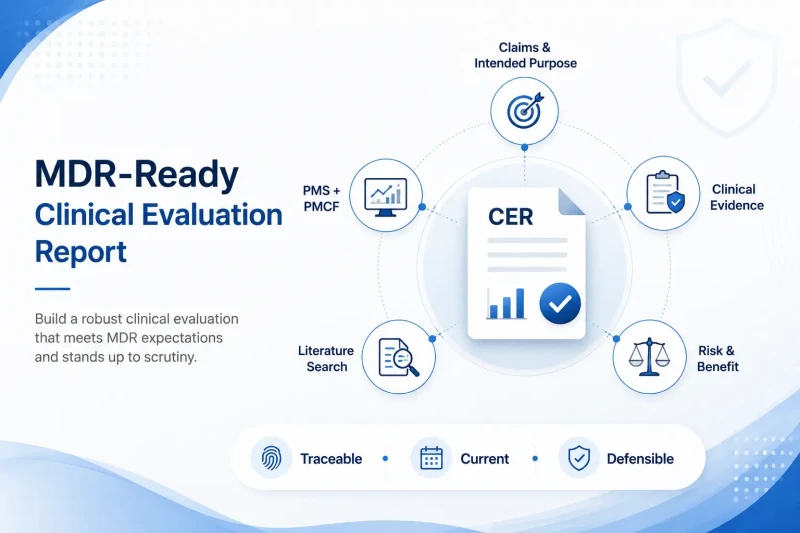
Under the EU Medical Device Regulation, a clinical evaluation report is no longer a document that can be assembled late in the conformity assessment process. It is part of the evidence system that connects the device's intended purpose, claims, risk profile, benefit-risk determination, post-market surveillance and ongoing clinical strategy.
By 2026, notified body review expectations are more mature. The question is rarely whether a clinical evaluation report, or CER, exists. The harder question is whether the report can defend every clinical claim with traceable, appraised and current evidence.
Ready to Streamline Your Regulatory Compliance?
Join hundreds of companies who trust OMC Medical for their regulatory needs. Get expert guidance and ensure compliance across all markets.
Call Now +44 208 066 7260Clinical evaluation reports that stand up to MDR scrutiny have one thing in common: they make the reviewer's work easier. They show exactly what evidence was searched, why it was included or excluded, how it was appraised, what gaps remain and how those gaps are controlled through PMCF or other post-market activities.
What MDR scrutiny actually tests
The MDR places clinical evaluation at the center of demonstrating conformity with relevant General Safety and Performance Requirements, often shortened to GSPRs. Regulation (EU) 2017/745 requires manufacturers to plan, conduct and document clinical evaluation in accordance with Article 61 and Annex XIV. That means the CER is not just a regulatory narrative. It is a documented evaluation of clinical evidence supporting safety, performance and clinical benefit.
For a clause-focused overview of the legal basis, OMC Medical's guide to Article 61 clinical evaluation in the EU MDR is a useful companion. This article takes a different angle: how to make the CER review-ready, internally consistent and defensible under notified body questioning.
MDR scrutiny usually focuses on five practical questions:
● Does the CER match the device, intended purpose, indications, users, patient population and claims?
● Is the clinical evidence sufficient for the device's class, novelty, risk profile and lifecycle stage?
● Are literature searches systematic, reproducible and clinically relevant?
● Are equivalence arguments justified with enough technical, biological and clinical data?
● Do PMS and PMCF plans address remaining uncertainties rather than sit as separate appendices?
If any of these points are weak, a notified body may raise nonconformities, request additional justification or require new clinical data.
Why clinical evaluation reports get challenged
Many CER issues are not caused by a complete absence of data. They happen because the logic connecting the data to the device is incomplete. A large bibliography cannot compensate for an unclear intended purpose, unsupported performance claims or a benefit-risk conclusion that does not address residual risks.
The most common weak point is inconsistency. The CER says one thing, the IFU says another, the risk management file contains risks not discussed in the clinical evaluation and the PMCF plan does not target the actual clinical gaps. MDR reviewers are trained to detect these disconnects.
A strong CER does not hide limitations. It identifies them early, assesses their impact and explains how they are acceptable or how they will be addressed.
Start with a clinical evaluation plan reviewers can follow
A defensible CER starts before the report is written. Annex XIV expects clinical evaluation to be planned. The clinical evaluation plan should define the scope, methods and acceptance criteria used to determine whether clinical evidence is sufficient.
A useful plan answers practical questions before the search begins. What clinical claims must be supported? What endpoints matter? What safety outcomes are relevant? What patient populations, users and environments are included? What would count as sufficient evidence for this specific device?
The plan should also define the state of the art. Under MDR, state of the art is not a decorative background section. It establishes the clinical context in which the device is assessed, including current treatment options, benchmark devices, known risks, accepted performance levels and relevant clinical guidance. Without a credible state-of-the-art analysis, the benefit-risk conclusion has no meaningful comparator.
MEDDEV 2.7/1 Rev. 4 remains influential for clinical evaluation methodology, particularly around data identification, appraisal and analysis, but it does not override MDR requirements or MDCG guidance. For a more detailed methodology discussion, OMC Medical's article on MEDDEV guidelines for clinical evaluation under EU MDR explains how the older framework still fits into MDR-era expectations.
Build a defensible evidence trail
The clinical evidence trail should be traceable from the claim to the source data and then to the conclusion. This is where many clinical evaluation reports become vulnerable. They describe evidence, but they do not prove why that evidence is sufficient.
Clinical data may come from investigations of the device, scientific literature, clinical experience, PMS, PMCF and, where justified, data from equivalent devices. The CER should make clear which data source supports which aspect of safety, performance or clinical benefit.
A practical approach is to map each claim to evidence and appraisal results. For example, if the device claims reduced procedure time, the CER should identify the clinical data supporting that claim, assess study quality, discuss relevance to the exact device version and explain whether the effect is clinically meaningful. If the evidence only supports usability or technical performance, the report should not overstate it as clinical benefit.
The evidence trail also needs version control. Device changes, material changes, software updates, new indications or modified instructions for use can all affect whether older clinical data remains applicable. A CER that does not discuss design history and device changes may appear current on paper but weak in substance.
Treat literature searches as auditable procedures
A literature search under MDR must be more than a keyword sweep. Reviewers expect a reproducible process. That includes the databases searched, dates covered, exact search strings, screening criteria, reasons for exclusion and a method for appraising quality and relevance.
The literature strategy should be broad enough to capture safety signals and state-of-the-art information, but focused enough to support the device's intended purpose. Searching only for favorable performance outcomes creates bias. Searching too broadly without a clear selection method creates noise.
Good clinical evaluation reports usually separate literature into clear categories: device-specific data, equivalent or similar device data, state-of-the-art literature, safety information and background clinical context. This prevents the report from blending weakly relevant evidence with directly applicable data.
When adverse events, complications or known clinical limitations appear in the literature, the CER should discuss them directly. Silence is more damaging than a well-reasoned explanation. A reviewer will often compare the CER against PMS data, vigilance information and risk management documentation, so adverse clinical information should be addressed consistently across the file.

Be cautious with equivalence arguments
Equivalence remains possible under the MDR, but it is one of the most scrutinized parts of clinical evaluation. The MDR and MDCG guidance expect manufacturers to examine technical, biological and clinical characteristics in detail. For class III and implantable devices, reliance on equivalence is especially constrained unless the specific MDR conditions are met.
The European Commission's MDCG guidance library includes key guidance documents on clinical evaluation, equivalence and sufficient clinical evidence. These documents are frequently used by reviewers when assessing whether a manufacturer's justification is credible.
A weak equivalence section says that two devices are similar. A strong equivalence section shows why the differences do not affect clinical safety, performance or benefit. It addresses design, specifications, materials, contact type, duration of contact, anatomical site, mode of action, intended users, clinical condition and patient population.
If full access to equivalent device data is not available, the CER should not rely on assumptions. In many cases, equivalence can support context or partial justification, but not replace the need for direct clinical data. Where equivalence is incomplete, the gap should flow into the PMCF strategy.
Connect clinical evaluation to risk management and GSPRs
The CER should not sit apart from the risk management file. Clinical evaluation is one of the main ways to confirm that known and foreseeable clinical risks are acceptable when weighed against benefits. If risk management identifies residual risks such as incorrect use, tissue reaction, delayed diagnosis, device migration or inaccurate output, the CER should address whether clinical evidence supports the acceptability of those risks.
This connection is also essential for GSPR conformity. The technical documentation should show a clear chain from each relevant clinical GSPR to supporting evidence. Where performance is demonstrated mainly through bench or analytical testing, the CER should explain why that evidence is clinically relevant and whether additional clinical data is necessary.
The benefit-risk conclusion should be specific. It should not simply state that the device has an acceptable safety profile. It should explain the clinical benefit, the population receiving that benefit, the residual risks, the severity and frequency of known complications where data is available, the uncertainties that remain and how those uncertainties will be monitored.
Use PMS and PMCF as living evidence sources
Under MDR, clinical evaluation is continuous. PMS, PMCF, vigilance and complaint data should feed the CER throughout the device lifecycle. This is especially important for legacy devices that rely partly on historical market experience.
A strong PMCF plan is not a generic promise to collect more data. It is a targeted strategy to confirm safety and performance, identify emerging risks, verify clinical benefit and answer unresolved clinical questions. The PMCF evaluation report should then feed back into the CER, either reinforcing conclusions or triggering updates.
OMC Medical's guide to post-market surveillance under EU MDR covers broader PMS best practices. For CER purposes, the key point is that PMS data should be analyzed clinically, not just counted administratively. Complaint trends, adverse event rates, user feedback, registry data and literature updates can all affect the clinical evaluation conclusion.
The relationship should be circular: the CER identifies gaps, the PMCF plan investigates them, PMS collects real-world signals and the next CER update reassesses the evidence. When this loop is visible, the clinical evaluation appears controlled and mature.
Make the conclusion review-proof
The conclusion is often where a CER either becomes persuasive or collapses into boilerplate. A defensible conclusion summarizes what the evidence proves, what it does not prove and why the remaining uncertainty is acceptable.
For lower-risk, well-established devices, the conclusion may be supported by long market history, low complaint rates, stable design, state-of-the-art conformity and adequate literature. For novel, higher-risk or implantable devices, reviewers will expect more direct clinical evidence and a more detailed justification of benefit-risk acceptability.
The wording should mirror the evidence. If the data supports safe use in adult hospital settings, do not conclude broadly across pediatric, home-use or minimally trained user settings unless those contexts are supported. If a performance claim depends on operator experience, include that condition in the analysis.
A practical MDR-ready CER checklist
Before submission, review the CER as if you were the notified body. The goal is to find gaps before they become formal questions.
● Confirm that the device description, intended purpose, indications, contraindications and claims match the IFU and technical documentation.
● Check that the clinical evaluation plan defines methods, scope, acceptance criteria and state-of-the-art benchmarks.
● Verify that literature searches are reproducible, documented and updated to an appropriate cut-off date.
● Map every clinical claim to appraised evidence and remove unsupported wording.
● Explain equivalence using technical, biological and clinical characteristics, not general similarity.
● Link clinical evidence to risk management, GSPRs, PMS, PMCF and benefit-risk conclusions.
● Document all evidence gaps and show how they are addressed or justified.
● Ensure CER conclusions are specific to the device version, population, user group and intended clinical setting.
This type of pre-review often reveals issues that are easy to correct but costly if found during conformity assessment.
Need support preparing MDR-ready clinical evaluation reports?
Clinical evaluation reports require more than regulatory formatting. They require clinical reasoning, evidence appraisal, risk alignment and a clear strategy for ongoing data collection.
OMC Medical supports medical device companies with regulatory documentation, clinical evaluation strategy, technical documentation preparation, product classification guidance and global compliance activities. If your CER needs to withstand notified body review or you are preparing for an MDR submission, OMC Medical can help you build a structured, defensible approach before questions arise.