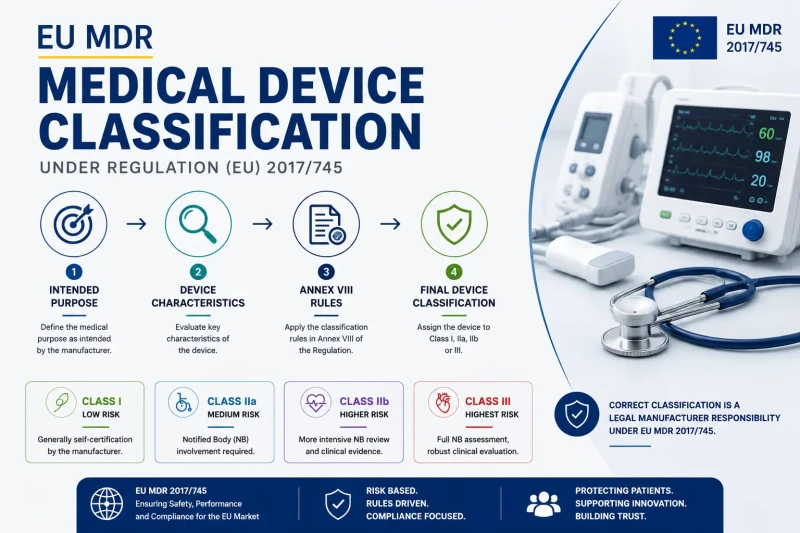
EU MDR device classification is one of the earliest decisions a manufacturer makes, but it is also one of the decisions most likely to affect the entire route to market. The class assigned to a device determines whether a Notified Body is involved, how deep the technical documentation must go, the level of clinical evidence expected and how post-market activities are planned.
Under the EU Medical Device Regulation, classification is not a marketing label or a legacy habit carried over from the Medical Device Directive. It is a legal conclusion based on the device's intended purpose and the rules in Annex VIII of Regulation (EU) 2017/745. For manufacturers, that means classification should be treated as a documented regulatory decision, not a late-stage administrative step.
This guide explains the classification logic from a manufacturer's perspective, including what to assess, where companies often make mistakes and how the classification decision shapes the EU MDR compliance pathway.
What EU MDR device classification means?
The EU MDR groups medical devices into four main risk classes: Class I, Class IIa, Class IIb and Class III. The classification reflects the potential risk of the device to patients, users and other persons, taking into account factors such as duration of use, invasiveness, whether the device is active and where it acts in or on the body.
Ready to Streamline Your Regulatory Compliance?
Join hundreds of companies who trust OMC Medical for their regulatory needs. Get expert guidance and ensure compliance across all markets.
Call Now +44 208 066 7260Article 51 of the MDR requires devices to be classified in accordance with Annex VIII. The manufacturer is responsible for determining the correct class and documenting the rationale. A Notified Body may challenge that rationale during conformity assessment, but the starting responsibility sits with the manufacturer.
Classification is therefore not just a compliance exercise. It affects budget, project timelines, evidence generation and the commercial launch plan. A device incorrectly treated as Class I when it should be Class IIa can face substantial delays once the error is discovered.
Start with the intended purpose
Every MDR classification assessment begins with the intended purpose. This is the medical use for which the device is intended by the manufacturer, based on the label, instructions for use, promotional materials, technical documentation and clinical claims.
Two products may look similar but fall into different classes if their intended purposes differ. A simple external support product may be Class I if it has a low-risk mechanical purpose. A similar-looking product may move to a higher class if it is intended for wound management, drug delivery, long-term contact with injured skin or monitoring of physiological parameters.
Manufacturers should make sure the intended purpose is consistent across all controlled documents. If the brochure claims a diagnostic or therapeutic function that the classification rationale ignores, the inconsistency can create issues during Notified Body review or market surveillance.
Before applying Annex VIII, manufacturers should also confirm that the product is a medical device in the first place. Borderline decisions can arise with wellness products, cosmetics, personal protective equipment, biocides, medicinal products and products without an intended medical purpose under Annex XVI. OMC Medical's article on the manual on borderline and classification of medical devices is a useful reference when the regulatory status is not obvious.
The core factors Annex VIII uses
Annex VIII classification rules are built around a set of concepts that manufacturers must apply carefully. Misinterpreting one definition can change the final class.
Duration of use is one of the most common decision points. The MDR distinguishes between transient, short-term and long-term use.
Invasiveness is another major factor. Non-invasive devices generally start in lower rules, but that can change when they channel, store or modify blood, body liquids, cells, tissues or gases. Invasive devices are assessed more strictly, especially if they are surgically invasive, implantable or used in connection with the central circulatory system or central nervous system.
The MDR also treats active devices separately. An active device depends on a source of energy other than that generated by the human body or gravity. Active therapeutic devices, diagnostic devices, monitoring devices and software may fall under rules that are more demanding than manufacturers expect.
Other key factors include whether the device contains or administers a medicinal substance, whether it is absorbed or locally dispersed in the body, whether it uses biological materials, whether it is intended for contraception or sterilization and whether it is used to disinfect or sterilize other devices.
How the MDR classification rules are structured
Annex VIII contains 22 classification rules. Manufacturers do not choose the rule that produces the most convenient outcome. They identify every applicable rule, then apply the highest resulting class if more than one rule applies.
Several MDR rules have had a major impact on products that were historically classified lower under the MDD. Rule 11 for software is a frequent example. Software that provides information used for diagnostic or therapeutic decisions is often Class IIa or higher, depending on the significance of the decision and the potential harm if the information is wrong. Manufacturers developing digital health tools should evaluate software early, and OMC Medical's guide to SaMD device classification gives more detail on this topic.
Rule 21 is another area that needs attention. It applies to devices composed of substances or combinations of substances that are introduced into the human body through a body orifice or applied to skin and are absorbed by or locally dispersed in the body. These products can move into Class IIa, IIb or III depending on their mode of action, absorption profile and site of action.
Rules on devices incorporating medicinal substances, devices manufactured using tissues or cells and devices with nanomaterials also require careful scientific and regulatory justification. If the primary mode of action is pharmacological, immunological or metabolic, the product may fall outside the MDR as a medicinal product rather than a medical device.
A practical classification workflow for manufacturers
A good classification file should show how the manufacturer reached the conclusion, not just state the final class. The workflow below can help regulatory teams structure the decision.
Manufacturers should also monitor updates to EU guidance. The European Commission maintains a page for MDCG-endorsed guidance documents, including documents that support interpretation of MDR obligations.
Why classification changes the route to market
Once the device class is determined, the manufacturer can identify the correct conformity assessment route. This is where classification becomes operational.
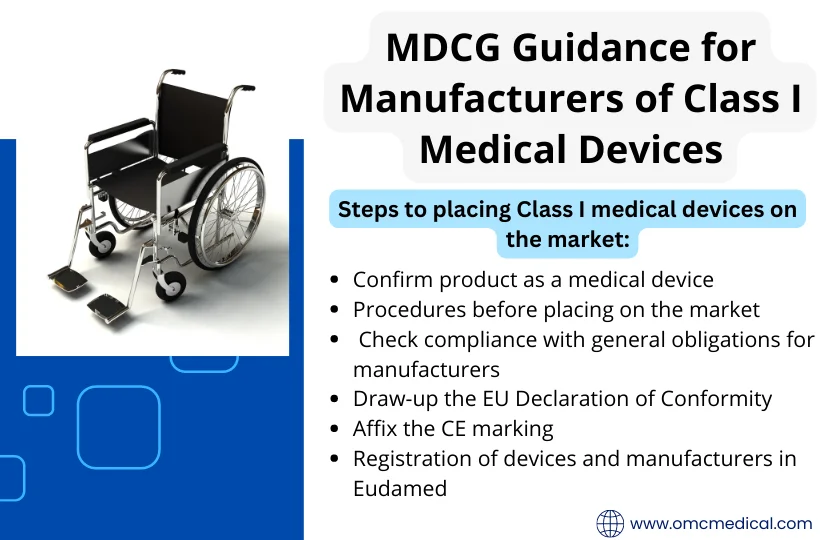
For many Class I devices, the manufacturer can prepare the technical documentation, establish conformity with the General Safety and Performance Requirements and issue the EU Declaration of Conformity without full Notified Body certification. However, sterile Class I devices, Class I devices with a measuring function and Class I reusable surgical instruments require Notified Body involvement for the relevant sterile, measuring or reusable surgical instrument aspects.
Class IIa, Class IIb and Class III devices require a Notified Body. This affects timelines significantly because Notified Body availability, completeness checks, audit scheduling and technical documentation review can take time. For higher classes, manufacturers should plan clinical evaluation, biological safety, usability, software lifecycle evidence, risk management and post-market clinical follow-up activities early enough to support the submission.
Classification also affects the depth of technical documentation. Annex II and Annex III documentation must be proportionate to the device and its risks, but higher-risk devices will face more detailed review. A Class III implantable device, for example, will need a much more developed clinical evidence package than a simple non-invasive Class I device.
Post-market obligations also scale with risk. All manufacturers need post-market surveillance, vigilance processes and trend reporting where applicable. Higher classes generally require more structured PMS planning, stronger PMCF justification and more frequent safety reporting.
 Common EU MDR classification mistakes
One of the most common mistakes is relying on the old MDD class. The MDR introduced new rules and strengthened several existing concepts. A device that was Class I under the MDD may not remain Class I under the MDR, especially if it includes software, substances, reusable surgical instruments or functions that are now treated differently.
Another frequent problem is an overly broad intended purpose. If the intended purpose says a device supports diagnosis, monitors disease progression or guides treatment, the classification must reflect those claims. Marketing teams and regulatory teams should align before external claims are released.
Manufacturers also sometimes classify a system as a whole without assessing accessories separately. Under the MDR, accessories can be classified in their own right. A low-risk main device does not automatically make every accessory low risk.
Software creates recurring classification issues because its risk is not visible in the same way as physical invasiveness. A mobile app may look low risk, but if it processes patient data to recommend treatment or support diagnosis, Rule 11 may apply. The classification depends on intended medical purpose and the significance of the information provided.
Substance-based devices can also be challenging. Products such as nasal sprays, throat preparations, gels, creams and gastrointestinal products may sit close to the boundary between medical devices, medicinal products and cosmetics. The primary mode of action and the manufacturer's claims need to be scientifically defensible.
What a strong classification rationale should include
A classification rationale should be clear enough for an internal reviewer, Notified Body or competent authority to follow the logic without guessing. It should be part of the technical documentation and controlled under the manufacturer's quality management system.
At a minimum, the rationale should include the device name, intended purpose, description of how the device works, target users, patient population, duration of contact, invasiveness, active or non-active status and all relevant MDR rules considered. It should explain why each applicable rule applies and why other plausible rules do not.
A concise but well-supported rationale is usually stronger than a long document that repeats the regulation without applying it to the device. The best rationales connect specific device characteristics to specific wording in Annex VIII.
This document should be revisited whenever the device changes. New indications, new user groups, new software features, changes to body contact, modified duration of use or new accessories can all affect classification.
Classification and manufacturer planning in 2026
By 2026, MDR classification is a baseline planning activity for manufacturers seeking EU market access. Even where legacy transition provisions are relevant for certain devices, future conformity assessment planning depends on the MDR class, not historical assumptions.
A manufacturer that confirms classification early can plan Notified Body engagement, clinical strategy, testing, labeling, translations, authorized representative arrangements and market launch sequencing with fewer surprises. A manufacturer that waits until the technical file is nearly complete may discover that the evidence package does not match the class.
The practical lesson is simple: classify before you commit to the regulatory pathway, not after. Classification should sit near the start of product development, alongside regulatory strategy, risk management and claims review.
Need support with EU MDR classification?
Correct classification gives manufacturers a stronger foundation for EU market access. It helps define the conformity assessment route, technical documentation scope, clinical evidence strategy and Notified Body engagement plan.
OMC Medical supports medical device companies with global regulatory strategy, product classification guidance, technical documentation, registration, translation, authorized representative services and post-market vigilance support. If your team is preparing an EU MDR submission or reassessing a legacy classification, experienced regulatory support can help turn the classification decision into a clear compliance pathway.