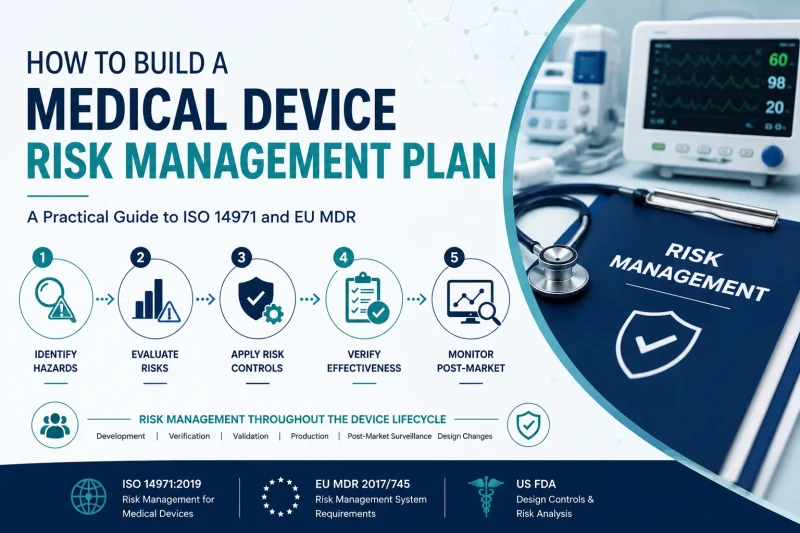
A medical device risk management plan should be useful before it is audit-ready. If it only repeats clauses from ISO 14971 without explaining how your team will identify hazards, evaluate risks, choose controls and maintain evidence, it will not help designers, quality teams or regulatory reviewers make better decisions.
The practical goal is simple: create a controlled plan that tells everyone how risk will be managed for a specific device, device family or platform throughout its life cycle. That includes development, verification, validation, production, post-market surveillance and design changes.
This guide takes a working approach to medical device risk management, with enough structure for compliance and enough detail for day-to-day use.
Start with the regulatory purpose, not the template
The main international standard for medical device risk management is ISO 14971:2019. It describes a process for identifying hazards, estimating and evaluating risks, controlling those risks and monitoring whether new information changes the risk profile of the device.
Ready to Streamline Your Regulatory Compliance?
Join hundreds of companies who trust OMC Medical for their regulatory needs. Get expert guidance and ensure compliance across all markets.
Call Now +44 208 066 7260In the EU, the Medical Device Regulation requires manufacturers to establish, implement, document and maintain a risk management system. Annex I of Regulation (EU) 2017/745 also requires risks to be reduced as far as possible, residual risks to be acceptable when weighed against benefits and users to be informed of residual risks where appropriate. For a deeper EU-focused explanation, OMC Medical has a companion article on risk management of medical devices under MDR.
In the US, risk analysis is also closely tied to design controls. FDA's Design Control Guidance for Medical Device Manufacturers discusses risk analysis as part of the design and validation process.
A plan should therefore do more than satisfy one checklist. It should connect the standard, the applicable market requirements and the way your organization actually develops and monitors devices.
Define what the plan covers
A common weakness in risk management files is an unclear scope. Teams sometimes create one generic risk plan and reuse it across products without clarifying what is included. That creates problems later when auditors ask why certain hazards, accessories, software modules, user groups or post-market data streams were excluded.
Your plan should state the device or device family, intended purpose, patient population, user profiles, use environments and life cycle phases covered. If the device includes software, connectivity, accessories, sterile packaging, measuring functions or drug-device combination elements, the plan should say how those interfaces are handled.
A practical scope statement answers questions such as:
What device configurations are included?
Which accessories and consumables are in scope?
Which markets or regulatory frameworks does the plan support?
Which stages of the life cycle are covered?
Which documents feed into the risk management file?
Do not make the scope so broad that it becomes meaningless. A plan for a simple non-sterile Class I device will not need the same technical depth as a plan for an implantable device with software, wireless connectivity and a sterile barrier system.
Separate the plan from the risk management file
The risk management plan and risk management file are related, but they are not the same thing.
The plan defines how risk management will be performed. The file contains the records and objective evidence generated by that process. A risk management file may include hazard analyses, design FMEAs, usability engineering outputs, cybersecurity assessments, verification results, labeling reviews, benefit-risk evaluations, production data, complaint reviews and risk management reports.
A useful distinction is this:
This separation keeps the plan lean. The plan should not contain every risk record, but it should explain exactly where those records live and how they are controlled.
Assign responsibilities early
Risk management often fails when it is treated as a quality task that happens after design decisions are already made. A strong plan assigns responsibilities across functions.
At minimum, the plan should identify ownership for risk analysis, clinical input, usability input, software risk, cybersecurity, manufacturing risk, labeling, verification, regulatory review and post-market review. For smaller companies, one person may hold multiple roles. That is acceptable if competence and independence are considered where needed.
The plan should also define who approves risk acceptability criteria, who can accept residual risks, who reviews post-market signals and who decides whether a design change requires a risk file update. These decisions should not be left to informal judgment during a deadline.
This is where the risk plan needs to align with the quality management system. Document control, design control, CAPA, complaint handling, supplier controls and change control all affect risk management. If your organization is strengthening its compliance infrastructure, OMC Medical's overview of Quality Management System requirements under EU MDR gives useful context on how risk management fits within broader QMS obligations.

Set risk acceptability criteria before analysis begins
Risk acceptability criteria should be defined before the team evaluates the device. If criteria are created after risks are known, they can appear biased toward accepting the design rather than protecting patients and users.
Most companies use severity and probability categories, but the plan must define what those categories mean. Severity should relate to harm, not inconvenience alone. Probability should be based on the probability of occurrence of harm, which may include the probability of a hazardous situation and the probability that the hazardous situation leads to harm.
The plan should also state what happens when data is limited. Early in development, probability estimates may be qualitative. Later, they may be supported by verification data, simulated use studies, production data, complaint history, published literature or clinical information.
Be careful with generic "acceptable," "ALARP" or color-coded matrices copied from old procedures. Under EU MDR, manufacturers are expected to reduce risks as far as possible, taking account of the state of the art. A risk that falls into a green box may still require further reduction if a feasible design control exists.
A practical plan defines:
Severity categories and examples relevant to the device
Probability categories and data sources
Risk acceptability rules for initial and residual risk
Criteria for benefit-risk evaluation when residual risks remain
Escalation rules for serious or uncertain risks
Requirements for documenting rationale and objective evidence
Choose the right analysis methods
There is no single risk analysis method that works for every device or every hazard. A plan should identify which methods will be used and why.
Preliminary hazard analysis is useful early because it helps the team think broadly about energy sources, biological hazards, software failures, use errors, environmental conditions and reasonably foreseeable misuse. FMEA can be useful for components, processes or software functions, but it can miss sequences of events involving users or clinical context if used alone. Fault tree analysis can help when a top-level harm has multiple contributing causes.
Usability engineering, cybersecurity, biological evaluation, sterilization validation, electrical safety and software life cycle processes can all generate risk inputs. The plan should specify how these outputs are integrated into the main risk management file rather than being treated as isolated reports.
The plan should also clarify terminology. A hazard is a potential source of harm. A hazardous situation is a circumstance in which people, property or the environment are exposed to one or more hazards. Harm is injury or damage to health. Keeping these terms clean avoids risk files filled with vague statements such as "device failure" listed as a harm.
Build traceability from hazard to evidence
Traceability is what makes a risk management file defensible. For each significant hazard, the reviewer should be able to follow the logic from hazard identification through risk estimation, control selection, verification and residual risk conclusion.
A practical traceability chain looks like this:
Hazard, sequence of events, hazardous situation, harm, initial severity and probability, initial risk evaluation, risk control option analysis, selected control measure, verification of implementation, verification of effectiveness, residual risk estimate, residual risk acceptability and any benefit-risk rationale.
This may sound detailed, but it prevents confusion during design reviews and audits. If a risk control is listed without verification evidence, the file is incomplete. If labeling is used as the only control for a serious design hazard, the rationale may be challenged. If residual risk is accepted without clinical benefit justification, the conclusion may not be credible.
The strongest files make traceability easy. They use stable risk IDs, consistent hazard terminology and links to verification reports, usability validation, clinical evaluation, software documentation, supplier records and labeling.
Prioritize risk controls in the right order
ISO 14971 and EU MDR both expect risk controls to follow a hierarchy. The preferred approach is to eliminate or reduce risk through inherently safe design and manufacture. If that is not sufficient, protective measures in the device or manufacturing process should be considered. Information for safety, such as warnings, contraindications and instructions, comes after design and protective measures.
This hierarchy matters because labeling cannot compensate for every design issue. A warning may reduce risk when user action is unavoidable, but it is usually weaker than a design change that prevents the hazardous situation from occurring.
For each unacceptable or reducible risk, the plan should require the team to document control option analysis. That means recording which risk control options were considered, which were selected, why others were rejected and whether the selected controls introduced new risks.
Examples of risk controls include design limits, alarms, interlocks, material changes, sterile barrier improvements, software fault detection, manufacturing process controls, supplier specifications, usability improvements, protective packaging, training materials and IFU warnings. The correct control depends on the device and hazard, not on a standard template.
Verify both implementation and effectiveness
Risk control verification has two parts. First, you need evidence that the control was implemented. Second, you need evidence that the control actually reduced the risk as intended.
For example, if a software alarm is selected as a risk control, implementation evidence may include software requirements, code review records and verification test results. Effectiveness evidence may include simulated use validation showing that intended users notice, understand and respond to the alarm under realistic conditions.
If a manufacturing inspection is selected as a risk control, implementation evidence may include an approved procedure and trained operators. Effectiveness evidence may include process validation, inspection performance data or nonconformance trends.
The plan should specify how effectiveness will be verified for each type of control. Otherwise, the risk file may contain controls that look good on paper but have no demonstrated impact.
Evaluate residual risk and overall residual risk
After controls are implemented and verified, each individual residual risk should be evaluated against the predefined criteria. Some residual risks may remain acceptable because they are low. Others may require a documented benefit-risk analysis, especially if further reduction is not practicable and the device provides meaningful clinical benefit.
The plan should also describe how the team will evaluate overall residual risk. This is not just a mathematical sum of individual risks. It is a final assessment of whether all residual risks, considered together, are acceptable in relation to the intended benefits of the device.
Overall residual risk evaluation should consider patterns. Several moderate residual risks affecting the same patient group, use step or clinical outcome may indicate a broader concern even if each line item appears acceptable on its own. The evaluation should also consider whether the information for safety is clear, whether users can reasonably understand it and whether the clinical benefits support the remaining risks.
A risk management report usually documents this final review. It should confirm that the plan was followed, required activities were completed, residual risks were evaluated, overall residual risk is acceptable and systems are in place to collect and review production and post-production information.
Connect risk management with clinical, usability and technical documentation
A risk management plan should not sit apart from the rest of the technical documentation. It should tell reviewers how risk outputs connect to clinical evaluation, usability engineering, biological safety, software documentation, performance testing, labeling and post-market surveillance.
For example, clinical evaluation can provide evidence of benefits, known complications, state of the art and residual clinical risks. Usability engineering can identify use errors and validate whether risk controls work for intended users. Biological evaluation can identify material and patient-contact risks. Cybersecurity documentation can show whether security vulnerabilities may create safety hazards.
This connection is especially important for EU MDR technical documentation, where risk management, general safety and performance requirements, clinical evaluation and post-market surveillance must tell a consistent story. If the risk file says a hazard is controlled by IFU warnings, the IFU must contain those warnings. If the clinical evaluation identifies a known complication, the risk analysis should address it.
Plan for production and post-market updates
Risk management does not end when the device is placed on the market. ISO 14971 requires manufacturers to establish a system for collecting and reviewing information from production and post-production phases. The plan should define the sources of information, review frequency, decision criteria and update process.
Relevant sources may include complaints, adverse events, vigilance reports, CAPA records, service data, repair records, production nonconformities, supplier issues, literature, registry data, user feedback and competitor safety information.
The plan should also define triggers for risk file updates. Examples include a new serious complaint, an unexpected use error trend, a supplier material change, a software vulnerability, a labeling change, a production process deviation, a new clinical publication or a regulatory authority communication.
Post-market data should feed back into risk estimates. If actual complaint trends differ from assumptions made during development, the risk file should be reviewed and revised where needed. OMC Medical's article on best practices for post-market surveillance under EU MDR explains how surveillance activities can be integrated into compliance systems rather than handled as a separate after-launch task.
Keep the plan audit-ready without making it bureaucratic
Auditors and notified bodies want to see a coherent process, but that does not mean the plan must be long. A concise, device-specific plan is usually stronger than a lengthy generic one.
Before approval, review the plan against these practical questions:
Is the scope specific enough for the device and intended markets?
Are responsibilities clear and realistic?
Are risk acceptability criteria defined before risk evaluation?
Are analysis methods appropriate for the device technology and use environment?
Does the plan require risk control option analysis?
Does it require verification of both implementation and effectiveness?
Does it explain overall residual risk evaluation?
Does it define production and post-market information sources?
Does it state when and how the risk file will be updated?
If the answer to any of these questions is unclear, the plan will likely create downstream gaps in the risk management file.
Common mistakes to avoid
The most common error is starting risk management too late. If the first serious risk review happens after a design freeze, the team may be forced into weak controls, rushed justifications or expensive redesign.
Another mistake is relying on FMEA alone. FMEA is useful, but medical device risk management must focus on harms to patients, users and others. A component failure mode is not the same as a hazardous situation, and a device malfunction is not always the final harm.
Teams also underestimate foreseeable misuse and use error. A device can meet engineering specifications and still create unacceptable risk if instructions are confusing, workflows are unrealistic or users are expected to remember too many critical steps under stress.
Finally, many files fail to close the loop after launch. Post-market information must be reviewed against the risk file. If new evidence changes probability, severity, detectability assumptions or benefit-risk conclusions, the file should be updated through the QMS.
Need help building a compliant risk management plan?
A practical plan can save time across design reviews, technical documentation, regulatory submissions and audits. It also helps your team make better safety decisions before problems become expensive to correct.
OMC Medical supports medical device companies with regulatory strategy, technical documentation, product registration, compliance activities and global market access. If your team needs support aligning medical device risk management with applicable regulatory expectations, contact OMC Medical to discuss the right next step for your device.