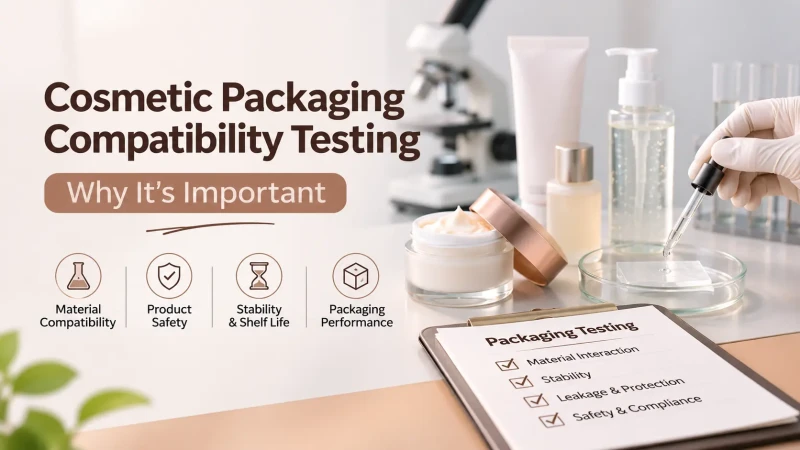
Cosmetic packaging compatibility testing evaluates whether a cosmetic formula and its packaging remain suitable for use together throughout the intended shelf life and foreseeable use conditions. It examines chemical interactions, physical changes, product quality and package functionality using the finished product in its intended container.
A formula that performs well in a laboratory vessel may behave differently inside a commercial bottle, jar or tube. Packaging materials can release substances, absorb formula ingredients, allow evaporation or lose their ability to seal and dispense correctly. Assessing these risks helps manufacturers select suitable packaging and support product safety decisions.
Why Is Packaging Compatibility Important for Cosmetic Products?
Packaging does more than hold a product. It influences protection from moisture, oxygen, light and contamination while controlling how consumers access and apply the formula.
A cosmetic packaging testing program can identify problems that formula development alone may miss. For example, a fragrance may interact with a plastic component, a closure liner may swell or a pump may stop delivering a consistent dose after storage.
Ready to Streamline Your Regulatory Compliance?
Join hundreds of companies who trust OMC Medical for their regulatory needs. Get expert guidance and ensure compliance across all markets.
Call Now +44 208 066 7260For manufacturers, cosmetic product packaging safety depends on understanding these interactions rather than assuming that a material suitable for one product will suit another.
There is also a regulatory documentation connection. For EU-market products, Annex I of Regulation (EC) No 1223/2009 identifies relevant packaging material characteristics, particularly purity and stability, among the information required for the Cosmetic Product Safety Report. It does not prescribe one universal compatibility protocol for every cosmetic.
Understanding these requirements is also an important part of cosmetic product registration, as manufacturers need to prepare the necessary product safety and regulatory documentation before entering a target market.
Compatibility findings therefore contribute to the evidence considered in a cosmetic product safety assessment, alongside formulation, exposure and toxicological information.
What Does Packaging Compatibility Testing Evaluate?
The assessment considers both directions of interaction: how packaging affects the product and how the product affects its container and components. The package compatibility testing approach described by Microchem Laboratory similarly focuses on evaluating the product-package combination.
How can chemical migration, absorption and adsorption affect the formula?
Assessing cosmetic packaging material compatibility means looking beyond visible damage. Substances may migrate from plastics, elastomers, coatings or other components into the formula. Conversely, formula ingredients may move into or onto packaging materials.
Absorption occurs when a substance enters the bulk of a material. Adsorption occurs when it accumulates on a surface. These processes can reduce the amount of a fragrance, preservative or other ingredient remaining available in the product, depending on the system.
Extractables and leachables provide two related perspectives:
Extractables: Substances released from packaging under defined laboratory extraction conditions, which may be more aggressive than normal storage.
Leachables: Substances that migrate into the actual product during storage or use.
Chemical analysis should be risk-based. Detecting a substance does not automatically establish that the product is unsafe. Its identity, concentration, anticipated exposure and toxicological significance need evaluation.
What physical changes and product quality problems should be checked?
The formula may cause swelling, softening, cracking, corrosion or deformation of packaging components. Environmental stress cracking can occur in susceptible plastics when chemical exposure combines with mechanical stress.
The product itself may develop changes in color, odor, appearance, pH or viscosity. Separation or precipitation may also occur. Comparing these findings with suitable controls helps determine whether the packaging contributed to the change.
Weight loss is another useful indicator. Evaporation through packaging or leakage around a closure can alter fill quantity and, in some formulations, ingredient concentrations. Measurements should distinguish genuine loss from weighing variability, handling effects or product removed during testing.
How are closures, dispensers and decoration assessed?
A package can remain visually intact yet fail during use. Pumps may lose prime, valves may stick, seals may leak or cap application and removal forces may change.
Functional assessments should reflect the intended dispensing system. Relevant checks can include delivered dose, spray pattern, leakage, reclosure performance and the ability to access the remaining product.
Labels and decoration also need attention. Product contact, condensation, humidity and handling may cause adhesive failure, ink smearing, loss of legibility or coating damage. An OMC Medical Cosmetic Label Review addresses labeling content requirements, while physical durability checks establish whether that information remains readable on the pack.
How Is the Testing Performed?
Effective cosmetic packaging testing begins with a written protocol based on the formulation, packaging system, intended markets, distribution conditions and consumer use. There is no single temperature, duration or sampling schedule suitable for every cosmetic.
How should storage conditions and samples be selected?
Use representative product batches and packaging made to the intended commercial specifications. Filling temperature, fill quantity, headspace, closure application and sealing settings should represent production because these variables can affect results.
Select conditions according to plausible failure mechanisms:
Real-time storage: Evaluate performance under the intended storage conditions over the proposed shelf life.
Accelerated storage: Use justified elevated conditions to investigate potential changes without assuming an automatic conversion to shelf life.
Temperature cycling or cold exposure: Include these where distribution, formulation behavior or intended use makes them relevant.
Light and humidity exposure: Assess these when they could affect the formula, container, label or secondary packaging.
Storage orientation: Consider upright, horizontal or inverted positions where appropriate to investigate contact with closures and seals.
Elevated temperatures can produce changes that do not occur during normal storage. Accelerated findings therefore need interpretation alongside real-time observations rather than being treated as a universal substitute.
How should results and acceptance criteria be documented?
Record baseline measurements before storage and repeat appropriate evaluations at predefined intervals. Acceptance criteria should be set before results are reviewed and linked to safety, quality and intended performance.
Depending on risk, evaluations may include appearance, odor, pH, viscosity, package dimensions, assembly weight, closure integrity and dispensing performance. Targeted chemical analysis may be needed when material composition or formulation chemistry indicates a migration concern.
Use suitable reference samples and controlled measurement methods. For example, consistent weighing procedures and designated unopened samples help interpret evaporation without confusing it with losses caused by repeated dispensing.
Document deviations, investigations and the rationale for acceptance. A report should explain what was tested, under which conditions and how the evidence supports the proposed product-package combination.
What Packaging Components Should Be Evaluated?
For cosmetic container compatibility testing, assess the final assembled commercial packaging configuration, not just an empty bottle or a resin sample. Components can behave differently after filling, sealing and assembly.
The relevant system may include the container body, closure, liner, gasket, pump, valve, dip tube, internal coating and any product-contact adhesive. Consider indirect contact where migration is plausible, including exposure through the headspace.
External components also matter when they affect protection or usability. Sleeves, labels, printed decoration and cartons may need evaluation for moisture damage, rubbing, adhesion or loss of essential information.
Although requirements differ between product categories, manufacturers can also refer to labelling and packaging requirements to understand the importance of packaging information and regulatory compliance. A justified approach to cosmetic packaging material compatibility also considers material grades, colorants, recycled content, component suppliers and manufacturing processes. Two visually identical packs are not necessarily equivalent.
Following Cosmetic Good Manufacturing Practices (GMP) also helps manufacturers maintain appropriate controls over packaging material selection, handling, storage and quality throughout the production process.
Where several sizes or variants share a packaging system, a bracketing strategy may be appropriate. Its rationale should consider differences such as surface-area-to-product ratio, closure design and formula composition rather than assuming that one result covers every configuration.
What Is the Difference Between Compatibility and Stability Testing?
Formula stability testing examines whether the cosmetic maintains its intended physical, chemical and microbiological quality over time. Compatibility assessment focuses on interactions between that formula and the packaging, including whether the assembled pack remains functional.
The phrase cosmetic packaging stability testing is sometimes used for work that combines these objectives. A protocol should state clearly which questions each measurement answers.
These assessments overlap and are often coordinated. A suitable reference container can help investigate whether a change originates in the formula or its commercial packaging, although the reference material must itself be appropriate.
Neither assessment automatically replaces microbiological quality testing or preservative efficacy testing. Those requirements should be addressed separately according to the product’s risk profile.

Why Should Cosmetic Manufacturers Conduct These Assessments?
Evidence for cosmetic product packaging safety helps manufacturers make better material-selection decisions and investigate failures before products reach consumers. It also supports communication between formulation teams, packaging engineers, quality personnel, suppliers and safety assessors.
The commercial consequences of incompatibility can include leakage complaints, inconsistent dispensing, product discoloration and packaging changes after launch. Assessments are most useful when potential problems are investigated early enough to revise the formula or package.
How does cosmetic packaging compatibility testing support change control?
An approved packaging system should have a documented specification and an evidence-based acceptance rationale. When the formula, component material, supplier or manufacturing process changes, assess whether the existing evidence still applies.
The extent of additional work should match the change. A new closure liner may require different checks from a carton artwork update. Material specifications, supplier information and previous results can inform the decision, but they should not replace testing when a relevant interaction remains uncertain.
How Can Manufacturers Put the Findings Into Practice?
Reliable packaging decisions require evidence that the formula and finished pack remain suitable together. Chemical interactions, weight loss, structural changes, dispensing performance and label durability all deserve consideration according to the product’s risks.
Start with the final commercial configuration, define meaningful acceptance criteria and connect the findings to stability work, safety assessment and change control. For support with your product’s testing needs, explore OMC Medical’s Cosmetic Product Testing service.