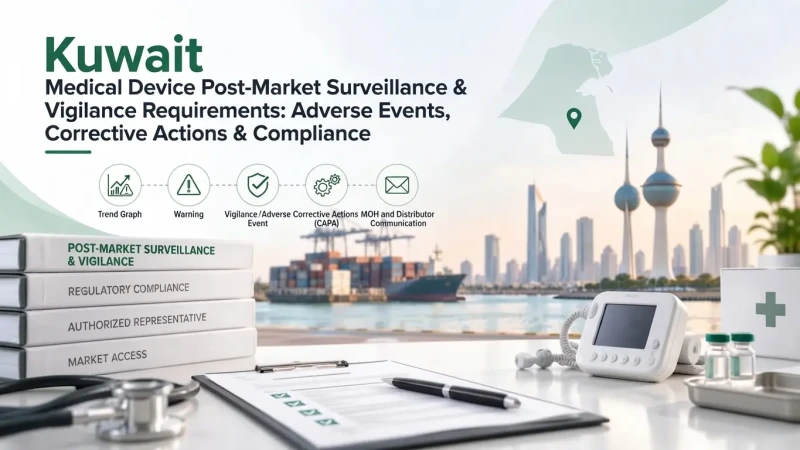
Kuwait post market surveillance is an essential part of maintaining medical device compliance after a product has been placed on the Kuwaiti market. Registration is not the end of regulatory responsibility. Manufacturers, local representatives, importers and distributors must continue monitoring device performance, handling complaints, reporting safety concerns and taking corrective action when needed.
For medical device manufacturers, Kuwait requires a practical and well documented approach to post-market controls. The Ministry of Health (MOH) is the national authority involved in medical device oversight, and companies should verify current requirements through official MOH channels and their Kuwait-based regulatory partner before submitting notifications or safety communications. This is especially important because public guidance may not always provide the same level of detail as frameworks such as EU MDR, FDA or SFDA.
This guide explains the main expectations behind Kuwait medical device post market surveillance, including vigilance, adverse event reporting, corrective actions and manufacturer responsibilities, without inventing fixed reporting timelines where none are publicly confirmed.
Why does Kuwait post market surveillance matter after registration?
Kuwait post market surveillance matters because medical device safety must be demonstrated throughout the product lifecycle, not only during initial registration. Devices can perform differently once used in real clinical settings, especially when they are introduced into new healthcare environments, used by different professionals or distributed through several supply chain partners.
Ready to Streamline Your Regulatory Compliance?
Join hundreds of companies who trust OMC Medical for their regulatory needs. Get expert guidance and ensure compliance across all markets.
Call Now +44 208 066 7260A strong PMS process helps manufacturers detect early signals, investigate complaints, update risk management files and decide whether corrective actions are needed. It also supports Kuwait medical device compliance by showing that the manufacturer is actively monitoring the safety and performance of products supplied in the country.
From a market access perspective, PMS records can become important during registration renewals, change submissions, regulatory questions and distributor audits. If a safety issue occurs, the manufacturer must be able to show what was known, when it was identified, what investigation was performed and what action was taken.
What is the regulatory context for medical device vigilance in Kuwait?
Medical device vigilance Kuwait activities are linked to the country’s broader medical device control system under the Kuwait MOH. Foreign manufacturers generally work through a local agent, importer, distributor or authorized representative for product registration and regulatory communication. The exact role and obligations should be clearly defined in contracts and regulatory procedures.
Manufacturers planning market entry should understand registration expectations before building their post-market process. OMC Medical’s guide to Kuwait medical device and IVD registration provides a useful starting point for understanding the registration pathway, documentation expectations and local representation considerations.
Kuwait post market surveillance should be aligned with the manufacturer’s global quality management system while also reflecting local distribution channels and MOH communication routes. If a manufacturer already follows ISO 13485, EU MDR PMS procedures or other recognized frameworks, those systems can provide a strong foundation, but they should still be checked against Kuwait-specific expectations.
What should a Kuwait post market surveillance system include?
A Kuwait post market surveillance system should be risk-based, documented and connected to the manufacturer’s broader quality system. The goal is not only to collect complaints, but to convert post-market information into regulatory decisions and product safety improvements.
At minimum, manufacturers should be able to gather and evaluate information from Kuwait and from other markets where the same device is sold. If a problem appears outside Kuwait but may affect devices distributed in Kuwait, the manufacturer should assess whether local action or notification is required.
A practical PMS system should include:
Complaint intake and escalation procedures for Kuwait distributors, healthcare facilities and end users
Evaluation of incidents, near misses, malfunctions and user-reported performance issues
Trend analysis for repeated complaints, even where individual cases are not serious
Risk management updates when new hazards or changed probabilities are identified
Post-market clinical or performance follow-up where relevant to the device type
Distributor feedback, service reports and installation records for applicable devices
Procedures for field safety corrective actions, recalls and customer notifications
Documented communication routes with the Kuwait local representative and MOH where required
The system should define who receives safety information, who performs clinical or technical review, who decides reportability and who authorizes communications to Kuwait authorities. If these responsibilities are unclear, important cases can be delayed or missed.

How should manufacturers handle Kuwait medical device vigilance?
Kuwait medical device vigilance focuses on detecting, evaluating and communicating safety concerns that arise after a device is supplied. Vigilance is narrower than PMS. PMS covers all post-market data, while vigilance focuses on adverse events, serious incidents, device defects and corrective actions that may require regulatory attention.
Manufacturers should not wait until an investigation is complete before starting an internal vigilance assessment. When a complaint suggests patient harm, potential harm, serious deterioration in health, device malfunction or incorrect result, it should be escalated quickly for technical, clinical and regulatory review.
Because publicly available Kuwait MOH vigilance requirements may not always specify detailed timelines for every device category or incident type, manufacturers should avoid assuming that foreign reporting clocks automatically apply. Instead, they should confirm the current medical device incident reporting Kuwait expectations through the local representative, MOH guidance and any conditions linked to the product registration.
International guidance from organizations such as the International Medical Device Regulators Forum can help standardize terminology, but Kuwait-specific communication should be managed locally. A good internal procedure can apply the strictest relevant timeline from the manufacturer’s global system while still documenting the Kuwait regulatory rationale.
What information is needed for Kuwait adverse event reporting?
For Kuwait adverse event reporting, the manufacturer and local representative should collect enough information to assess seriousness, causality, device involvement and required action. Incomplete initial information is common, but the investigation file should show reasonable efforts to obtain missing details.
Useful information includes:
Device name, model, lot number, serial number and registration details where available
Description of the event, complaint or malfunction
Date of event, date of awareness and reporting source
Patient or user outcome, without unnecessary personal data
Healthcare facility or distributor involved, where relevant
Initial risk assessment and reportability decision
Investigation findings, root cause and corrective action
Copies of communications with the Kuwait representative, distributor or MOH
How are corrective actions and field safety communications managed?
Kuwait post market surveillance becomes especially important when data shows that action is needed to reduce risk. Corrective actions may include labeling updates, software fixes, customer training, product quarantine, product correction, recall or withdrawal from the market. The appropriate action depends on the nature of the problem, device risk class, affected units and potential impact on patients or users.
When a field safety corrective action may affect products distributed in Kuwait, the manufacturer should coordinate with its local representative before communicating with customers or the MOH. Translations may be needed if communications are sent to healthcare facilities or users. The message should be accurate, consistent with the global field safety notice and adapted to local distribution information.
Manufacturers should also separate safety communication from promotional communication. If customer-facing materials are updated because of a safety issue, claims should remain controlled and consistent with approved labeling. OMC Medical’s overview of Kuwait marketing regulation may be useful for teams reviewing promotional or public-facing content alongside regulatory controls.
A field action file should explain why the action was taken, which units were affected, how customers were identified, what instructions were sent, how effectiveness was checked and whether further reporting or follow-up was required.
What are manufacturer and local representative responsibilities?
Clear responsibility allocation is central to Kuwait medical device safety reporting. The manufacturer remains responsible for device safety and performance, but the local representative or distributor often plays a critical role in receiving complaints, communicating with healthcare facilities and supporting MOH interactions.
For imported devices, the Kuwait-based party may be the first to hear about an issue. That means escalation timelines in commercial agreements should be practical and strict enough to allow regulatory assessment. If the distributor waits weeks to forward complaints, the manufacturer may lose the ability to make a timely vigilance decision.
Kuwait post market surveillance procedures should require the local partner to forward safety complaints immediately or within a defined internal timeframe. Even where Kuwait does not publish a detailed public clock for a specific scenario, the manufacturer’s quality system should not rely on vague wording such as “as soon as possible” without operational expectations.
How does PMS support Kuwait medical device compliance and renewals?
Kuwait medical device compliance is strengthened when post-market records are complete, traceable and linked to regulatory files. Registration documentation often describes the device as it was approved or accepted for supply. PMS confirms whether real-world use remains consistent with that evidence.
If a recurring complaint trend suggests a labeling problem, design issue or user training gap, the manufacturer may need to update technical documentation and assess whether a change notification is required. The same applies when a corrective action changes instructions for use, intended users, warnings, software behavior or device accessories.
A mature PMS system also helps companies prepare for questions from local partners, hospitals and authorities. Instead of reacting manually to each request, the regulatory and quality teams can rely on complaint summaries, CAPA records, periodic reviews and documented risk assessments.
Manufacturers that operate across the Gulf region may also compare Kuwait requirements with neighboring jurisdictions. For example, OMC Medical has covered post-market surveillance requirements in Saudi Arabia, which can help teams understand regional differences while avoiding the mistake of assuming every Gulf country uses the same reporting framework.
What are common gaps in Kuwait post market surveillance requirements?
Kuwait post market surveillance requirements can be missed when companies treat post-market controls as a global headquarters activity only. Kuwait-specific distribution data, customer feedback and local complaint channels must be included in the process.
Common gaps include weak distributor agreements, incomplete complaint forms, missing lot traceability, no documented reportability rationale, delayed escalation of incidents and field safety notices that are not adapted for local customers. Another frequent issue is failing to assess whether a non-Kuwait field action affects devices already supplied in Kuwait.
Manufacturers should also avoid over-reliance on registration files. A device may be registered, but if the company cannot produce complaint history, CAPA evidence or field action records, its compliance position may be weaker during a safety review or renewal discussion.
Practical checklist for Kuwait medical device post market surveillance
A practical checklist helps regulatory and quality teams confirm that Kuwait medical device post market surveillance is built into daily operations rather than handled only during emergencies.
Use the following checklist as a starting point:
Confirm the current Kuwait MOH expectations for the device type and registration route
Define the role of the local representative, importer and distributor in writing
Train local partners on complaint intake and urgent escalation
Maintain Kuwait distribution traceability for affected batch or serial number identification
Document reportability assessments for adverse events and malfunctions
Track trend signals and update risk management files when needed
Prepare templates for field safety notices, recalls and customer responses
Review Kuwait impact whenever a global complaint trend or field action is identified
This checklist should be adapted to device risk, product complexity and the manufacturer’s global QMS.
Conclusion: Kuwait post market surveillance is an ongoing compliance duty
Kuwait post market surveillance is a continuous regulatory and quality responsibility that protects patients, supports safe device use and helps manufacturers maintain confidence in their products after registration. An effective system should cover complaint handling, Kuwait medical device vigilance, incident assessment, adverse event reporting, corrective action and clear communication with local partners.
Manufacturers should avoid using unverified timelines or assuming that Kuwait follows another jurisdiction’s rules exactly. Instead, they should maintain a robust global PMS process, confirm current MOH expectations and document the Kuwait-specific rationale for vigilance decisions.
OMC Medical supports manufacturers with Kuwait medical device registration, regulatory compliance and post-market surveillance and vigilance planning. If your company needs assistance reviewing Kuwait requirements, preparing documentation or coordinating local regulatory activities, you can contact OMC Medical for professional regulatory support.