Saudi Arabia Medical Device Complaint Handling & Vigilance: What Manufacturers Need to Know
Medical device complaint handling Saudi Arabia regulators can trace from intake to closure requires more than a complaints log. Manufacturers need documented safety assessments, defensible reporting decisions and clear coordination with their Saudi Authorized Representative (AR). A complaint may need urgent escalation before anyone has established its root cause.
The practical challenge is connecting the quality system to the Saudi Food and Drug Authority (SFDA) vigilance process without delaying patient protection. Customer service, distributors, regulatory affairs and quality assurance must recognize the same escalation triggers.
This guide focuses on complaint handling and vigilance, rather than the wider post-market surveillance system. It explains how to investigate complaints, assess reportability, allocate responsibilities and decide whether corrective action must extend to devices already supplied.
Medical device complaint handling Saudi Arabia: the regulatory starting point
Saudi medical devices are governed by the Medical Devices Law, its Implementing Regulation and applicable SFDA requirements. For complaint-related safety reporting, consult the effective version of MDS-REQ 11, Requirements for Post-Market Surveillance of Medical Devices, through the SFDA’s official regulations library.
Ready to Streamline Your Regulatory Compliance?
Join hundreds of companies who trust OMC Medical for their regulatory needs. Get expert guidance and ensure compliance across all markets.
Call Now +44 208 066 7260A complaint and a reportable adverse event are not the same thing. A complaint alleges a deficiency involving a device’s identity, quality, durability, reliability, usability, safety or performance. Only some complaints meet regulatory reporting criteria, but every complaint needs an appropriate assessment.
Complaint handling also feeds the broader surveillance system. OMC Medical’s guide to Saudi Arabia medical device post-market surveillance requirements explains that wider framework.
Mandatory requirements and internal controls must remain distinct. Reporting obligations come from the applicable SFDA requirements. Recommended practices, such as same-day internal escalation or independent review of non-reportable decisions, help a manufacturer meet those obligations but should not be presented as statutory deadlines.
Receive and record complaints without losing safety information
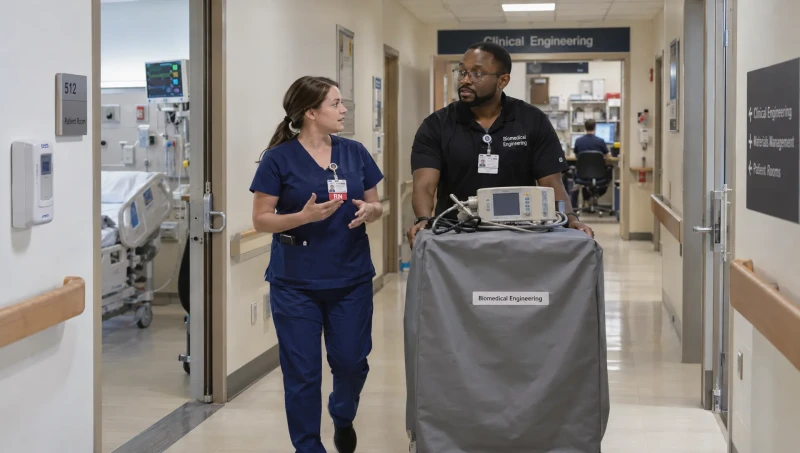
Complaints can arrive through hospitals, distributors, service engineers, sales teams, emails or returned-product requests. An account manager’s informal conversation can contain safety information even when the customer never submits a formal complaint.
Medical device complaint handling in Saudi Arabia should therefore begin at the first point of contact, not only when quality assurance receives a completed form.
Capture enough information to identify the event and support immediate triage:
- Device identification: Product name, model, catalog number, lot or serial number, UDI where available and relevant software version.
- Event description: What happened, when and where it occurred, how the device was being used and whether another device or treatment was involved.
- Clinical consequences: Death, injury, treatment delay, additional intervention or a potentially incorrect diagnostic result.
- Traceability and evidence: Reporter contact details, awareness dates, device availability, photographs, packaging and relevant service records.
Missing information should trigger follow-up, not automatic rejection of the complaint. Record what is known, identify gaps and assign an owner.
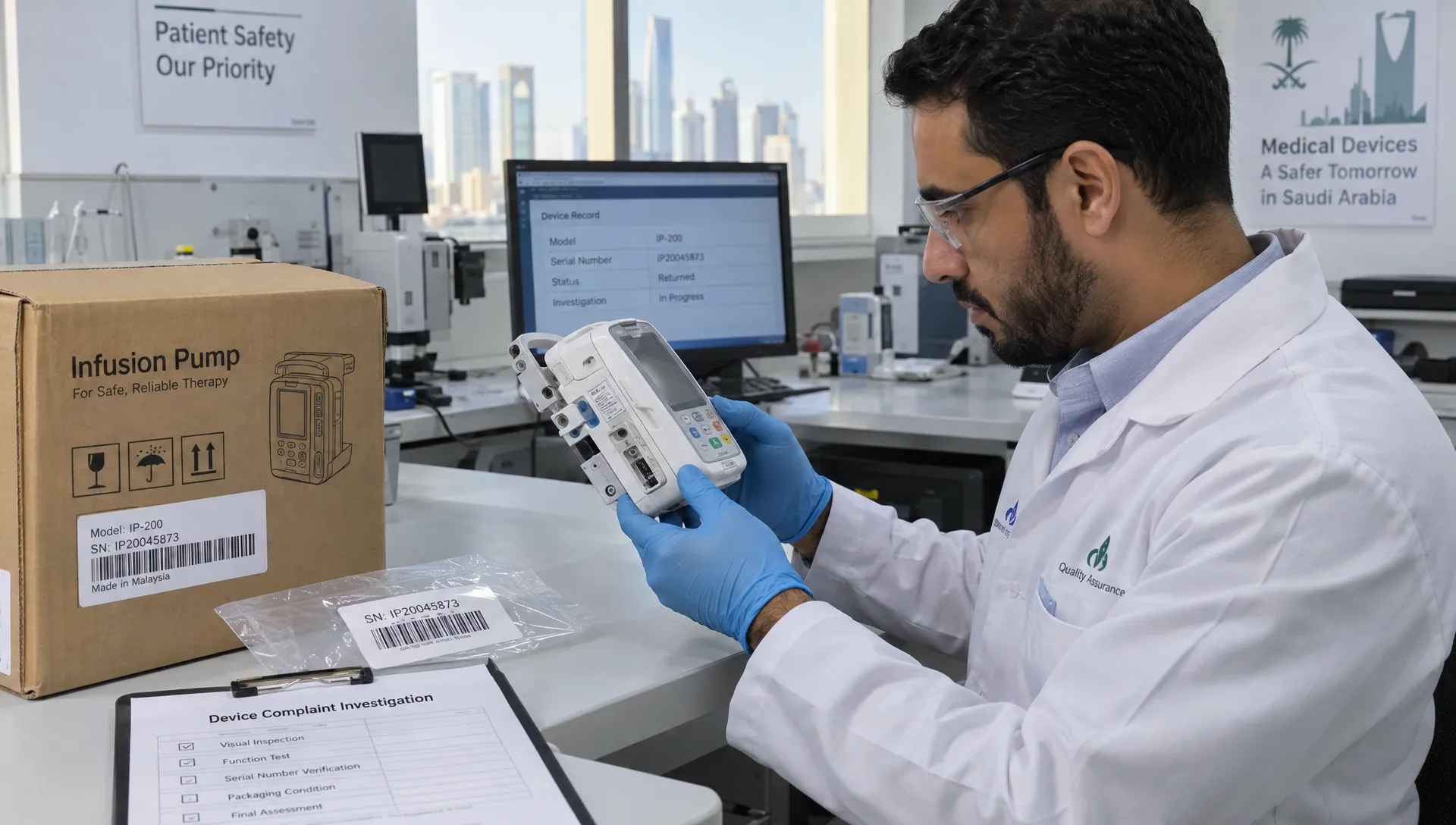
Where appropriate, preserve the device, accessories and packaging. Coordinate safe handling of contaminated products and avoid destructive testing until the investigation plan addresses evidence preservation.
Investigate the complaint and assess risk
Triage before completing the technical investigation
Start with patient safety. Determine whether the device remains in use, whether other units may be affected and whether immediate containment is necessary. An unexplained malfunction involving a life-supporting device deserves a different response from a cosmetic packaging defect with no safety implications.
Evaluate actual harm and reasonably foreseeable harm if the problem recurs. Consider the device’s intended purpose, affected population, detectability of the failure and availability of alternative treatment.
For IVDs, the relevant harm may arise from a false result, missed diagnosis or delayed treatment rather than direct physical injury from the device.
Medical device complaint handling in Saudi Arabia must connect this event-specific assessment to the manufacturer’s risk-management file. A previously recognized hazard does not automatically make a new event non-reportable.
Build an evidence-based investigation
Assign an investigation owner and document the scope. Review manufacturing and release records, supplier information, service history, software logs and similar complaints across markets.
Use a structured method such as fault-tree analysis or the five whys where it helps identify causes. Separate confirmed findings from hypotheses. “Could not reproduce” describes a test outcome; it does not establish that the reported event did not occur.
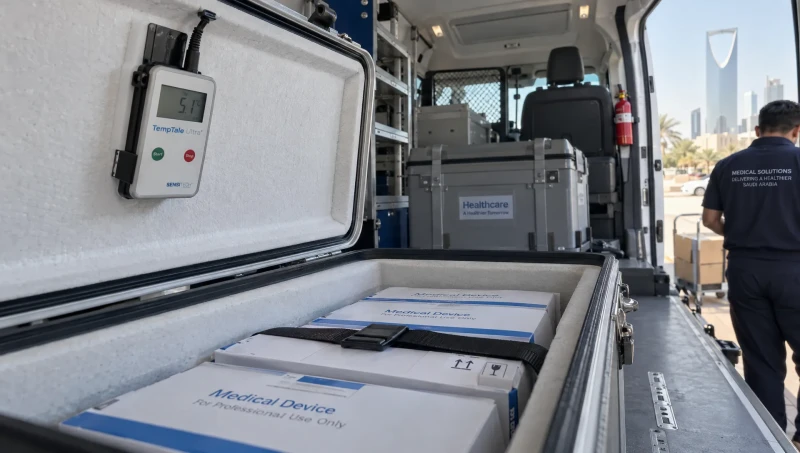
If transport or storage damage is suspected, examine packaging integrity, environmental records and shipment handling. Where facilities use commercial shipping containers for temporary storage, assess suitability against the device’s labeled conditions rather than assuming that a weather-resistant enclosure provides qualified storage.
If the device cannot be returned, document reasonable attempts to obtain it and the resulting investigation limitations.
Decide whether the complaint is reportable to the SFDA
SFDA medical device complaint reporting requires a documented assessment against the applicable adverse-event criteria. Do not use commercial importance, customer compensation or certainty of a manufacturing defect as substitutes for a reportability decision.
The assessment should address:
- Event and device involvement: Did an event occur, and is there a reasonable basis to suspect that the device contributed?
- Actual or potential consequence: Did the event cause death or serious deterioration in health, or could recurrence produce such an outcome?
- Applicable reporting provisions: Do the SFDA criteria, exclusions or special reporting arrangements apply to the circumstances?
A malfunction with no injury can still warrant reporting because the next occurrence could have a serious outcome. Conversely, not every customer dissatisfaction issue is a reportable adverse event.
For example, intermittent pump under-delivery associated with interrupted therapy requires urgent safety assessment. A damaged outer carton with an intact protective barrier may follow a different pathway, depending on the evidence and potential consequences.
For medical device adverse event reporting in Saudi Arabia, incomplete information should not become a reason to wait beyond an applicable deadline. Submit an initial report when required and provide follow-up information as the investigation develops.
Assess overseas events separately for their relevance to devices supplied in Saudi Arabia, particularly where a common defect or corrective action affects the Saudi market.
SFDA reporting deadlines and NCMDR submissions
SFDA vigilance reporting uses severity-based reporting windows. The familiar 2-day, 10-day and 30-day structure distinguishes serious public-health threats, death or unanticipated serious deterioration in health and other reportable adverse events.
Verify the effective SFDA text before calculating a live legal deadline. The applicable event definition, awareness trigger and working-day or calendar-day convention must come from the current requirement, not an older article or another jurisdiction’s rules.
For conservative internal planning, manufacturers can establish these calendar-day submission targets:
- Serious public-health threat: Escalate immediately and target submission no later than 2 calendar days after awareness.
- Death or unanticipated serious deterioration in health: Target submission no later than 10 calendar days after awareness.
- Other reportable adverse events: Target submission no later than 30 calendar days after awareness.
These are recommended internal controls, not a substitute for confirming the legally applicable SFDA deadline. A shorter SFDA instruction or case-specific request takes priority.
Use the National Center for Medical Devices Reporting (NCMDR) reporting channel and follow its current instructions. Preserve the submitted report, acknowledgment, reference number and subsequent correspondence.
Medical device complaint handling in Saudi Arabia should track initial submission, follow-up information and final investigation conclusions separately. Neither laboratory testing nor internal approval should silently stop the reporting clock.
Manufacturer versus Saudi Authorized Representative responsibilities
For overseas manufacturers, the Saudi AR is a critical local regulatory interface. However, appointing an AR does not transfer the manufacturer’s responsibility for investigating device problems and addressing safety risks.
The practical allocation below should be reflected in written procedures and agreements. It does not replace either party’s statutory obligations.
| Activity | Manufacturer’s role | Saudi Authorized Representative’s role |
|---|---|---|
| Complaint intake | Maintain the global complaint system and ensure relevant information reaches quality and regulatory teams | Forward locally received complaints promptly and obtain available Saudi-market details |
| Technical investigation | Lead testing, record review, root-cause analysis and product risk assessment | Help obtain local evidence, device information and clarification from relevant parties |
| Reportability assessment | Provide the technical and clinical rationale supporting the decision | Coordinate local interpretation and escalation under applicable SFDA requirements |
| SFDA reporting | Supply accurate information and investigation updates | Coordinate or perform local submissions according to applicable obligations and agreed arrangements |
| Corrective action | Define product corrections, CAPA and effectiveness measures | Support Saudi implementation, communication and regulatory follow-up |
| Record control | Retain complaint, investigation and corrective-action evidence | Maintain applicable local correspondence, submission records and implementation evidence |
Agree who submits, who approves, who monitors acknowledgments and who acts when the usual contact is unavailable. An agreement that says only “the other party will report” creates an avoidable compliance gap.
Organizations entering the market should establish these arrangements alongside the Saudi Arabia medical device registration requirements, rather than after the first serious complaint.
Document root cause, CAPA and the reporting rationale
A defensible complaint file explains how the organization reached its conclusions. Retain the original allegation, investigation plan, evidence reviewed, test results, risk assessment, reportability decision and communications.
Where a complaint is considered non-reportable, record the rationale and applicable criteria. “No injury reported” is not sufficient when the malfunction could cause serious harm if repeated.
Distinguish three different actions:
- Correction: Address the immediate problem, such as replacing an affected unit.
- Corrective action: Eliminate the cause of a detected problem to prevent recurrence.
- Preventive action: Address the cause of a potential problem before it occurs.
Not every complaint requires a separate CAPA. Repeated failures, systemic deficiencies, unacceptable risk or ineffective previous action are stronger indicators that formal CAPA is appropriate.
For medical device complaint handling in Saudi Arabia, closure should reflect the evidence, not a customer-service target. A complaint can be administratively resolved while regulatory follow-up or CAPA remains open, provided those activities remain linked and controlled.
Define effectiveness measures before implementing CAPA. Depending on the issue, these might include verification testing, process performance or recurrence rates adjusted for the number of devices in use.
When complaints lead to an FSCA or recall
A complaint investigation may identify a risk affecting devices already distributed. A field safety corrective action (FSCA) addresses that risk in the field. Depending on the circumstances, it may involve a recall, modification, software update, revised instructions or other safety action.
A recall is not the automatic outcome of every serious complaint. Equally, replacing only the complaining customer’s device may be inadequate when the same defect affects other units.
Assess the scope using affected models, lots, software versions, distribution records and the failure mechanism. Consider whether users need immediate instructions while the technical solution is developed.
Coordinate the applicable SFDA notification and communication requirements through the Saudi regulatory process. A field safety notice should identify affected devices, explain the risk and tell recipients exactly what action to take.
Medical device complaint handling in Saudi Arabia must remain connected to implementation evidence: delivery of notices, customer acknowledgment, product recovery or correction and effectiveness checks. Sending a notice does not establish that the risk has been controlled.
For urgent protective action, follow the applicable emergency provisions rather than assuming that routine administrative sequencing can justify delay.
Frequently Asked Questions
What Are the Steps Involved in Handling a Medical Device Complaint?
Receive and record the complaint, assess immediate safety risks, evaluate reportability, investigate the cause and implement appropriate correction or CAPA. Submit required regulatory reports within the applicable deadlines, verify action effectiveness and retain the evidence supporting closure. Reporting and investigation often proceed in parallel.
What Are the Regulations for Medical Devices in Saudi Arabia?
The framework includes the Medical Devices Law, its Implementing Regulation and applicable SFDA requirements. Manufacturers must consider market authorization, establishment and AR obligations, technical documentation, labeling and post-market duties. For vigilance, check the effective SFDA post-market requirements and current NCMDR instructions rather than relying on an unverified guidance reference.
Who Is the Biggest Manufacturer of Medical Equipment?
There is no single answer without defining the metric and reporting period. Rankings differ by medical-device revenue, total corporate revenue, market capitalization or product category. Medtronic is a major dedicated medical-device company, while diversified healthcare groups may rank differently when their non-device businesses are included.
What Are the FDA Medical Device Reporting Requirements?
The US FDA framework is separate from Saudi SFDA requirements. Under 21 CFR Part 803, manufacturers generally submit MDRs within 30 calendar days after becoming aware of information reasonably suggesting a device may have caused or contributed to death or serious injury, or experienced a qualifying malfunction. Certain events require a report within 5 workdays, including specified remedial-action situations or an FDA written request. Importer and user-facility duties differ. These US deadlines must not be applied to Saudi cases.
Build a complaint process that supports timely action
Effective medical device complaint handling in Saudi Arabia connects reliable intake, documented investigation, prompt reporting decisions and controlled field action. Define responsibilities before an incident occurs and keep legal deadline verification within the controlled procedure.
OMC Medical can support manufacturers with Medical device PMS and vigilance services. Contact the team to discuss complaint procedures, Saudi vigilance coordination and post-market compliance support.