Medical Device Registration Abu Dhabi DoH vs MOHAP Guide
If you are researching medical device registration Abu Dhabi DoH, the first thing to clarify is jurisdiction. Abu Dhabi is part of the UAE federal market, so product registration and local healthcare regulation are connected, but they are not the same process.
Many manufacturers ask whether a device needs approval from the Department of Health Abu Dhabi, known as DoH, from MOHAP or from another federal authority before it can be supplied to an Abu Dhabi hospital or clinic. The answer depends on your role, the product type and how the device will be imported, distributed, marketed or used.
This guide explains the difference between federal medical device regulation and Abu Dhabi healthcare regulation in practical terms.
What is medical device registration in Abu Dhabi?
Medical device registration in Abu Dhabi usually means obtaining the correct UAE market authorization for a medical device before it is imported, supplied or commercially distributed in the UAE.
Ready to Streamline Your Regulatory Compliance?
Join hundreds of companies who trust OMC Medical for their regulatory needs. Get expert guidance and ensure compliance across all markets.
Call Now +44 208 066 7260Because Abu Dhabi is one emirate within the UAE, a manufacturer does not normally register the same medical device with DoH just because the product will be sold in Abu Dhabi. Instead, the device generally needs to meet UAE federal medical product requirements.
At the same time, DoH may become relevant when the device is used in Abu Dhabi healthcare settings, connected to Abu Dhabi health systems, deployed as health technology or involved in provider licensing, clinical governance or patient safety requirements.
That distinction is the source of most confusion.
In simple terms:
Federal requirements focus on whether the medical device can be placed on the UAE market.
DoH requirements focus on regulated healthcare activities, facilities, providers and relevant health technology use within Abu Dhabi.
A single product may trigger both sets of requirements depending on the business model.
For a broader overview of the national process, OMC Medical’s guide to UAE medical device registration explains the federal pathway in more detail.
Who regulates medical devices in the UAE?
The UAE has both federal and emirate-level healthcare authorities.
Federal medical product regulation has historically been associated with MOHAP, the Ministry of Health and Prevention. However, companies should be careful with terminology because the UAE has been transitioning federal medical product functions under the Emirates Drug Establishment, or EDE. In practice, many market participants still say “MOHAP registration” when referring to the federal medical device pathway.
Before making a submission, manufacturers should verify the current official authority, portal, forms and guidance applicable at the time of filing. This is especially important in 2026 because federal regulatory responsibility, terminology and digital systems may not always be described consistently in older online content.
At the emirate level, local health authorities regulate healthcare delivery within their jurisdiction. For Abu Dhabi, that authority is the Department of Health Abu Dhabi DoH regulates healthcare activities, facilities, professionals and relevant health-system requirements in Abu Dhabi.
What is the role of DoH Abu Dhabi?
DoH is not simply a product registration body for every medical device sold in Abu Dhabi.
Its main role is to regulate the Abu Dhabi healthcare sector. This includes healthcare facilities, healthcare professionals, health services, clinical quality, patient safety and related health-system requirements.
DoH can be relevant to medical devices when a product or technology intersects with Abu Dhabi healthcare operations. Examples include hospital use, facility licensing, digital health deployment, health information exchange, clinical governance or DoH medical device registration considerations.
DoH also maintains health-technology-related regulatory and assessment functions in Abu Dhabi. This means a manufacturer or technology provider should not assume that federal product registration alone resolves every local operational requirement if the product will be implemented inside Abu Dhabi’s regulated health system.
Typical DoH-related questions include:
Will the device be used by a DoH-licensed healthcare facility?
Does the technology connect to patient records, health data systems or clinical workflows?
Is the product software, AI-enabled or part of a digital health service?
Does the healthcare facility need local approval, notification or internal governance before use?
Are there Abu Dhabi-specific procurement, coding, reimbursement or clinical requirements?
The answer may vary by product and use case.
What is the role of MOHAP and federal authorities?
The federal pathway addresses whether a medical device may be placed on the UAE market. This is the area many companies refer to as MOHAP medical device registration, even though current responsibilities should be checked against EDE and other official federal instructions.
Federal medical device regulation commonly covers:
Device classification based on risk and intended purpose
Manufacturer and manufacturing site information
Appointment of a UAE local representative, registration holder or authorized party
Technical documentation review
Evidence of safety, performance and quality management
Labelling and instructions for use
Importation, distribution and market availability
Post-market vigilance and reporting obligations
Foreign manufacturers generally work through a UAE-based licensed entity for registration, importation and market representation. If you need to understand that local role, OMC Medical’s UAE Authorized Representative guide explains the responsibilities manufacturers should plan for.
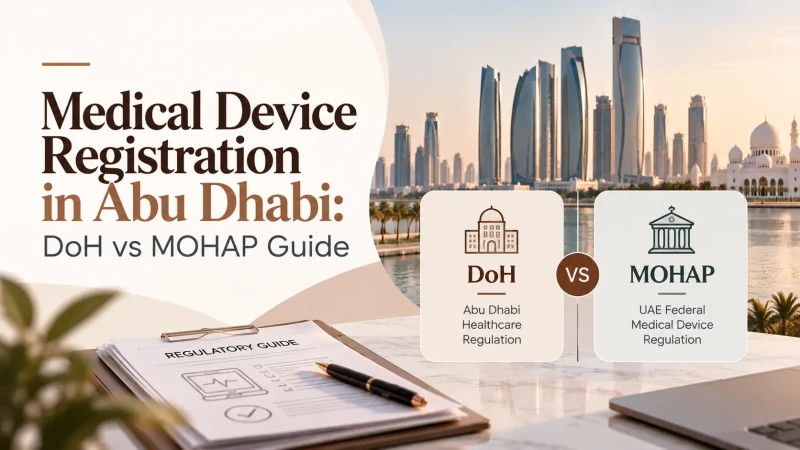
DoH vs MOHAP: How medical device registration Abu Dhabi DoH fits the UAE pathway
The phrase medical device registration Abu Dhabi DoH often appears in search queries because manufacturers want one clear answer. The practical answer is that DoH and the federal pathway usually regulate different parts of the same market entry plan.
DoH may matter because your device will be used in Abu Dhabi’s healthcare system. The federal pathway matters because your device may need UAE product registration or market authorization before lawful supply.
This means the question is rarely “DoH or MOHAP?” In many cases, the correct answer is “federal product pathway first, then assess Abu Dhabi-specific healthcare requirements if the device will be used in a DoH-regulated setting.”
 Do medical devices need DoH registration in Abu Dhabi?
Most medical devices do not need a separate DoH product registration simply because they are sold or used in Abu Dhabi.
However, DoH requirements may apply depending on how the device is used. A device supplied to an Abu Dhabi hospital, a software platform used in patient care or a technology connected to local health data systems may trigger Abu Dhabi health-sector requirements beyond the federal product approval.
Think of the distinction this way:
A manufacturer seeking market access should first assess UAE federal medical device requirements.
An importer or distributor should check federal registration, import and establishment requirements.
A healthcare facility should check DoH licensing, procurement, clinical use and governance obligations.
A health technology provider should assess both federal device classification and Abu Dhabi health technology requirements.
A CE-marked device, FDA-cleared device or product approved in another reference market may still require UAE review. International approvals can support the submission, but they do not automatically replace UAE obligations.
Which authority applies to your business model?
The right pathway depends heavily on your role in the supply chain.
Foreign manufacturer
A foreign manufacturer usually focuses on the UAE federal registration pathway. The manufacturer will typically need a UAE-based partner, representative or registration holder to support local regulatory responsibilities.
DoH may become relevant if the manufacturer is directly involved in implementation at Abu Dhabi healthcare facilities, digital health integration or local clinical projects.
UAE importer or distributor
A UAE importer or distributor usually needs to consider licensing, federal product registration status, import requirements and post-market responsibilities.
If the distributor supplies hospitals or clinics in Abu Dhabi, customers may also request proof that the device is eligible for use and that all local facility requirements can be met.
Abu Dhabi healthcare facility
A DoH-licensed hospital, clinic or health center is primarily concerned with compliance inside the Abu Dhabi healthcare system. This includes procurement controls, safe use, staff training, clinical governance, maintenance, reporting and any applicable DoH requirements.
The facility should not treat DoH compliance as a substitute for federal product authorization. It should also verify that devices purchased from suppliers have the appropriate UAE regulatory status.
Software or AI health technology provider
Software can be more complex. A clinical decision support tool, diagnostic algorithm, monitoring app or AI-enabled imaging product may be a medical device if its intended purpose meets the relevant definition.
In that case, the product may need federal device assessment and Abu Dhabi health technology review if deployed in DoH-regulated healthcare settings.
Key documents and regulatory requirements
The exact document set depends on device classification, intended use, manufacturer location, predicate approvals and current federal instructions. Still, manufacturers should prepare a robust technical package before approaching the UAE market.
Common documents include:
Device description and intended purpose
Classification rationale
Manufacturer details and manufacturing site information
Quality management system evidence, often ISO 13485 certification
Free Sale Certificate or equivalent market authorization evidence where applicable
CE certificates, FDA clearance or approval documents where available
Declaration of Conformity
Instructions for use and labelling
Risk management file
Clinical evaluation or performance evidence
Sterilization and biocompatibility evidence if applicable
Electrical safety, software validation or cybersecurity evidence if relevant
Post-market surveillance and vigilance procedures
Letter of authorization for the UAE representative or registration holder
Technical documentation should be consistent across all documents. Product names, model numbers, legal manufacturer details, intended use statements and certificate scopes must match.
OMC Medical has a separate resource on UAE medical device technical file preparation for companies building a submission dossier.
How CE and FDA approvals help, and where they do not
CE marking, FDA 510(k) clearance, FDA approval, Health Canada licensing or other reference-market approvals can strengthen a UAE submission. They provide evidence that a device has already been reviewed or accepted in a mature regulatory system.
They may support classification, safety and performance arguments. They can also help reviewers understand the product’s history, scope and risk controls.
But international approvals are not automatic UAE approvals.
Manufacturers still need to check:
Whether the approval covers the same model and intended use
Whether certificates are valid and issued by acceptable bodies
Whether labelling and instructions match the UAE submission
Whether the manufacturing site is included in the certificate scope
Whether local representative, import and vigilance obligations are satisfied
Whether Abu Dhabi healthcare deployment triggers additional DoH considerations
A common problem is using a CE certificate for one device family while submitting a different model, accessory or software version in the UAE. This can lead to questions, delays or rejection.
Common mistakes when choosing the pathway
Many delays happen before submission because the company has selected the wrong authority or misunderstood the scope of approval.
Common mistakes include:
Assuming DoH registers all medical devices used in Abu Dhabi
Treating older MOHAP guidance as current without checking federal updates
Believing CE marking or FDA clearance automatically permits UAE sales
Forgetting to appoint a suitable UAE local representative or registration holder
Mixing up healthcare facility licensing with product registration
Submitting inconsistent model names, manufacturer details or intended use statements
Ignoring software, AI, cybersecurity or health data requirements
Waiting until hospital procurement to confirm regulatory status
Overlooking post-market vigilance obligations after approval
The safest approach is to map the product, supply chain and healthcare use case before preparing the submission.
Practical examples: which route may apply?
A surgical implant manufacturer outside the UAE wants to sell to Abu Dhabi hospitals. The main starting point is the federal medical device pathway, supported by a UAE representative or registration holder. DoH becomes relevant when Abu Dhabi hospitals procure and use the implant under local healthcare governance.
A DoH-licensed clinic buys a registered ultrasound device from a UAE distributor. The distributor should ensure the product has the correct UAE regulatory status. The clinic should manage DoH-related facility obligations, staff training, maintenance and safe use.
A software company offers an AI tool that supports radiology diagnosis in Abu Dhabi. The company should assess whether the software is a medical device under federal requirements. It should also evaluate DoH health technology, data and healthcare implementation requirements because the tool affects clinical workflows in Abu Dhabi.
A distributor wants to import a CE-marked wound care device for UAE-wide sale. CE evidence may support the submission, but the distributor still needs to confirm the current federal registration route, local representation, import requirements and post-market obligations.
These examples show why Abu Dhabi medical device registration is best managed as a pathway assessment, not a single form.
Practical steps before entering the Abu Dhabi market
Companies planning market entry should complete a structured review before quoting timelines or signing distribution agreements.
Confirm the product status: Decide whether the product is a medical device, accessory, IVD, software medical device, wellness product or another regulated category.
Classify the device: Prepare a classification rationale based on intended purpose, invasiveness, duration of use, software function and risk.
Check current federal requirements: Verify whether the active process is under EDE, MOHAP legacy systems or another official federal instruction at the time of submission.
Select the UAE representative model: Appoint the correct local representative, registration holder, importer or distributor based on commercial and regulatory responsibilities.
Prepare the technical file: Align certificates, labelling, IFU, model lists, safety evidence, clinical evidence and post-market procedures.
Assess Abu Dhabi-specific use: Determine whether DoH requirements apply because of facility use, digital health deployment, clinical service delivery or health data integration.
Plan post-market compliance: Define complaint handling, adverse event reporting, field safety corrective action and renewal responsibilities before launch.
This sequence helps avoid one of the most expensive mistakes in UAE market access: winning interest from an Abu Dhabi customer before the device pathway is clear.
Conclusion: DoH and federal registration are different checks
For medical device registration Abu Dhabi DoH, the key is to separate product market authorization from local healthcare regulation. Federal requirements generally determine whether the device can be placed on the UAE market. DoH requirements determine how healthcare activities, facilities, providers and relevant health technologies are regulated within Abu Dhabi.
A successful UAE market entry strategy should address both questions early.
OMC Medical supports manufacturers, importers and distributors with UAE medical device registration, regulatory pathway assessment, documentation review, authority requirements and submission support. If you are unsure whether your device needs a federal submission, DoH-related review or both, OMC Medical can help you map the correct route before delays affect your Abu Dhabi launch.