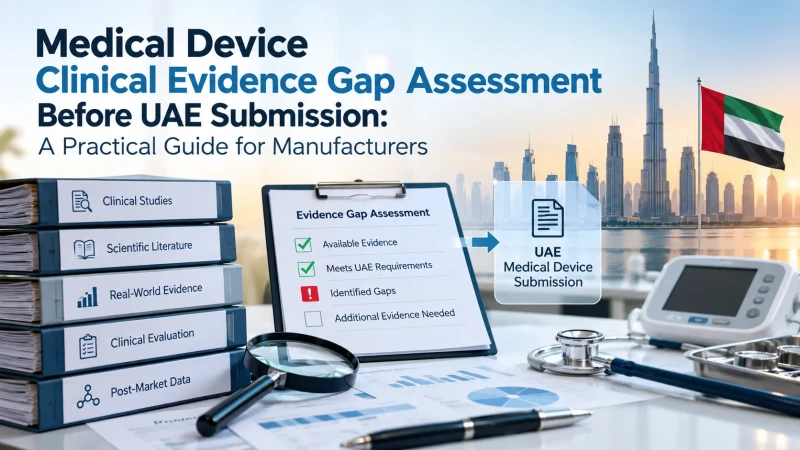
Medical Device Clinical Evidence Gap Assessment UAE: A Practical Guide for Manufacturers
A medical device clinical evidence gap assessment UAE manufacturers conduct before submission should answer one practical question: does the available evidence support this device, its intended purpose and every clinical claim being made? A dossier can contain numerous studies and certificates yet still leave important questions unanswered.
The assessment should identify those weaknesses before the submission package is finalized. That means examining evidence relevance, study quality, device changes and unresolved safety questions, then documenting what must be addressed. This guide explains how to turn that review into a usable evidence-gap matrix and a prioritized closure plan.
Establish the UAE regulatory context first
The Emirates Drug Establishment (EDE) is the federal authority responsible for regulating medical products in the UAE. Confirm the applicable registration pathway and current service requirements through the official EDE website before finalizing the assessment. Older guidance and previously prepared dossiers may reference MOHAP, so check their continuing applicability rather than assuming nothing has changed.
Confirm the UAE medical device clinical evidence requirements relevant to the product, its classification and the applicable submission route. An overseas authorization or EU MDR clinical evaluation can contribute useful supporting material, but neither should be treated as automatically satisfying UAE requirements.
Ready to Streamline Your Regulatory Compliance?
Join hundreds of companies who trust OMC Medical for their regulatory needs. Get expert guidance and ensure compliance across all markets.
Call Now +44 208 066 7260Keep two questions separate:
Regulatory completeness: Does the application contain the documents and evidence required for the applicable route?
Scientific sufficiency: Do those documents substantiate the device’s safety, clinical performance and claimed benefits?
The matrix below is a recommended manufacturer working tool, not an official UAE form. Its purpose is to expose unsupported conclusions, not merely confirm that a clinical report exists.
Define the device and claims before reviewing studies
For a medical device clinical evidence gap assessment UAE submission teams can use, start with a controlled product baseline. Otherwise, reviewers may assess evidence against an outdated intended purpose or a different device configuration.
Record the model or device family, relevant accessories, software version where applicable and the labeling proposed for submission. Define the intended patient population, indications, anatomical site, intended users and clinical setting. Include contraindications and the duration or frequency of use where these affect clinical outcomes.
Next, create a claims register. Separate basic performance statements from claims of patient benefit, superiority, reduced complications or longer service life. Each claim needs a defined meaning and an appropriate evidence source.
For example, evidence that a device produces an accurate measurement does not necessarily demonstrate that using it improves treatment outcomes. Similarly, a study in adults does not automatically substantiate use in children.
Agree on this baseline across regulatory, clinical, engineering and commercial teams. If marketing materials promise more than the instructions for use or clinical evaluation supports, resolve that discrepancy before assessing evidence sufficiency.
Identify what evidence exists and what is missing
Build an inventory with traceable sources
Collect clinical investigation reports, relevant publications, clinical evaluation documents, post-market clinical information, complaints, vigilance records and other applicable real-world data. Record the evidence search strategy, search dates and selection rationale so that another reviewer can understand how the evidence set was assembled.
A structured clinical evaluation report can provide useful traceability between evidence and conclusions. However, an existing report still needs to be checked against the actual device and claims proposed for the UAE.
For a medical device clinical evidence gap assessment UAE manufacturers can defend, record unfavorable findings as carefully as favorable results. Missing safety information and unexplained contradictory findings are medical device clinical data gaps, even when several positive studies are available.
Bench testing, biocompatibility, electrical safety and usability evidence may support the overall justification. Identify what each source establishes without presenting every nonclinical test as proof of a patient benefit.
Assess relevance before counting publications
A study is relevant only to the extent that its device, population, procedures and outcomes match the proposed use. Compare the investigated device with the submitted product, including materials, design, operating principle, software and clinically significant accessories.
For a dental implant, distinguish evidence on implant survival from evidence supporting immediate loading, a specific prosthetic configuration or use in compromised bone. A patient-facing description of dental implant treatment can help nonclinical team members understand the treatment context, but it cannot substantiate a manufacturer’s device claims.
Foreign clinical data should be assessed for applicability rather than dismissed because of its location. Examine differences in patient characteristics, clinical practice, user training and follow-up arrangements. Document whether those differences could change the conclusions.
Evidence from another device also needs an explicit justification. A shared indication or similar appearance alone does not establish that its clinical results apply to your product.
Appraise study quality and limitations
A clinical evidence sufficiency assessment must consider the strength of the evidence, not just whether a publication mentions the device. Review the full report where available rather than relying on abstracts or promotional summaries.
A medical device clinical evidence gap assessment UAE teams use for submission readiness should examine:
Study design: Whether the design and comparator can answer the clinical question being asked.
Population and sample size: Whether the participants represent intended users or patients and whether the study can support the proposed conclusion.
Endpoints: Whether outcomes are clinically meaningful and aligned with the claimed benefit.
Follow-up: Whether observation is long enough to assess the relevant performance and safety questions.
Bias and completeness: Whether missing data, exclusions, confounding or selective reporting weaken the findings.
Document limitations individually and cumulatively. Several small studies with the same short follow-up period do not necessarily resolve uncertainty about long-term safety. Likewise, statistical significance does not automatically establish a clinically meaningful improvement.
Build a medical device clinical evidence gap assessment UAE submission teams can use
Create a matrix that connects each clinical question to its supporting evidence, limitations and resolution. Give every gap an owner, target date and closure criterion. Keep the underlying evidence identifiable by report number, publication reference or controlled document version.
The examples below illustrate an internal assessment method, not UAE-mandated evidence thresholds.
In a medical device clinical evidence gap assessment UAE manufacturers can maintain over time, each row should represent a decision, not simply a missing document. “Clinical report required” is less useful than “the available evidence does not support the proposed population.” The latter identifies what must change and why.

Prioritize gaps by their effect on safety, claims and submission readiness
Separate submission-critical gaps from documentation weaknesses
Use a clear internal priority system. A gap is submission-critical when it prevents a defensible conclusion about a claimed use, leaves a significant safety concern unresolved or creates a material inconsistency in the proposed application.
A documentation weakness may be less severe, such as a missing cross-reference where the underlying evidence already exists. However, poor traceability can become substantive if reviewers cannot establish which device or population was studied.
Do not present internal priority labels as official EDE categories. Explain the rationale for each priority, including the potential clinical consequences and the effect on the proposed submission scope.
Choose an evidence-based closure route
A medical device clinical evidence gap assessment UAE manufacturers use effectively should distinguish gaps requiring new data from gaps that can be resolved through better analysis or a narrower claim.
Possible actions include obtaining missing study reports, updating a literature review, analyzing existing patient-level data, documenting a justified bridge between device versions or conducting additional clinical investigation. Revising the intended purpose may also be appropriate when a claim cannot be substantiated.
Claim revision must be scientifically and commercially coherent. It should not be used to conceal an unresolved safety issue. Any change should flow through labeling, risk management, clinical evaluation and submission documents.
For closure, specify an observable result. “Review completed” is insufficient if the question remains unanswered. A stronger criterion is that the revised evidence supports the retained claim, with residual limitations evaluated and approved.
Reconcile the clinical conclusions with the submission file
Before closing the assessment, check that the evidence-based conclusions agree with the instructions for use, risk management documentation, clinical evaluation and proposed promotional claims. Confirm that device identifiers and versions match throughout.
OMC Medical’s guide to UAE medical device technical file preparation addresses the wider dossier structure. The clinical gap assessment should feed into that file, not operate as a separate document with conflicting conclusions.
For a medical device clinical evidence gap assessment UAE submission teams can audit, retain the assessment history, reviewer approvals and reasons for accepting any residual uncertainty. An action should not be marked closed merely because a document has been uploaded.
Repeat the assessment when new clinical findings, significant complaints, design changes or revised claims could affect its conclusions. Plans to collect post-market evidence should not be treated as an automatic substitute for evidence needed to support the proposed use before submission.
Finally, distinguish internal readiness from authority acceptance. Completing the matrix does not guarantee registration or eliminate the possibility of additional questions during review.
Conclusion: close the gaps that affect the proposed use
A medical device clinical evidence gap assessment UAE manufacturers can act on links every retained claim to relevant evidence, identifies uncertainty honestly and assigns a clear closure decision. The goal is a defensible submission, not a longer bibliography.
OMC Medical supports product classification, technical documentation preparation and medical device registration. Contact the team to discuss how your clinical evidence review can be coordinated with the wider UAE submission plan.