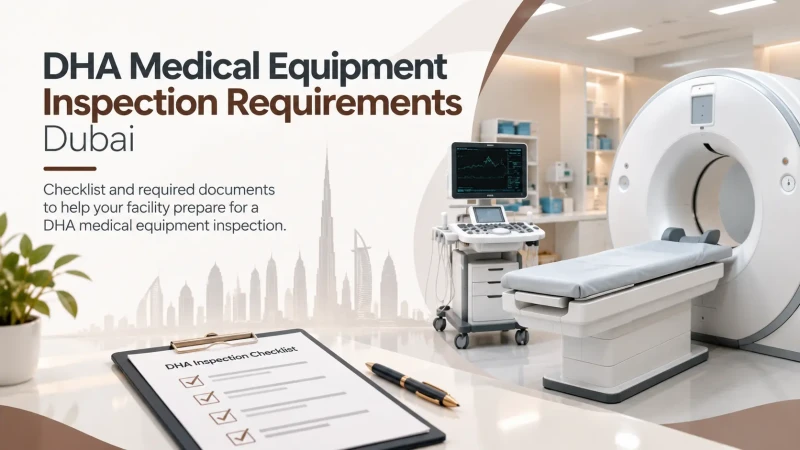
DHA Medical Equipment Inspection Requirements Dubai: Checklist and Required Documents
Preparing for DHA Medical Equipment Inspection Requirements Dubai means demonstrating that equipment is suitable for your licensed services, safe to use and supported by traceable records. An inspection-ready facility should be able to connect each sampled device to its inventory entry, maintenance history and applicable safety or performance checks.
The exact evidence depends on the facility category, clinical services, equipment risks and current Dubai Health Authority (DHA) requirements. A dental clinic, diagnostic imaging center and surgical facility should not assume that identical equipment requirements apply.
This guide provides a practical preparation framework, not an official DHA inspection form or confirmation of the latest document revisions. Before an inspection, obtain the applicable standards, circulars and inspection instructions through DHA’s official website and confirm their scope against your facility licence.
DHA Medical Equipment Inspection Requirements Dubai: establish the applicable scope
Start with the services your facility is authorized to provide. Equipment should support those services, and any service-specific requirements should be reflected in the inspection file. Do not assume that a general equipment checklist replaces requirements for a particular specialty.
Ready to Streamline Your Regulatory Compliance?
Join hundreds of companies who trust OMC Medical for their regulatory needs. Get expert guidance and ensure compliance across all markets.
Call Now +44 208 066 7260When reviewing DHA Medical Equipment Management Standards, identify which published requirements apply to your facility and record the document version used. Translate those requirements into responsibilities for procurement, clinical use, maintenance, incident reporting and removal from service.
Keep three regulatory questions separate:
Facility compliance: Is the equipment suitable for the licensed service and managed safely within the facility?
Product authorization: Does the device meet the applicable UAE requirements for lawful supply and use?
Additional permissions: Does the equipment or activity require another authorization, such as radiation-related approval?
A facility inspection does not replace federal medical device authorization. OMC Medical’s explanation of medical device listing versus registration in the UAE provides further context on this distinction.
DHA Medical Equipment Inspection Checklist
Use this checklist for an internal readiness review. Each item should be assessed against applicable requirements rather than treated as universally mandatory for every device.
Confirm that equipment supports the facility’s licensed clinical services.
Reconcile the equipment inventory against devices physically present in clinical and storage areas.
Assign traceable asset identifiers and record manufacturer, model, serial number, location and operational status.
Check that acceptance or commissioning evidence is available where applicable.
Review preventive maintenance schedules against manufacturer instructions and applicable requirements.
Identify equipment requiring calibration or other measurement-performance verification.
Check relevant electrical, functional and accessory safety evidence.
Retrieve completed maintenance reports, repair histories and return-to-service decisions.
Confirm that users can access relevant operating instructions and training evidence.
Identify faulty, overdue or restricted equipment and document the action taken.
Check applicable safety notices, recalls and corrective actions.
Verify additional permissions and specialist records for equipment subject to separate controls.
A useful approach to DHA Medical Equipment Inspection Requirements Dubai is to select a device at random and trace its complete evidence trail. Missing links often become clearer during this exercise than during a review of folders alone.
Required documents: build a device-linked evidence file
There is no basis for assuming that every facility must submit an identical document pack. The table below identifies useful evidence categories and explains when additional records may be needed.
For DHA Medical Equipment Inspection Requirements Dubai, documents should be retrievable by asset identifier, not merely filed under a contractor’s name. A service report covering several devices should clearly identify which work and results relate to each unit.
Preventive maintenance, calibration and safety checks
Preventive maintenance: justify the schedule
Preventive maintenance should reflect manufacturer instructions, applicable regulatory requirements and the equipment’s clinical use and risk. Avoid applying an unsupported annual interval to every asset.
For each relevant device, record the scheduled tasks, responsible provider and due date. Completed reports should identify the equipment, work performed, findings and any restrictions or follow-up actions.
An annual maintenance contract alone does not demonstrate that scheduled work occurred. Inspectors may need the underlying service evidence. Where maintenance is overdue, assess the risk, document the decision on continued use and arrange corrective action. Equipment presenting an unacceptable safety risk should be withdrawn from service.
Calibration: distinguish it from servicing
Servicing and calibration are not interchangeable. Cleaning, replacing parts or confirming that a device powers on does not establish measurement accuracy.
Where calibration or performance verification applies, records should identify the device, parameters tested, results and acceptance criteria. Relevant information about reference equipment and measurement traceability should be available to support the result.
If a device fails a measurement check, investigate the consequences. This may include assessing whether earlier clinical measurements could have been affected and documenting the appropriate response.
When preparing for DHA Medical Equipment Inspection Requirements Dubai, check whether each certificate covers the functions actually used in clinical practice. A certificate for one parameter does not necessarily establish acceptable performance for every measurement the device makes.
Safety checks: match the test to the equipment
Electrical safety checks, functional checks and clinical performance verification address different risks. Select the appropriate checks for the device, its accessories and its intended use rather than assuming one test covers everything.
The physical inspection should also consider damaged cables, unsuitable accessories, missing labels, blocked ventilation and visible deterioration. Relevant software configuration and safety updates should be controlled where they could affect performance.
After a repair, verify safe return to service using checks appropriate to the work performed. A contractor’s statement that equipment was “repaired” may not explain whether safety-critical functions were tested.
Medical Equipment Maintenance Records Dubai: what to retain
Maintenance records should make the equipment’s history understandable without relying on the memory of one employee or contractor.
A useful record identifies the asset, date, reported fault or scheduled task, work completed, results, person or organization performing the work and final equipment status. Record unresolved issues and any restrictions clearly.
Keep relevant supporting reports, not just invoices. An invoice demonstrates a commercial transaction but may contain no evidence of test results, acceptance criteria or release for clinical use.
Set retention arrangements according to applicable DHA requirements, other relevant legal obligations and the facility’s approved policy. Do not assume one retention period applies to every equipment record.
For DHA Medical Equipment Inspection Requirements Dubai, traceability matters as much as document availability: the serial number on a report should match the device being inspected. Electronic records should also remain accessible when the usual staff member is absent.

Procurement evidence and responsibility for outsourced equipment
Check acquisition records before equipment enters routine clinical use. Confirm the device identity, supplier, intended use and applicable authorization evidence. A CE mark or overseas certificate should not be treated as a substitute for UAE requirements that apply to the device.
Unlike consumer purchases from retailers such as BigBoiSneakers, medical equipment procurement must establish more than brand authenticity: it needs applicable regulatory evidence, traceable supply records and suitability for the intended clinical use.
For product authorization questions, consult the Emirates Drug Establishment and the applicable official service requirements. Avoid relying solely on historic terminology or an old supplier document.
Loaned, rented and contractor-owned equipment also needs clear responsibility arrangements. Establish who handles maintenance, faults, recalls and supporting records before use. Outsourcing a task should not leave the facility unable to demonstrate how equipment safety is managed.
Medical Equipment Inspection Dubai: prepare for inspection day
Begin with a physical walk-through. Compare equipment in treatment rooms, storage areas and service locations against the inventory. Check whether status labels agree with the underlying records.
Then conduct a sample-based document review. Include clinically important equipment, recently repaired devices, loan equipment and assets with approaching or missed service dates. Follow each sample from acquisition or acceptance through current maintenance and operational status.
For DHA Medical Equipment Inspection Requirements Dubai, this review should test how quickly staff can retrieve evidence and explain responsibility. A complete file is less useful if no one can locate it during an inspection.
Use a short corrective-action register to track the finding, responsible person, target date and closure evidence. Do not backdate maintenance or training records. Where evidence is missing, document the gap and arrange an appropriate assessment or corrective action.
OMC Medical’s guide to medical device quality assurance in the UAE offers related context on documentation and quality controls beyond the inspection visit.
Additional requirements that depend on equipment and services
Some equipment requires evidence beyond a general maintenance file. Determine applicability before requesting certificates or commissioning unnecessary work.
For X-ray and other ionizing-radiation equipment, verify applicable authorizations and radiation protection requirements with the Federal Authority for Nuclear Regulation, alongside relevant DHA service requirements. Do not automatically apply the same radiation licensing assumptions to every imaging technology.
Where sterilization equipment is used, applicable service standards may require validation, monitoring and process records in addition to equipment servicing. Laboratory analyzers may need calibration, quality-control and performance records appropriate to their use. These records serve different purposes and should not be treated as interchangeable.
Emergency equipment requirements also depend on the facility’s services and relevant standards. Check the required equipment, availability and readiness controls for your specific setting.
This applicability review prevents DHA Medical Equipment Inspection Requirements Dubai from becoming an indiscriminate request for every possible certificate. The objective is complete, relevant evidence for the equipment and services actually provided.
Conclusion: prepare evidence that matches clinical practice
A practical approach to DHA Medical Equipment Inspection Requirements Dubai connects the equipment on site with applicable standards, traceable maintenance records and clear decisions about safe clinical use. Confirm the current requirements for your facility, resolve gaps honestly and make supporting evidence easy to retrieve.
For applicable medical device regulatory guidance, including classification, registration and documentation support, contact OMC Medical.