A class II medical device is a device for which FDA believes general controls alone are not sufficient to provide reasonable assurance of safety and effectiveness, but where additional special controls can usually manage the device's risks. In FDA's three-class system, Class II sits between Class I devices, which are generally lower regulatory concern, and Class III devices, which typically require Premarket Approval because of higher risk or insufficient controls.
Ready to Streamline Your Regulatory Compliance?
Join hundreds of companies who trust OMC Medical for their regulatory needs. Get expert guidance and ensure compliance across all markets.
Call Now +44 208 066 7260For US medical device manufacturers, Class II classification is not just a label. It can determine whether you need 510(k) clearance, whether a 510(k) exemption applies, whether De Novo may be appropriate for a novel device, what testing and labeling expectations apply, and what obligations continue after commercialization.
What Is a Class II Medical Device?
An FDA Class II medical device is a device type that is subject to general controls and special controls. FDA uses this classification when general controls, such as establishment registration, device listing, labeling requirements, and quality system requirements, are not enough on their own, but additional controls can reasonably address the risks associated with the device.
FDA classification depends on the device's intended use, indications for use, technology, risk profile, and the regulatory controls needed to provide reasonable assurance of safety and effectiveness. It is not accurate to describe every Class II device as simply "medium risk" or "medium to high risk." Some Class II devices may present moderate risk, while others may have significant risks that are managed through specific performance standards, testing, labeling, or postmarket controls.
In practice, Class II is the category where many US market entry strategies become more evidence-driven. Many class II medical devices require a 510(k) premarket notification, but not all do. Some are 510(k)-exempt, and certain novel devices without a suitable predicate may be appropriate for the De Novo pathway.
FDA explains its classification approach in its guidance on how to classify your medical device, including the role of intended use, indications for use, and regulatory controls.
Class I vs Class II vs Class III Medical Devices
FDA medical device classification is based on the level of regulatory control needed for a device type, not just the product's appearance, complexity, or commercial category. A simple-looking device can carry a more demanding pathway if its intended use creates greater risk, while a technologically complex product may still fit an established Class II device type if risks are well understood and controlled.
The distinction between these classes matters because it affects evidence planning, submission strategy, labeling, quality system readiness, commercial claims, import preparation, and postmarket responsibilities.
Class II Medical Device Examples
Class II medical device examples are useful for orientation, but manufacturers should be careful not to assume that an entire product category always has one FDA classification. FDA classification depends on the specific device type, intended use, indications for use, technology, and applicable regulation or product code.
Examples of devices that may fall within Class II include:
For example, a catheter intended for one anatomical use may not share the same classification as a catheter intended for another use. Similarly, software that merely stores or displays information may be treated differently from software intended to analyze patient data and support diagnosis or treatment decisions.
This is why manufacturers should classify the specific device and claim set, not just the product family.
How Does FDA Determine If a Device Is Class II?
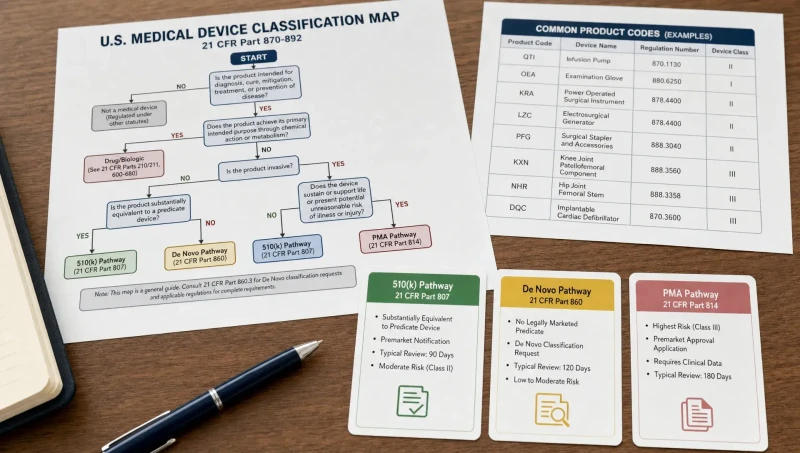
FDA classification begins with what the device is intended to do. The most practical way to understand the process is to follow the regulatory logic from claims to pathway:
Intended use to indications for use to device type to FDA regulation to product code to applicable controls to classification to regulatory pathway.
The intended use describes the general purpose of the device. The indications for use provide more specific information, such as the disease or condition, patient population, anatomical site, clinical setting, user, or type of measurement. Small changes in indications can change the classification analysis.
After defining intended use and indications, manufacturers typically search FDA classification regulations and the FDA Product Classification Database. The database can help identify potentially relevant device types, regulation numbers, product codes, device panels, submission types, and exemption status.
A defensible classification analysis should usually identify:
The intended use and indications for use
The applicable medical specialty panel
The relevant regulation number, if one exists
The product code and device type
The device class
Whether 510(k) is required or exempt
Applicable special controls, FDA guidance, and recognized standards
Potential predicate devices, if a 510(k) pathway is being considered
The product code is particularly important because it connects the device to FDA's expectations for that device type. Product codes can point manufacturers toward known predicates, special controls, review practices, and submission content expectations.
What Controls Apply to Class II Medical Devices?
Class II devices are subject to general controls and special controls. These controls work together to manage risk and support reasonable assurance of safety and effectiveness.
General controls are baseline FDA requirements that apply broadly across medical devices, unless an exception applies. They can include establishment registration, device listing, labeling requirements, prohibitions against adulteration and misbranding, recordkeeping, Medical Device Reporting, corrections and removals reporting, and quality system requirements where applicable.
Special controls are additional requirements or expectations that apply to certain device types. FDA uses special controls when general controls alone are not enough. Special controls may include performance standards, postmarket surveillance, patient registries, special labeling, premarket data requirements, testing recommendations, design-related controls, or guidance documents.
For Class II manufacturers, special controls are often where the practical workload becomes clear. Depending on the device, they may influence bench testing, electrical safety testing, electromagnetic compatibility, software validation, cybersecurity documentation, biocompatibility, sterilization validation, usability engineering, clinical performance, labeling, or postmarket follow-up.
The key is that special controls are not generic. They should be identified for the specific regulation, product code, device type, intended use, and technological characteristics.

Do Class II Medical Devices Need 510(k) Clearance?
Many Class II medical devices require a 510(k), but not every Class II device does. A 510(k) is a premarket notification submitted to FDA to demonstrate that a new device is substantially equivalent to a legally marketed predicate device.
A device cleared through 510(k) is generally described as FDA-cleared, not FDA-approved. FDA approval usually refers to Premarket Approval applications for many Class III devices. This distinction is important for regulatory accuracy, labeling, investor materials, distributor communications, and marketing claims.
In a 510(k), the manufacturer compares the new device with a predicate device. FDA evaluates whether the new device has the same intended use as the predicate and whether any differences in technological characteristics raise different questions of safety and effectiveness. If differences exist, the manufacturer must provide data showing that the device is at least as safe and effective as the predicate for its intended use.
A strong 510(k) strategy usually depends on:
Selecting an appropriate predicate device
Confirming the same intended use
Comparing technological characteristics clearly
Addressing applicable special controls and standards
Providing performance data that supports substantial equivalence
Ensuring labeling aligns with the proposed indications for use
FDA provides additional information about premarket notification 510(k), including the purpose of the pathway and the concept of substantial equivalence. OMC Medical also provides a practical overview of the FDA 510(k) submission process for manufacturers planning US market entry.
Are Class II Medical Devices 510(k)-Exempt?
Some Class II devices are exempt from 510(k) requirements. FDA may grant an exemption when the agency determines that a premarket notification is not necessary to provide reasonable assurance of safety and effectiveness for that device type.
However, 510(k) exemption is not the same as exemption from FDA regulation. A manufacturer of a 510(k)-exempt Class II device may still need to comply with other applicable requirements, such as establishment registration, device listing, labeling, quality system requirements, complaint handling, Medical Device Reporting, corrections and removals, and import requirements.
Manufacturers should also check whether the exemption has limitations. A device may lose exemption status if it has a different intended use, different technological characteristics, or falls outside the limits described in the applicable regulation or FDA exemption notice.
For this reason, a 510(k)-exempt strategy should still be documented. The company should be able to explain why the device fits the exempt product code, why the intended use and indications remain within the exemption, and which FDA requirements continue to apply.
Can a Class II Medical Device Use the De Novo Pathway?
Yes, certain devices that ultimately become Class II may use the De Novo pathway. De Novo is intended for novel devices for which there is no legally marketed predicate, but for which general controls, or general and special controls, can provide reasonable assurance of safety and effectiveness.
A device without a suitable predicate is not automatically destined for Premarket Approval. Historically, novel devices could be placed into Class III by default, but De Novo provides a pathway for FDA to classify certain novel devices into Class I or Class II when appropriate controls can manage the risks.
The main difference between 510(k) and De Novo is the role of the predicate. A 510(k) depends on substantial equivalence to a legally marketed predicate device. De Novo is used when there is no suitable predicate and the manufacturer is asking FDA to establish a new device type and classification regulation or controls.
For manufacturers, the De Novo pathway can be strategically important for innovative technologies, including some software-driven or diagnostic devices. It can also create a new product code that later devices may use as predicates in future 510(k) submissions.
FDA provides information on the De Novo classification request. OMC Medical's guide on choosing between a 510(k) and De Novo pathway explores practical decision points for manufacturers assessing predicate strategy.
What Are the FDA Requirements After Class II Device Clearance?
Class II regulatory work does not end once a device is cleared, classified through De Novo, or confirmed as 510(k)-exempt. After market entry, manufacturers must maintain ongoing compliance with applicable FDA requirements.
Postmarket obligations can vary by device type, manufacturer role, and applicable regulations, but commonly include the following areas:
Manufacturers should also keep classification aligned with change control. Design changes, software updates, new materials, new suppliers, modified labeling, or expanded indications may affect whether a new 510(k), special 510(k), De Novo supplement, or other regulatory action is needed.
This is particularly important for devices with software, connected features, cybersecurity considerations, sterile packaging, reusable components, or user-interface changes. Regulatory, quality, clinical, engineering, and commercial teams should coordinate before changes are implemented or promoted.
Is a Class II Device the Same in Other Countries?
No. A US Class II medical device is not automatically Class II in the European Union, United Kingdom, Canada, Australia, or other markets. Each jurisdiction has its own classification rules, terminology, conformity assessment routes, evidence expectations, and postmarket obligations.
For example, EU MDR classification is rule-based and uses classes such as I, IIa, IIb, and III. Canada uses Classes I to IV. Australia has its own classification rules under the Therapeutic Goods framework. The UK has its own regulatory framework, with transition arrangements and requirements that differ from FDA.
A device's US product code, FDA regulation, and 510(k) status can be helpful regulatory intelligence, but they do not determine global classification. Manufacturers planning multi-market launches should map each jurisdiction separately and avoid assuming that an FDA-cleared Class II device will follow the same route elsewhere.
This is also where standardized terminology can help. Understanding medical device nomenclatures early can support product registration, listing, and technical documentation across markets.
Practical Takeaways for US Manufacturers
For US market entry, Class II classification should be addressed early in the development and claims planning process. Waiting until verification testing is complete or marketing materials are drafted can create avoidable rework.
Manufacturers should first define the intended use and indications for use, then identify the relevant FDA regulation, product code, controls, and pathway. If a 510(k) is required, predicate selection and substantial equivalence should guide the evidence plan. If no suitable predicate exists, De Novo may need to be evaluated before assuming that Premarket Approval is the only option.
The most reliable classification strategy is documented, cross-functional, and connected to the full product lifecycle. It should support design verification, validation, labeling, quality system planning, submission strategy, launch readiness, and postmarket compliance.
Plan Your FDA Class II Strategy With Confidence
Class II classification can shape nearly every part of a US medical device launch, from predicate strategy and testing to labeling, registration, quality system readiness, and postmarket compliance. Getting it right early helps manufacturers avoid preventable delays and build a more predictable FDA pathway.
OMC Medical supports medical device companies with regulatory strategy, product classification guidance, registration planning, technical documentation, translations and localization, authorized representative services, and post-market vigilance across international markets. If you are preparing a Class II device for the US market or coordinating FDA requirements with other jurisdictions, experienced regulatory support can help you move forward with clarity.