
FDA cleared vs approved vs granted describes three different FDA regulatory outcomes for medical devices. FDA cleared generally refers to a device that has received FDA 510(k) clearance. FDA approved generally refers to a device that has received FDA PMA approval. FDA granted commonly refers to a De Novo request that FDA has granted for a novel device type.
Ready to Streamline Your Regulatory Compliance?
Join hundreds of companies who trust OMC Medical for their regulatory needs. Get expert guidance and ensure compliance across all markets.
Call Now +44 208 066 7260These terms are not interchangeable. They reflect different FDA regulatory pathways, evidence expectations, review standards, and marketing implications. For a manufacturer entering the US market, using the wrong term can create compliance risk in product pages, brochures, packaging, investor materials, and sales conversations.
FDA Cleared vs Approved vs Granted
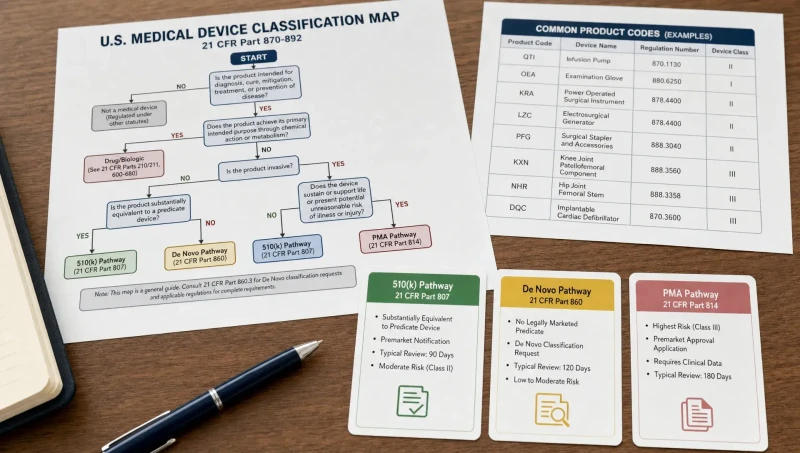
Device class matters, but it does not automatically decide the pathway. Some Class I devices are exempt from 510(k), some Class II devices are exempt, many Class II devices require 510(k), and some devices may be eligible for De Novo. PMA is generally associated with Class III devices, but manufacturers should verify the applicable classification regulation, product code, exemptions, and FDA expectations.
What Does FDA Cleared Mean?
FDA cleared usually means the device went through the 510(k) Premarket Notification pathway. In a 510(k), the manufacturer demonstrates that the new device is substantially equivalent to a legally marketed predicate device.
Substantial equivalence is not a claim that the device is identical. FDA evaluates whether the device has the same intended use as the predicate and whether any differences in technological characteristics raise different questions of safety and effectiveness. The submission typically includes device descriptions, indications for use, performance testing, labeling, and comparison to the predicate.
Clinical evidence is not required for every 510(k), but it may be needed when bench, software, usability, biocompatibility, or other non-clinical data are not enough to address the relevant questions. Some devices are exempt from 510(k), but exemption does not mean exemption from all FDA requirements.
A simple hypothetical example: a manufacturer develops a powered surgical instrument with the same intended use as an existing legally marketed device and similar technological characteristics. If FDA agrees that performance testing supports substantial equivalence, the device may receive FDA 510(k) clearance. It would be inaccurate to call that device FDA approved.
For a more detailed process view, OMC Medical’s guide to the FDA 510(k) submission process explains the steps involved in preparing for medical device clearance.
What Does FDA Approved Mean?
FDA approved generally refers to Premarket Approval, or PMA. FDA describes PMA as the most stringent type of device marketing application and generally applies it to high-risk Class III devices that support or sustain life, are of substantial importance in preventing impairment of human health, or present a potential unreasonable risk of illness or injury.
Under the PMA pathway, the manufacturer must provide valid scientific evidence to support a reasonable assurance of safety and effectiveness for the device’s intended use. A PMA may include clinical investigation data, non-clinical testing, manufacturing information, labeling, and other information required by FDA.
A realistic hypothetical example: an implantable cardiac device intended to treat a serious condition may require PMA if FDA determines that general and special controls, or substantial equivalence to a predicate, are not sufficient. In that case, FDA medical device approval would depend on robust evidence supporting safety and effectiveness.
PMA approval can also involve post-approval requirements, such as post-approval studies, reporting obligations, or manufacturing controls, depending on the device and FDA’s decision.
What Does FDA Granted Mean?
FDA granted meaning is most often discussed in the context of the FDA De Novo pathway. De Novo exists for novel medical devices for which there is no legally marketed predicate, but where the device may be classified as Class I or Class II because the risks can be adequately controlled.
This pathway is important because a device can be new without necessarily being high risk. If a manufacturer cannot identify a suitable predicate, a 510(k) may not be appropriate. If the device is not high risk and FDA can establish general controls, and special controls where needed, De Novo may be the right route.
When FDA grants a De Novo request, FDA creates a new classification for that device type. The granted De Novo device may then become a potential predicate for future 510(k) submissions, provided the future device has the same intended use and meets the applicable substantial equivalence requirements.
This is the key distinction: 510(k) clearance is not a De Novo grant, and a De Novo grant is not PMA approval. De Novo is a classification pathway for certain novel low-to-moderate-risk devices, not a shortcut around evidence. Manufacturers still need to justify risk controls and provide appropriate performance data.
If your device appears novel but not high risk, OMC Medical’s article on choosing between 510(k) and De Novo provides additional pathway context.
FDA Registration vs Clearance vs Approval vs Grant
FDA medical device registration is often misunderstood. Establishment registration and device listing are administrative requirements for many medical device establishments and products. They are not the same as FDA clearance, FDA approval, or a De Novo grant.
According to FDA’s device registration and listing information, owners or operators of certain establishments involved in the production and distribution of medical devices intended for US commercial distribution generally must register annually and list their devices. This helps FDA identify who is involved in the device supply chain and what devices are being marketed.
However, FDA registration and listing do not automatically mean that FDA has cleared or approved a medical device. A listed device may still require a 510(k), De Novo, PMA, or may fall under an exemption, depending on its classification and regulatory requirements.
For companies entering the US market, FDA registration vs approval is a critical distinction. Registration may be necessary for establishment compliance, but it does not replace pathway assessment, premarket submission requirements, labeling compliance, quality system obligations, or post-market responsibilities.
How Do You Determine the Right FDA Pathway?
A practical pathway assessment should start with the device, not with the term the manufacturer wants to use in marketing. FDA regulatory pathways depend on intended use, classification, exemptions, predicate availability, and risk.
A useful sequence is:
Define the intended use: Identify what the device is intended to do and the medical purpose claimed.
Define the indications for use: Clarify the patient population, condition, anatomical site, environment of use, and user type.
Check device classification: Use FDA classification regulations, product codes, and databases to identify likely classification.
Check exemptions: Determine whether a 510(k) exemption applies and whether limitations to exemption remove that exemption.
Assess predicate availability: If a suitable predicate exists, evaluate whether a 510(k) is appropriate.
Assess De Novo eligibility: If no suitable predicate exists and risk appears low to moderate, evaluate De Novo.
Assess PMA requirements: If the device is high risk or subject to PMA, plan for the evidence and review burden of PMA.
Manufacturers should not select a pathway based only on Class I, II, or III. Classification is essential, but the applicable regulation, product code, exemption status, intended use, technological characteristics, and FDA precedent are all part of the analysis.
510(k) vs De Novo vs PMA
The phrase 510(k) vs PMA vs De Novo is useful, but the real question is whether the device can be supported by substantial equivalence, needs a new risk-based classification, or requires proof of safety and effectiveness through PMA.
What Evidence Does FDA Require?
FDA evidence requirements vary by device type and pathway. A simple, non-sterile Class I device will not have the same evidence profile as an implantable device, a software diagnostic device, or an electrically powered therapeutic device.
Depending on the device, FDA may expect evidence such as bench or performance testing, biocompatibility, electrical safety and electromagnetic compatibility, software documentation, cybersecurity information, sterilization validation, packaging and shelf-life data, usability or human factors information, animal studies, clinical evidence, risk analysis, labeling, and manufacturing information.
The key is relevance. Manufacturers should identify the risks associated with the intended use and technology, then provide the testing and documentation needed to address those risks. Over-testing can waste time and resources, while under-testing can lead to FDA questions, additional information requests, or refusal to accept issues.

How Long Does FDA Clearance, De Novo, or Approval Take?
Manufacturers should separate two timelines: preparation time and FDA review time. Preparation time can include classification research, predicate analysis, test planning, protocol development, testing, clinical work where needed, labeling development, quality documentation, and submission compilation.
FDA review time depends on the pathway and submission quality. FDA commonly describes 510(k) review around a 90-day review timeframe, De Novo around 120 FDA review days, and PMA around 180 days, but these figures should not be treated as guaranteed calendar timelines. Review may be affected by acceptance screening, FDA questions, requests for additional information, the complexity of testing, clinical evidence, and how quickly the manufacturer responds.
The most preventable delay is an incomplete or poorly justified submission. A clear regulatory rationale, well-organized evidence, consistent labeling, and early identification of likely FDA concerns can reduce avoidable back-and-forth.
Can You Call a Medical Device FDA Approved?
Only use FDA approved if the device has actually received FDA PMA approval or another FDA approval action that supports that terminology. A device cleared through 510(k) should be described as FDA cleared, not FDA approved. A device that received a granted De Novo request should not be marketed as PMA approved.
Accurate terminology matters across websites, product pages, packaging, advertising, brochures, distributor materials, investor decks, and sales training. Examples of more precise wording include:
FDA-cleared through the 510(k) pathway
De Novo request granted by FDA
FDA-approved through PMA
Misstating FDA status can create regulatory, commercial, and reputational risk, especially for manufacturers expanding into the US market.
Common Misconceptions
Real-World Style Examples
FDA Cleared
A manufacturer develops a new digital thermometer with the same intended use and similar technology to a legally marketed predicate. The company performs performance testing and labeling comparison. If FDA agrees that the device is substantially equivalent, the device may be FDA cleared through 510(k).
FDA Granted
A company develops a novel monitoring device for a specific clinical use and cannot identify a suitable predicate. The risks appear controllable through performance standards, labeling, and special controls. If FDA agrees, it may grant a De Novo request and classify the new device type as Class II.
FDA Approved
A manufacturer develops an implantable device intended to treat a serious cardiac condition. Because the device is high risk and requires valid scientific evidence of safety and effectiveness, FDA may require PMA. If the PMA is successful, the device may be FDA approved.
These are hypothetical examples and should not be used as pathway conclusions for a specific product.
Which FDA Pathway May Apply to Your Medical Device?
Before choosing a pathway, manufacturers should document the following:
What is the intended use? This drives classification and evidence requirements.
What are the indications for use? Small wording changes can affect the pathway.
What is the likely classification? Check FDA classification regulations and product codes.
Is the device exempt? Confirm both exemption and limitations to exemption.
Is there a suitable predicate? If yes, assess 510(k) feasibility.
What evidence is required? Map testing to risks and FDA expectations.
Could De Novo apply? Consider this if the device is novel and low to moderate risk.
Is PMA required? Evaluate whether the device is high risk or subject to PMA.
Would early FDA interaction be useful? For novel, complex, or high-risk devices, early engagement may reduce uncertainty.
This framework is general educational information, not individualized regulatory advice. Device-specific analysis is essential before making US market-entry decisions.
How OMC Medical Can Help
Understanding FDA cleared vs approved vs granted is only the first step. The practical challenge is determining which pathway applies to your device and preparing a compliant US market-entry strategy.
OMC Medical supports medical device manufacturers with FDA medical device registration, device listing, regulatory pathway assessment, 510(k) support, FDA compliance, US Agent services where applicable, and regulatory documentation. For manufacturers with novel devices, OMC Medical can also help assess whether the De Novo pathway may be relevant and what evidence gaps should be addressed.
If you are preparing to enter the US market, contact OMC Medical for device-specific regulatory guidance before relying on assumptions about FDA clearance, De Novo grants, PMA approval, or FDA registration status.