CE Marking for Medical Devices: Requirements and Certification Process
CE marking for medical devices confirms that a product meets the applicable EU regulatory requirements before it is placed on the market. For manufacturers, obtaining it requires a documented chain of decisions covering qualification, classification, conformity assessment, clinical evidence and ongoing surveillance.
The route depends on the device’s intended purpose and risk class. Some manufacturers can self-declare conformity; others must undergo assessment by a designated Notified Body. This guide explains the practical requirements under the EU Medical Device Regulation (MDR), Regulation (EU) 2017/745, and the records needed at each stage.
What does the CE mark establish?
The CE mark represents the manufacturer’s declaration that its device complies with applicable EU legislation. It is not a quality award, a commercial endorsement or a guarantee that a device is risk-free.
Although manufacturers often search for “CE certification for medical devices,” there is no single certificate issued by an EU authority to every device. Where required, a Notified Body issues certificates following conformity assessment. The manufacturer remains responsible for compliance and signs the EU Declaration of Conformity.
Ready to Streamline Your Regulatory Compliance?
Join hundreds of companies who trust OMC Medical for their regulatory needs. Get expert guidance and ensure compliance across all markets.
Call Now +44 208 066 7260The principal legal reference is Regulation (EU) 2017/745, particularly Article 52 and Annexes I through XI. In vitro diagnostic devices follow the separate IVDR, Regulation (EU) 2017/746, with different classification rules and assessment requirements.
How does CE marking for medical devices work step by step?
The CE marking process for medical devices should begin before design decisions and clinical claims become fixed. The following sequence connects the regulatory decisions to the evidence needed for market access.
Step 1: Confirm the product’s regulatory status and intended purpose
Write a precise intended-purpose statement covering the medical function, target population, intended users and use environment. Identify indications, contraindications and the claims that labeling and promotional materials will make.
CE marking for medical devices starts with this qualification decision because the product’s intended purpose determines whether the MDR applies and influences subsequent classification.
Location alone does not establish medical-device status. For example, decorative interior lighting does not become a medical device merely because it is installed in a clinic. Lighting intended for a specific medical function requires a separate qualification assessment.
Also check whether the product belongs to an Annex XVI group without an intended medical purpose. These specified groups fall within the MDR’s scope despite lacking a medical indication.
Practical output: An approved intended-purpose statement and a documented rationale explaining the applicable regulatory framework.
Step 2: Determine the device’s MDR classification
Apply the rules in MDR Annex VIII. Classification depends on factors including invasiveness, duration of use, anatomical location, active functionality and the consequences of incorrect performance. Software requires particular attention to the decisions its information supports.
The medical device CE marking requirements become more demanding as the classification and associated assessment obligations increase.
It means supplied sterile, Im means having a measuring function and Ir means a reusable surgical instrument.
Incorrect classification can invalidate the planned route for CE marking for medical devices. Record the applicable rule, its reasoning and any additional rules considered. If multiple rules apply, use the rule producing the highest classification.
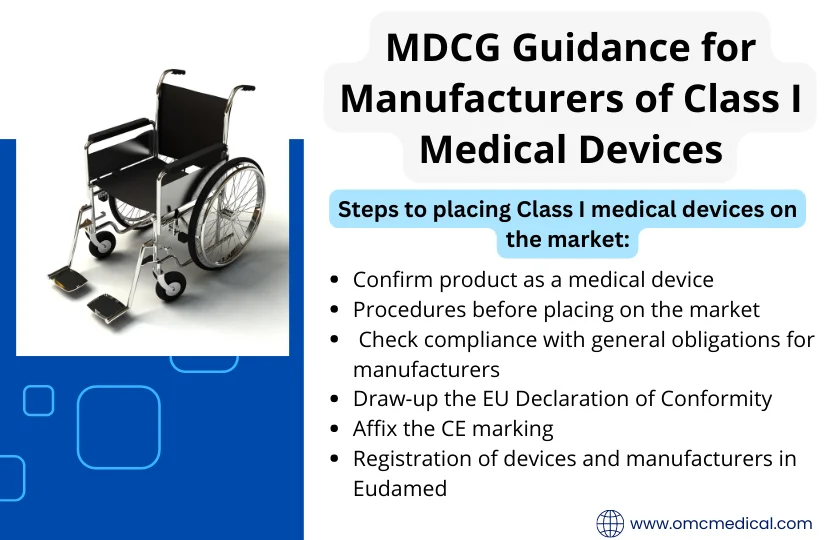
For additional context, see OMC Medical’s guide to MDR requirements for Class I medical devices.

Step 3: Select the conformity assessment route
Article 52 sets out the available routes for medical device conformity assessment. Select the route before finalizing the certification plan or contracting with a Notified Body.
For ordinary Class I devices, the manufacturer prepares the required documentation, establishes compliance and issues the declaration without routine Notified Body involvement. Self-declaration does not remove obligations for risk management, clinical evaluation or post-market surveillance.
For higher classes, common routes include:
Annex IX: Assessment of the quality management system and technical documentation, with review requirements determined by device class and relevant provisions.
Annex X combined with Annex XI: EU type-examination followed by the applicable production-conformity assessment, where permitted.
Applicable Annex XI routes for Class IIa: An alternative approach available under Article 52, subject to its specified documentation and assessment requirements.
For Class Is, Im and Ir devices, Notified Body involvement is restricted to the relevant aspects, rather than a full assessment of every design feature.
The route for CE marking for medical devices must match both the classification and the manufacturer’s production arrangements. Document that decision rather than relying on a supplier’s previous certificate or a competitor’s approach.
Step 4: Establish the quality management system and responsible roles
MDR Article 10 requires manufacturers to establish a quality management system proportionate to the device type and risk class. It should connect regulatory strategy with design controls, supplier management, production, complaint handling and corrective action.
ISO 13485 provides a widely used framework for medical-device quality management. However, an ISO 13485 certificate is not a substitute for MDR conformity assessment, and the MDR does not require every manufacturer to obtain a separate ISO 13485 certificate.
For CE marking for medical devices, the quality system must work in practice. Auditors can examine completed design reviews, supplier evaluations, validation records and corrective actions, not just procedures.
Identify the person responsible for regulatory compliance under Article 15 and ensure that the arrangement meets the applicable organizational and qualification requirements.
Manufacturers established outside the EU/EEA must also arrange an appropriately established EU Authorized Representative through a written mandate. The representative performs defined regulatory tasks but does not take over the manufacturer’s responsibility for device design and conformity. Identify importer responsibilities separately.
OMC Medical provides Authorized Representative and importer services for relevant market-access needs.
Practical output: An operational quality system, assigned regulatory responsibilities and applicable economic-operator agreements.
Step 5: Build technical documentation and demonstrate GSPR compliance
Annexes II and III define the core technical-documentation and post-market-documentation requirements. The file must explain the device, how it is manufactured and the evidence supporting its safety and performance.
A General Safety and Performance Requirements (GSPR) checklist should identify each applicable Annex I requirement, the method used to address it and the supporting evidence. For requirements judged inapplicable, provide a justification.
Depending on the product, evidence may include biocompatibility, electrical safety, electromagnetic compatibility, software verification, cybersecurity, usability, sterilization validation, packaging integrity and shelf-life testing.
The EU MDR requirements for medical devices are product-specific. A reusable instrument, an implant and a software application will not need identical test programs.
Successful CE marking for medical devices depends on traceability between claims, hazards, controls and verification results. OMC Medical’s CE Technical File support can help manufacturers organize the documentation required for this assessment.
Practical output: Controlled technical documentation with a complete GSPR evidence map and justified applicability decisions.
Step 6: Complete risk management and clinical evaluation
Risk management should run throughout development and continue after commercialization. ISO 14971 provides a recognized framework for identifying hazards, estimating and evaluating risks, implementing controls and monitoring their effectiveness.
Connect the risk-management file to design verification, usability engineering, labeling and clinical evaluation. A warning in the instructions for use should not replace a feasible design-based risk control.
Clinical evaluation under Article 61 and Annex XIV must support the device’s intended purpose and claims. Identify relevant clinical data, appraise its quality and explain whether the combined evidence is sufficient. Bench testing alone does not automatically establish clinical performance.
Clinical investigations are not mandatory for every device. However, implantable and Class III devices face specific requirements and limited exceptions. Equivalence claims also require substantiation and adequate access to the necessary data.
CE marking for medical devices requires a defensible explanation of evidence gaps and how they will be resolved. Prepare a post-market clinical follow-up (PMCF) plan, or justify why PMCF is not applicable, rather than using future follow-up to excuse missing premarket evidence.
Step 7: Complete Notified Body assessment where required
Choose a Notified Body designated under the MDR for the relevant device types and assessment activities. Check its designation and scope in the European Commission’s Notified Bodies database, not simply whether it offers general certification services.
Confirm the application requirements, device grouping, audit arrangements and technical-documentation submission expectations. The assessment may include quality-system audits, technical-documentation review and additional procedures applicable to particular device categories.
When reviewers raise findings, respond with controlled evidence. Updating one report may also require changes to the risk file, clinical evaluation, labeling or quality procedures.
For CE marking for medical devices involving a Notified Body, certification is a substantive assessment, not an administrative purchase. Budget for testing gaps, audit findings and review cycles rather than assuming submission guarantees certification.
Practical output: Applicable MDR certificates and closure of assessment findings. For eligible self-declared Class I devices, retain the manufacturer’s documented compliance review instead.
Step 8: Sign the declaration and affix the CE mark
Once the applicable assessment is complete and conformity is established, prepare the EU Declaration of Conformity under Annex IV. The manufacturer assumes responsibility by signing it.
The declaration identifies the manufacturer and, where applicable, the Authorized Representative. It also includes the device identification, Basic UDI-DI, risk class, applicable legislation and relevant Notified Body and certificate details.
Do not confuse this document with a test report, ISO certificate or Notified Body certificate. Each serves a different purpose.
Affix the CE mark according to Article 20 and Annex V. It must be visible, legible and indelible on the device or sterile packaging where possible and appropriate, and appear in the instructions for use and sales packaging as required. Where a Notified Body participates in the applicable assessment, its identification number accompanies the mark.
The final release check for CE marking for medical devices should also confirm labeling languages, economic-operator details, applicable UDI requirements and registration obligations. The Basic UDI-DI is a regulatory identifier, not the UDI carrier printed on a product label.
Step 9: Maintain compliance after market entry
Market release begins the continuing compliance phase. Operate the post-market surveillance system, evaluate complaints, report qualifying serious incidents and manage field safety corrective actions when required.
Keep risk management, clinical evaluation and technical documentation current. Class I devices require a post-market surveillance report, while Classes IIa, IIb and III require periodic safety update reports under the applicable rules.
Complete the EUDAMED registrations required under the applicable module rollout and check any remaining national obligations. Assess proposed changes before implementation, including whether Notified Body notification or approval is necessary.
If relying on a legacy-device transition, assess eligibility separately under Article 120 as amended. Transitional arrangements are conditional and do not replace the full MDR pathway described here.
What common mistakes delay certification?
Many delays arise because documents are developed separately and contradict one another. CE marking for medical devices is easier to assess when the intended purpose, clinical claims, risk controls and labeling tell the same technical story.
Common problems include:
Unsupported classification: Selecting a class without a documented Annex VIII analysis.
Overstated claims: Advertising benefits that the clinical evaluation does not substantiate.
Incomplete evidence mapping: Listing standards without connecting reports to applicable GSPRs.
Misunderstood certificates: Treating ISO 13485 certification or component test reports as device-level MDR conformity.
Late supply-chain planning: Failing to define Authorized Representative, importer or critical-supplier responsibilities.
Weak change control: Modifying software, materials or manufacturing processes without assessing regulatory impact.
Before submission, conduct a cross-document review using one representative device configuration. Check that product names, versions, intended users, contraindications and performance specifications agree throughout the file.
Manufacturers also planning US market access should treat that pathway separately. OMC Medical’s guide to CE Marking vs FDA Clearance explains why one market’s authorization does not replace the other’s requirements.
Plan a documented route to EU market access
CE marking for medical devices requires a consistent, evidence-based pathway from intended purpose and classification to assessment, declaration and ongoing surveillance. Resolving classification questions and evidence gaps early helps manufacturers avoid preventable rework.
Contact OMC Medical for support with product classification, technical documentation, Authorized Representative services and the regulatory steps relevant to your device.