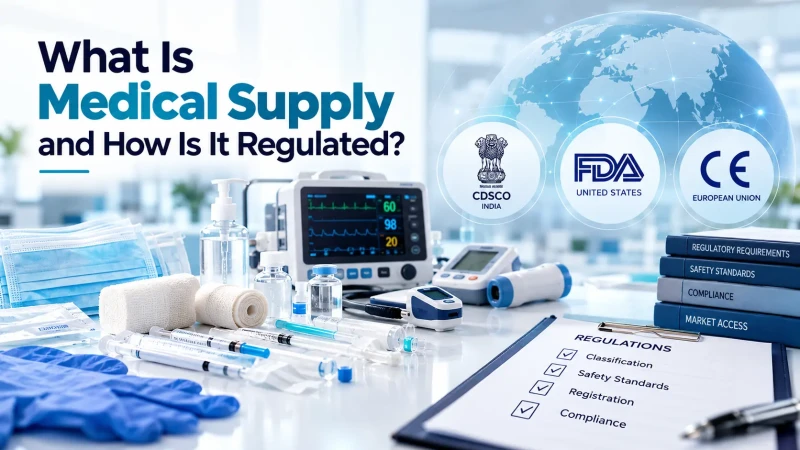
Medical supply is a broad term for the products used to diagnose, prevent, monitor or treat illness and injury, from syringes and wound dressings to infusion pumps and diagnostic software. In most markets, these products are regulated as medical devices, so they cannot simply be made, imported or sold without meeting defined legal requirements.
For manufacturers, importers and distributors, understanding how medical supply is regulated is the first step towards market access. The rules differ by country, but the logic is shared: classify the product by risk, show that it is safe and performs as intended, and keep it compliant after launch.
This guide explains what medical supply means, the main types of medical supplies, how India, the United States and the European Union regulate them, and the steps involved in getting a product authorized.
What Is Medical Supply?
Medical supply refers to the products, materials and equipment used in healthcare to diagnose, prevent, monitor, treat or alleviate a disease, injury or disability. Regulators generally place most of these products under the term "medical device".
Ready to Streamline Your Regulatory Compliance?
Join hundreds of companies who trust OMC Medical for their regulatory needs. Get expert guidance and ensure compliance across all markets.
Call Now +44 208 066 7260What matters legally is a product's intended purpose, not the name it is sold under. A product marketed for a medical purpose is likely to fall under medical device rules, even if it is described as a general supply.
How medical supplies differ from other healthcare products
Pharmaceuticals: Medicines work mainly through pharmacological, immunological or metabolic action. A medical device does not achieve its main intended effect this way, although it may be assisted by such action.
Cosmetics: Products meant to cleanse, protect or change appearance follow separate cosmetic rules.
Food supplements: Oral products that add to the diet are regulated separately from devices.
Borderline products: Some items sit between categories, so the classification should be confirmed with the relevant authority before launch.
What Are the Types of Medical Supplies?
Medical supplies cover a wide range of products. Grouping them helps show which rules and evidence requirements are likely to apply.
Disposable supplies: Single-use items such as gloves, syringes, needles, dressings, catheters and masks. Sterility, packaging and shelf life are common regulatory concerns.
Reusable equipment: Surgical instruments, stethoscopes, wheelchairs and endoscopes. Validated cleaning, disinfection and sterilization instructions are a key focus.
Diagnostic devices: Test kits, reagents and analyzers, known as in vitro diagnostics (IVDs). Many regions regulate them under dedicated frameworks, such as the EU's Regulation (EU) 2017/746 (IVDR).
Active devices: Powered products such as infusion pumps, ventilators, patient monitors and imaging systems. Electrical safety, software and alarms matter most here.
Implants: Stents, joint replacements and pacemakers. Long-term contact with the body usually means the strictest controls.
Medical software: Standalone applications and algorithms that meet the definition of a device, often called Software as a Medical Device (SaMD), as well as software built into other devices.
Why Are Medical Supplies Regulated?
Medical supplies regulations exist because these products are used on or in people who are often vulnerable, and a failure can cause serious harm. Regulation serves three main purposes.
Patient and user safety: Manufacturers must identify risks, reduce them as far as possible and show that the benefits outweigh what remains. This protects patients, clinicians and carers alike.
Product quality and performance: Controlled design, consistent manufacturing and evidence for performance claims help ensure every unit behaves as intended.
Regulatory oversight and traceability: Authorities need to know who makes, imports and sells a product so they can act on complaints, recalls and safety notices.
Because risk varies widely, most systems apply stricter controls to higher-risk devices instead of treating every product the same way.
How Are Medical Supplies Regulated in Different Countries?
India, the United States and the European Union all classify devices by risk, but their authorization routes differ. The table summarizes the main points; always confirm the current position with the relevant authority.
.Beyond these headline differences, each market also has its own labelling, language and local-representation rules, so one global approach rarely works. OMC Medical publishes market guides for India, the USA and Europe.
What Are the Medical Supply Regulatory Requirements?
Details vary by market, but medical supply regulatory requirements usually cover five areas.
Classification
A device is assigned a risk class based on its intended purpose, how invasive it is, how long it contacts the body and whether it is powered. The class drives everything else, including the evidence needed and the review route. Because classification rules differ by country, the same product can fall into different classes in different markets.
Technical documentation
Manufacturers must compile evidence that the device is safe and performs as claimed. This normally includes the device description and intended use, design and manufacturing information, a risk management file, verification and validation results, and clinical evidence proportionate to the risk. In the EU, the required content is set out in Annexes II and III of the MDR.
Labelling and instructions for use
Labels and instructions must identify the manufacturer and product, state the intended purpose, and give warnings and directions for safe use. Many markets require the local language and, where applicable, unique device identification (UDI), as in the US and EU.
Quality management system
Manufacturers must run a documented quality system that controls design, production, suppliers, complaints and corrective action. The standards used to build and audit it are covered in the next section.
Applicable authorization
Depending on the country and class, the outcome may be a licence, clearance, approval, certificate or listing. Many markets also require a local representative or importer, such as an EU authorized representative for manufacturers based outside the EU.
Which Medical Supply Safety Standards Apply?
Standards describe recognized ways to demonstrate safety and performance. They are often voluntary, but regulators commonly accept them as a route to compliance. Under the EU MDR, devices that conform to harmonized standards are presumed to meet the requirements those standards cover, and India's Medical Devices Rules refer to BIS standards first, then ISO or IEC standards where no Indian standard exists.
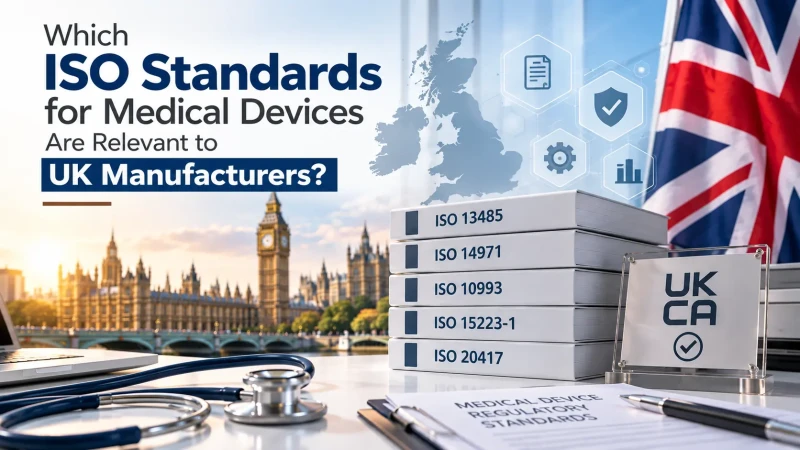
ISO 13485: The quality management standard for medical devices. It covers design, production, traceability and servicing, and it is incorporated by reference into the FDA's QMSR.
ISO 14971: The risk management standard. It sets out how to identify hazards, evaluate and control risks, and review production and post-production information across the product lifecycle.
Product-specific standards depend on the device. Common examples include:
IEC 60601-1 series: Basic safety and essential performance of electrical medical equipment.
IEC 62304: Software lifecycle processes for medical device software.
ISO 10993 series: Biological evaluation of materials that contact the body.
ISO 11607: Packaging for terminally sterilized devices.
IEC 62366-1: Usability engineering.
Which standards apply depends on the device, its intended use and the market. Record the edition of each standard used and why it applies.
How Can Businesses Maintain Medical Supply Compliance?
Authorization is not the end of the process. Medical supply compliance is an ongoing obligation for manufacturers, and often for importers and distributors too.
Track regulatory change: Rules and deadlines move. The FDA's QMSR took effect on 2 February 2026, and India phased in licensing by risk class. Give someone ownership of monitoring updates in each market, including new editions of the medical supply safety standards you rely on.
Control changes: Assess changes to design, suppliers, labelling or manufacturing sites against your existing approval. Some changes need notification or a new submission.
Keep complete records: Technical documentation, quality records, distribution records and complaint files should be organized and retrievable for audits or inspections. Retention periods vary by market, so follow local requirements.
Run post-market surveillance: Collect and review real-world performance and safety data, and report serious incidents or adverse events within the timelines each authority sets, such as medical device reporting in the US.
Maintain registrations and certificates: Keep establishment registrations, device listings, licences and UDI data current. US establishment registration is annual, and EU notified body certificates have a limited validity of up to five years.
Audit regularly: Internal audits, supplier checks and management review show gaps before an authority does.
What Is the Medical Supply Registration Process?
The exact route depends on the market, but medical supply registration generally follows these steps.
Confirm the product is a medical device. Check its intended purpose against the definition in each target market.
Classify the device. Apply the market's classification rules and document the rationale.
Identify the authorization route. For example, a CDSCO licence in India, a 510(k), De Novo or PMA submission in the US, or CE marking through conformity assessment in the EU.
Arrange local representation if required. This may be an EU authorized representative or an Indian import licence holder.
Prepare the technical file and quality system evidence. Align both with the requirements of the chosen route.
Submit the application or complete conformity assessment. Submissions go to the authority's portal or, in the EU, to a notified body where one is required.
Respond to questions and inspections. Authorities may request more information or inspect the manufacturing site.
Complete post-authorization steps. These can include registration, listing, UDI data and final labelling, followed by ongoing compliance duties.
Timelines and fees depend on the authority, the device class and the quality of the submission, so plan them market by market. No outcome can be guaranteed in advance.
How Can OMC Medical Help?
OMC Medical is a regulatory affairs consultancy for medical devices and IVDs, pharmaceuticals, cosmetics and food supplements. The company holds ISO 13485:2016 and ISO 17100:2015 certifications and has branches across Europe, Asia, the Middle East and the Americas. For medical supply businesses, relevant support includes:
Product classification to determine the correct regulatory category for a device or software.
Technical documentation that demonstrates safety and performance.
ISO 13485 and QMS support to build and maintain a compliant quality system.
Product registration for market entry.
Authorized representative services for manufacturers who need a legal representative in another market.
Post-market surveillance and vigilance to monitor product performance and safety after launch.
Conclusion
Medical supply spans everything from disposable consumables to implants and software, and each product must be shown to be safe and effective before and after it reaches patients. India, the United States and the European Union differ in process, but all three follow a risk-based approach: classify, document, authorize, then monitor.
Businesses that understand the rules early avoid delays later. Classify accurately, build the evidence and quality system around recognized standards, and plan for post-market duties from the start.
If you are preparing to enter a new market, contact OMC Medical to discuss your product and the authorization route that fits it.