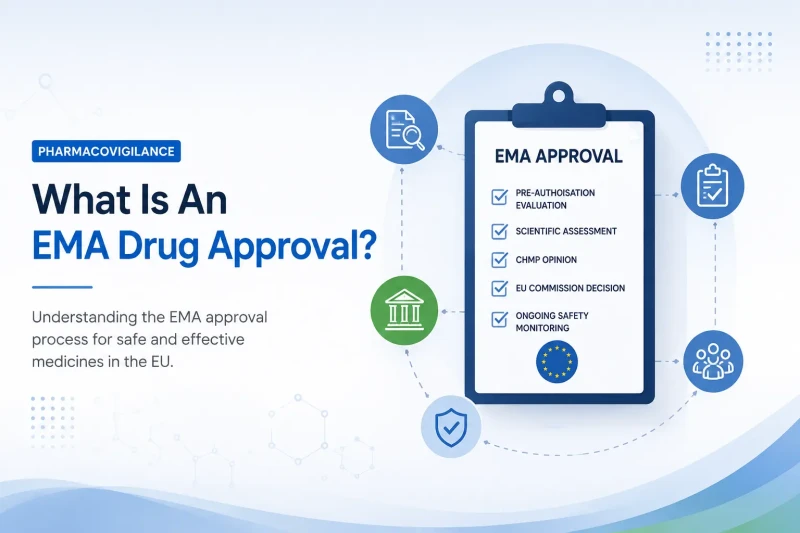
If you are asking what is an EMA drug approval, the practical answer is this: it is the EU regulatory pathway through which a medicine is scientifically assessed by the European Medicines Agency and, where the outcome is positive, granted a legally valid marketing authorisation by the European Commission.
In day-to-day industry language, people often say a medicine is “EMA approved.” Strictly speaking, the EMA does not issue the final legal approval for centrally authorised medicines. The EMA coordinates the scientific evaluation, primarily through its Committee for Medicinal Products for Human Use, known as the CHMP. The European Commission then makes the legally binding decision on whether the medicine can be placed on the market across the European Union.
Ready to Streamline Your Regulatory Compliance?
Join hundreds of companies who trust OMC Medical for their regulatory needs. Get expert guidance and ensure compliance across all markets.
Call Now +44 208 066 7260This distinction matters for pharmaceutical companies, biotech companies and regulatory affairs teams because EU market access depends on both the quality of the scientific dossier and the formal marketing authorisation decision.
The European Medicines Agency evaluates medicines for human and veterinary use. For human medicines, its work includes assessing applications for new medicines, monitoring safety after authorisation, coordinating scientific advice and supporting harmonised standards across the EU medicines regulatory network.
What Is EMA Drug Approval?
EMA drug approval refers to the regulatory process used to assess whether a medicine has a positive benefit-risk balance and can be authorised for use in the EU. The process is especially relevant for medicines submitted through the centralized authorisation procedure, where a single application can support access across EU Member States and, through related arrangements, the wider EEA where applicable.
In the pharmaceutical industry, “EMA” stands for European Medicines Agency. When professionals ask what is EMA in the pharmaceutical industry, they are usually referring to the agency’s role in coordinating scientific assessment, supporting regulatory guidance and overseeing post-authorisation safety activities within the EU medicines framework.
A related concept is marketing authorisation. In pharma, marketing authorisation is the formal legal permission to place a medicinal product on the market for a defined indication, patient population, dosage form, strength, route of administration and set of conditions. It is not only a commercial milestone. It defines the approved product information, risk management obligations and post-authorisation commitments that shape the product’s lifecycle.
For centrally authorised products, the EMA’s CHMP issues a scientific opinion. The European Commission then adopts the final decision. A positive CHMP opinion is therefore a critical milestone, but it is not the same as the final Commission marketing authorisation.
How Does the EMA Drug Approval Process Work?
The EMA drug approval process is structured, evidence-driven and highly dependent on regulatory planning before the formal application is submitted. Although each product has its own scientific and procedural considerations, the main stages are broadly consistent for centralized marketing authorisation applications.
Pre-submission and regulatory preparation
Pre-submission preparation sets the foundation for a successful application. At this stage, companies define the regulatory strategy, confirm the appropriate legal basis, prepare the dossier and align internal teams on evidence requirements.
For many applicants, an EMA pre-submission meeting can help clarify procedural expectations before filing. These interactions may cover submission format, planned application timing, eligibility for the centralised route, rapporteur appointment procedures and other practical aspects of the application.
Preparation often includes:
● Confirming whether the centralised procedure is mandatory or optional for the product
● Planning the Common Technical Document, or CTD, structure
● Aligning quality, non-clinical and clinical modules
● Preparing product information and risk management documentation
● Reviewing pharmacovigilance system readiness
● Identifying potential major objections before submission
Good preparation does not eliminate regulatory questions, but it reduces avoidable procedural delays and dossier inconsistencies.
Marketing authorisation application
The marketing authorisation application, often called an MAA, is the formal submission requesting authorisation to place the medicine on the EU market. It contains the quality, safety and efficacy evidence needed to support the proposed use of the medicine.
The application is submitted in accordance with EU regulatory requirements and electronic submission standards. The content must support the claimed indication, proposed product information and benefit-risk position.
Scientific evaluation
After validation, the scientific evaluation begins. For human medicines in the centralised procedure, the CHMP leads the assessment, with appointed rapporteurs coordinating detailed review work.
The assessment considers whether the medicine is manufactured to appropriate quality standards, whether the safety profile is adequately characterised and whether clinical data demonstrate efficacy for the proposed indication. The committee also evaluates the overall benefit-risk balance.
Requests for additional information
During evaluation, the EMA may issue questions to the applicant. These questions can address gaps, uncertainties or points requiring clarification in the dossier.
Requests may relate to manufacturing controls, analytical methods, clinical trial interpretation, subgroup data, pharmacovigilance plans, risk minimisation measures or proposed product information. In many cases, the formal procedure includes clock stops that allow the applicant time to prepare responses.
The quality of these responses can strongly influence the outcome. A technically complete answer is not enough if it does not resolve the underlying regulatory concern.
CHMP opinion
At the end of the scientific evaluation, the CHMP adopts an opinion. A positive opinion indicates that the committee considers the medicine’s benefit-risk balance favourable for the proposed use, subject to the agreed conditions.
The CHMP opinion is forwarded to the European Commission. If the opinion is negative, the applicant may have procedural options such as requesting re-examination under applicable rules.
European Commission decision
The European Commission makes the final legally binding decision for centrally authorised medicines. A positive Commission decision results in a marketing authorisation that is valid across the EU.
This step is important because “EMA approval” is often used as shorthand, but the formal authorisation is granted by the Commission. Regulatory teams should use precise language in internal documents, investor communications and launch planning.
Post-authorisation safety monitoring
Authorisation is not the end of regulatory responsibility. After a product enters the market, the marketing authorisation holder must comply with pharmacovigilance, variation, renewal, safety reporting and lifecycle management obligations.
Post-authorisation activities may include periodic safety updates, risk management plan maintenance, post-authorisation safety studies, signal management, product information updates and regulatory submissions for variations.

What Is the Centralised Authorisation Procedure?
The centralised authorisation procedure is an EU route that allows a company to submit one marketing authorisation application for assessment by the EMA. If the European Commission grants authorisation, the medicine receives a single marketing authorisation valid across the EU.
This route is mandatory for certain categories of medicines, including many biotechnology-derived medicines, advanced therapy medicinal products, orphan medicines and medicines for specific therapeutic areas listed in EU legislation. It may also be available optionally for certain innovative medicines or products that meet EU criteria.
For businesses seeking EU market authorization, the centralised procedure can offer major strategic value. It avoids the need for separate national approvals in each Member State for eligible products and supports harmonised product information across the EU.
The centralised route also brings high expectations. The dossier must be robust enough for EU-level scientific scrutiny and companies must be prepared for coordinated questions across quality, safety, efficacy and risk management.
What Does EMA Evaluate Before Authorisation?
The EMA’s scientific evaluation focuses on whether the medicine should be authorised for the proposed indication and conditions of use. The assessment is not limited to clinical trial results. It examines the product across its full development and control framework.
Quality is especially important because a medicine’s clinical performance cannot be separated from how it is manufactured and controlled. Safety evaluation extends beyond adverse event tables and includes risk minimisation measures, warnings, contraindications and pharmacovigilance planning. Efficacy evaluation requires not only statistical significance but regulatory relevance to the proposed indication.
For complex products, such as biologics, advanced therapies, oncology medicines or products using novel mechanisms, the evidence package may require particularly careful alignment between development data and regulatory claims.
EMA Approval Process Timeline
The EMA approval process timeline varies by product, regulatory pathway, application quality, scientific complexity and the questions raised during assessment. Companies should avoid building launch plans around a single fixed calendar assumption.
For standard centralized marketing authorisation applications, the EMA describes the assessment as taking up to 210 active evaluation days, excluding clock stops when the applicant prepares responses to questions. The overall calendar time can be longer because clock stops, submission validation, committee scheduling, translation steps and the European Commission decision process all affect the final timeline.
Accelerated assessment may be available for certain medicines of major public health interest, subject to eligibility and agreement. Other pathways, such as conditional marketing authorisation or authorisation under exceptional circumstances, may apply in specific situations where EU legal criteria are met.
From a planning perspective, the most reliable approach is to develop a product-specific timeline that accounts for:
● Pre-submission interactions and internal dossier readiness
● Validation activities before the assessment starts
● CHMP assessment phases and potential clock stops
● Time needed to answer regulatory questions
● Opinion adoption and European Commission decision-making
● Launch preparation after authorisation
Regulatory affairs teams should also consider dependencies outside the EMA procedure, including manufacturing readiness, qualified person release, pharmacovigilance system activation, packaging, translations, pricing and reimbursement strategy.
EMA vs FDA
EMA vs FDA comparisons are common, especially for companies planning parallel EU and US submissions. Both agencies evaluate medicines using rigorous scientific standards, but their legal frameworks and decision-making structures differ.
The practical implication is that an FDA approval does not automatically allow a medicine to be marketed in the EU. Likewise, EU marketing authorisation does not replace US FDA approval. Prior regulatory decisions may help inform strategy, but each jurisdiction expects submissions that meet its own legal and scientific requirements.
Companies developing global regulatory plans should identify differences early, including comparator choice, clinical endpoint acceptability, pediatric obligations, labeling strategy, risk management expectations and CMC documentation.
EMA Marketing Authorisation Database and Approved Drugs
Regulatory professionals often need to verify whether a medicine is authorised, review public assessment information or track product information changes. Official EMA and European Commission resources are the best starting points.
The EMA provides a searchable medicines database that includes information on centrally evaluated medicines, including European public assessment reports, known as EPARs. EPARs can be useful for understanding the basis of a positive or negative assessment, authorised indications, risk management considerations and product information.
The European Commission also maintains the Union Register of medicinal products, which provides formal information on centrally authorised medicines and Commission decisions.
When people search for the EMA approved drugs list or an EMA marketing authorisation database, they are often looking for one of these official resources. These databases are useful for:
● Confirming authorisation status
● Reviewing authorised indications and product information
● Understanding assessment history through public documents
● Supporting competitor intelligence and regulatory benchmarking
● Tracking lifecycle changes for centrally authorised medicines
Professionals should rely on official sources rather than unofficial lists, especially when making regulatory, legal, investment or market access decisions.
Why EMA Approval Matters for Pharmaceutical Companies
EMA drug approval is a major milestone for companies seeking access to the EU pharmaceutical market. For eligible products, a positive centralised procedure outcome can support broad EU market access through one authorisation rather than separate national approvals.
The process also provides regulatory credibility. A positive CHMP opinion and Commission marketing authorisation indicate that the product has passed a detailed EU-level assessment of quality, safety, efficacy and benefit-risk balance.
For pharmaceutical and biotech companies, EMA authorisation affects several business-critical areas:
● EU launch planning and commercial readiness
● Regulatory compliance and lifecycle management
● Pharmacovigilance systems and safety governance
● Manufacturing and supply chain controls
● Product information, labeling and promotional boundaries
● Investor, partner and licensing discussions
The obligations continue after approval. Marketing authorisation holders must maintain compliance, submit variations where required, keep pharmacovigilance systems active and respond to emerging safety or quality issues.
A strong EMA strategy therefore begins long before the MAA is filed. It should connect clinical development, CMC, regulatory operations, pharmacovigilance, labeling, market access and commercial planning.
How OMC Medical Can Help
EU market authorization requires more than compiling a dossier. Companies need a regulatory strategy that fits the product, development stage, evidence package and intended commercial pathway.
OMC Medical supports pharmaceutical and biotech companies with regulatory consulting, regulatory strategy, pharmaceutical regulatory submissions, documentation support and marketing authorisation planning. This can include helping teams prepare for EU submission requirements, organise regulatory documentation, assess procedural considerations and manage submission-related activities.
For businesses preparing an EMA drug approval strategy or evaluating the centralized authorisation procedure, experienced regulatory support can help identify gaps early and reduce avoidable rework during the application lifecycle.