In vitro diagnostic devices sold in Saudi Arabia require a Medical Device Marketing Authorization (MDMA) from the Saudi Food and Drug Authority (SFDA) before market entry. IVD registration in Saudi Arabia goes through the GHAD electronic system, and foreign manufacturers must work through a licensed Saudi Authorized Representative unless they have a local entity.
For manufacturers familiar with EU IVDR or US FDA pathways, the Saudi framework is recognisable but has its own procedural rhythm. The process sits within the broader Saudi Arabia medical device registration system, yet IVDs carry specific classification, performance evaluation, and labeling expectations that generic device guidance often glosses over.
What the SFDA IVD Registration Pathway Actually Involves
The core sequence for IVD registration in Saudi Arabia is straightforward : classify the IVD, appoint a local representative if needed, ensure establishment licensing is in place, prepare the technical file, submit through GHAD, respond to reviewer queries, and receive the MDMA certificate.
Two separate requirements trip up many first-time applicants. The MDMA is the product approval. The Medical Device Establishment License (MDEL) is a separate establishment approval held by the manufacturer, the authorized representative, importers, and distributors. A valid MDEL does not replace an MDMA, and an MDMA does not remove the need for each establishment in the supply chain to hold its own license.
Ready to Streamline Your Regulatory Compliance?
Join hundreds of companies who trust OMC Medical for their regulatory needs. Get expert guidance and ensure compliance across all markets.
Call Now +44 208 066 7260SFDA IVD Classification: Classes A, B, C, D
SFDA classifies IVDs into four risk classes: A, B, C, and D. The applicable classification depends on the device’s intended purpose and the relevant SFDA classification rules.
Classification depends on intended use, the user, the consequence of a false result, and the population tested. A test used for blood donor screening can sit in a higher class than a similar assay used for routine monitoring.

SFDA IVD Registration Requirements: The Technical File
The SFDA IVD requirements centre on a complete technical file that supports the claimed intended use. Mandatory elements include:
Device description and intended purpose, with clear specification of the target population and testing environment
Risk management documentation following ISO 14971, applied specifically to the IVD’s failure modes
Performance evaluation covering analytical performance, clinical performance, and stability where relevant
Labeling and Instructions for Use in Arabic and English
Evidence of conformity to relevant standards, typically including ISO 13485 for the manufacturing quality system
SFDA reviewers expect the performance evaluation to be proportionate to the risk class. A Class A buffer does not need the same clinical evidence as a Class D blood screening assay, but every class needs documented justification for the claims made.
The Saudi Authorized Representative and Establishment Licensing
Foreign manufacturers without a registered local entity must appoint a Saudi Authorized Representative based in the Kingdom. The representative holds the MDMA on the manufacturer’s behalf, manages GHAD submissions, receives SFDA correspondence, and carries regulatory responsibility for the product in Saudi Arabia.
The relationship is not a formality. The authorized representative must hold a valid MDEL and must be able to provide the technical documentation to SFDA on request. Choosing a representative with genuine regulatory capability matters more than choosing one with the lowest administrative fee.
Labeling, IFU, and Saudi-Specific Requirements
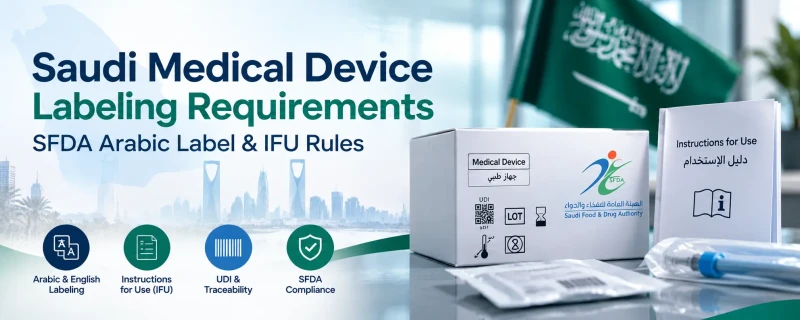
SFDA labeling requirements for medical devices apply to IVDs with additional language expectations. Labels and Instructions for Use must be provided in Arabic and English. The Arabic text must be accurate, not a loose translation, and must appear alongside the English rather than as a separate insert where the regulation requires bilingual presentation.
The SFDA e-IFU requirements allow electronic Instructions for Use in defined circumstances, subject to conditions around user access and risk justification. This is not an automatic option for every IVD; professional-use devices have more flexibility than self-testing products.
GHAD Submission and MDMA Timelines
The authorized representative submits the dossier through the GHAD portal. SFDA review commonly takes around 35 working days once the submission is accepted, but the end-to-end timeline from file preparation to MDMA issuance typically runs three to six months. Reviewer queries, incomplete performance data, and labeling corrections are the most common delays.
MDMA certificates are valid for up to three years. Renewal requires submission before expiry, with updated post-market data where applicable.
Unique Device Identification for IVDs
IVDs must comply with Saudi UDI requirements using GS1, HIBCC, or ICCBBA standards. The UDI must appear in the GHAD submission and on the device labeling as specified by SFDA. This requirement applies across risk classes, though implementation timing can vary by device type.
Practical IVD Registration Checklist
This condensed checklist covers the essential steps for Saudi Arabia IVD registration:
Confirm the IVD risk class using SFDA classification rules
Appoint a licensed Saudi Authorized Representative if no local entity exists
Verify MDEL status for manufacturer, representative, importer, and distributor
Compile the technical file: intended use, description, ISO 14971 risk management, performance evaluation, bilingual labeling and IFU
Prepare UDI data and verify labeling compliance
Submit through GHAD and monitor for reviewer queries
Respond to Agency Information Requests promptly, typically within the stated turnaround window
Receive the MDMA and confirm listing on the Medical Devices National Registry
Common Mistakes That Delay SFDA IVD Approval
The most frequent rejection reasons are avoidable. Submitting a technical file written for EU IVDR without adapting it to SFDA expectations is a recurring problem; Saudi reviewers want the same evidence, but structured for their review process. Incomplete Arabic labeling is another common query trigger. Underestimating the authorized representative’s role leads to communication delays when SFDA requests clarification.
Working with a regulatory partner such as omc medical can help manufacturers align the technical file with SFDA expectations before submission, reducing the back-and-forth that extends timelines.