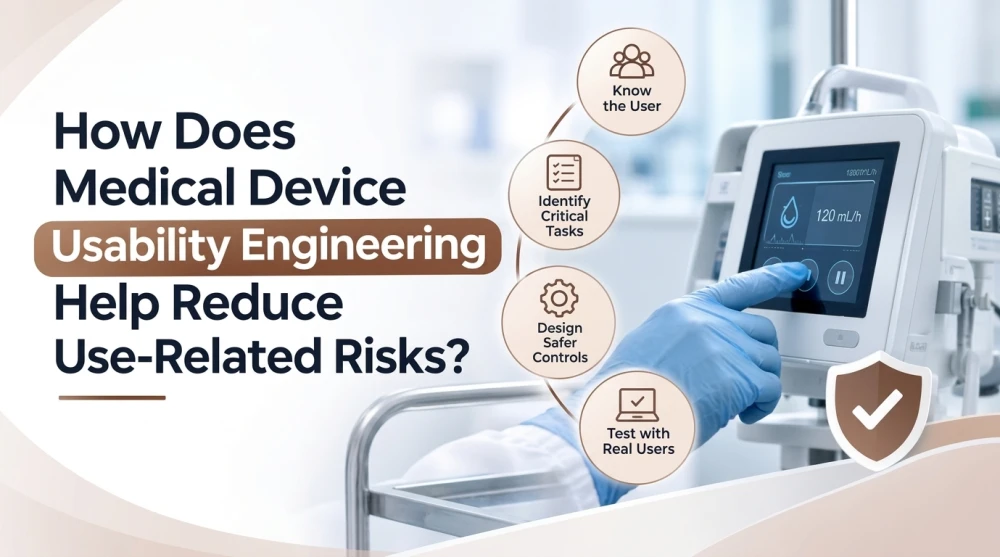
Medical device usability engineering reduces use-related risks by finding out who uses a device, what they actually do with it and where it can go wrong. The team fixes those weak spots, then tests the fixes with real users. The mindset is simple: a use error is a design problem to catch early, not a user failure to explain afterwards.
If you’ve been searching for human factors engineering medical devices guidance, you’re looking at the same discipline under another name. Below, we cover critical tasks, testing, how IEC 62366-1 and ISO 14971 fit together, and what FDA and EU regulators expect. It works best inside your wider medical device quality assurance system.
What Are Medical Device Use-Related Risks?
Medical device use-related risks arise when someone uses a device in a way the design didn’t anticipate or support. Nothing has to break. The harm comes from the interaction itself. Typical examples:
Misreading a dose or unit on a display
Connecting the wrong tubing or accessory
Skipping a priming or locking step
Silencing an alarm without understanding it
Following instructions that are vague or buried
The causes usually sit in the design: cluttered screens, look-alike connectors, unclear labels, poor lighting, constant interruptions. One point on scope: IEC 62366-1 covers correct use and use errors (normal use), not abnormal use.
Ready to Streamline Your Regulatory Compliance?
Join hundreds of companies who trust OMC Medical for their regulatory needs. Get expert guidance and ensure compliance across all markets.
Call Now +44 208 066 7260How Does the Process Work in Practice?
You describe the intended use, find the tasks that could lead to harm, design controls, and test them with representative users. Every stage feeds the risk management file, so usability evidence and safety evidence stay connected. You describe the intended use, identify tasks that could cause harm, design controls, and test them with representative users. Medical Device Usability Engineering keeps usability and safety evidence connected throughout the process.
Start With Users and Use Environments
Sound human factors engineering medical devices work starts with a use specification: the intended purpose, patient population, user groups and environment. Profiles should go beyond job titles. Think about training, experience, vision, dexterity, language, whether the user is a professional or a lay caregiver, and how stressed or rushed they might be. A nurse on a ward and a patient alone at home face very different risks.
Environment matters just as much. Lighting, noise, interruptions, gloves, cleaning and storage conditions all change how a device behaves in someone’s hands, so your test conditions should mirror them.
Pin Down the Critical Tasks
A critical task is any task that, if done wrongly or not at all, would or could cause serious harm to the patient or user, including compromised medical care. These tasks decide where your effort goes, because the validation study has to cover every one.
Teams typically find them through:
Task analysis of the full workflow, from unpacking to disposal
A use-focused risk analysis, such as an FMEA
Complaints, recalls and adverse event data for similar devices
Observing or interviewing current users
Write down why each task was or wasn’t classed as critical. Reviewers tend to question that reasoning, especially for tasks tied to therapy delivery.
Choose Risk Controls That Actually Work
Controls follow the ISO 14971 priority order: safety by design first, then protective measures, then information for safety such as labels and training. Applying Medical Device Usability Engineering principles helps manufacturers prioritise design-based risk controls rather than relying only on warnings and user training.
Most of the strongest controls live in medical device user interface design. Think keyed or colour-coded connectors, confirmation steps before irreversible actions, safe defaults, and clear display of units and alarms. Warnings and training have a role, but they’re the weakest option. If you can design the hazard out, do that.
Test Formatively, Then Validate
Formative evaluations are the iterative studies you run while the device is still taking shape: heuristic reviews, walkthroughs, small prototype sessions. They’re exploratory on purpose, because the goal is to find problems while changes are cheap. Good medical device user interface design usually emerges from several of these rounds, and every change should trace back to the risk it addresses.
What Is Human Factors Validation Testing?
Human factors validation testing, also called summative evaluation, is the final check that the finished design can be used safely and effectively by its intended users in realistic conditions. It isn’t where you discover new problems. By now the design should be stable. A solid study includes:
Participants who represent each intended user group
All critical tasks, done without coaching beyond what real users would get
Realistic simulated-use conditions and representative training
Root-cause analysis of every use error, close call and difficulty
A residual risk evaluation based on the results
FDA’s guidance recommends 15 participants per user group, which is why merging groups to save money can weaken a study.
How Do IEC 62366-1 and ISO 14971 Work Together?
They complement each other. ISO 14971 is the overall risk management process. IEC 62366-1 is the usability engineering process for the safety-related side of the user interface, and it feeds into that risk management. Amendment 1:2020 sharpened the link. It’s generally read as meaning usability results alone don’t decide whether a use-related risk is acceptable. That call belongs to the ISO 14971 process.
In practice, hazards found through usability work enter the risk analysis. Controls are chosen and verified, summative results show whether they work, and risk management judges what’s left. Medical device use-related risks shouldn’t live in a separate file from the rest of your analysis. Our guide to a medical device risk management plan shows how the plan frames this. By integrating Medical Device Usability Engineering into the overall risk management process, manufacturers can maintain traceability between identified use errors, implemented controls and validation results.

What Do FDA and EU Regulators Expect?
FDA
FDA’s main document is Applying Human Factors and Usability Engineering to Medical Devices, issued February 3, 2016. It contains non-binding recommendations, and FDA’s expectations for human factors engineering medical devices are set out mainly there: use-related risk analysis, critical tasks, mitigation and validation.
FDA has also finalised guidance on what to include in premarket submissions. Content of Human Factors Information in Medical Device Marketing Submissions was published on 28 May 2026. It applies to 510(k), De Novo and PMA submissions and uses submission categories to determine how much information to provide. Whether human factors validation testing data is expected depends on factors such as critical tasks and device history. Check the current text for transition dates, and talk to FDA if anything is unclear.
EU MDR
Usability evidence supports the Annex I general safety and performance requirements, which address use error, ergonomics and the knowledge and training of intended users. Manufacturers usually show this through the usability engineering file and risk management file, both part of the technical documentation. See our summary of EU MDR technical documentation requirements or our Technical Documentation service.
Standards and their harmonisation status change, so confirm the current list and your notified body’s expectations. A certified system helps keep the process consistent, and ISO 13485 and QMS Support can align design controls, risk management and usability records.
Does Usability Engineering Stop at Launch?
No. Real-world use reveals problems no study can fully predict. Complaints, service reports and vigilance data can all point to interface or instruction issues, and that information should flow back into the risk analysis. A structured Post-Market Surveillance and Vigilance system can surface patterns in medical device use-related risks that weren’t visible before launch.
A Quick Example
Imagine a hand-held injector with a dose window that’s hard to read in low light. Task analysis flags dose confirmation as critical. The team improves the display with larger numerals, higher contrast and a click for each dose step. Prototype sessions show the window works, but some users still misread the end-of-dose signal, so a clearer indicator is added. A summative study in simulated home conditions then confirms users complete the critical tasks, or documents any errors left. Risk management decides whether the residual risk is acceptable.
Strong medical device usability comes from that whole chain, not the final test alone. Better medical device user interface design made the difference at each step.
Common Mistakes to Avoid
Treating usability as a late-stage test
Defining critical tasks too narrowly
Recruiting participants who don’t match real users
Relying on warnings when a design change would remove the hazard
Keeping usability and risk files separate
Ignoring post-market data
A solid medical device quality assurance framework prevents most of these by tying usability work to design controls and review.
Conclusion
Usability engineering gives manufacturers a disciplined way to find and reduce the risks that appear when real people use real devices in real settings. Define the users and environments, focus on critical tasks, choose effective controls and validate with representative participants, and use errors to become a managed problem instead of a surprise.
It delivers the most when it works hand in hand with ISO 14971 and when the outputs stay traceable in your Technical Documentation. Human factors engineering medical devices programmes that start early, iterate often and continue after launch lead to safer designs and smoother reviews. Careful medical device user interface design, confirmed through human factors validation testing, remains one of the most practical ways to protect patients and users.
For global medical device companies navigating regulatory reviews, working with an authorized representative or partnering with a experienced regulatory affairs consultancy like OMC Medical ensures your usability documentation meets both FDA and EU Notified Body expectations. Specialized support for your medical device product registration and rigorous pharmaceutical product testing helps bridge the gap between human factors design and market approval. Contact OMC Medical to streamline your usability engineering strategy and international filings.