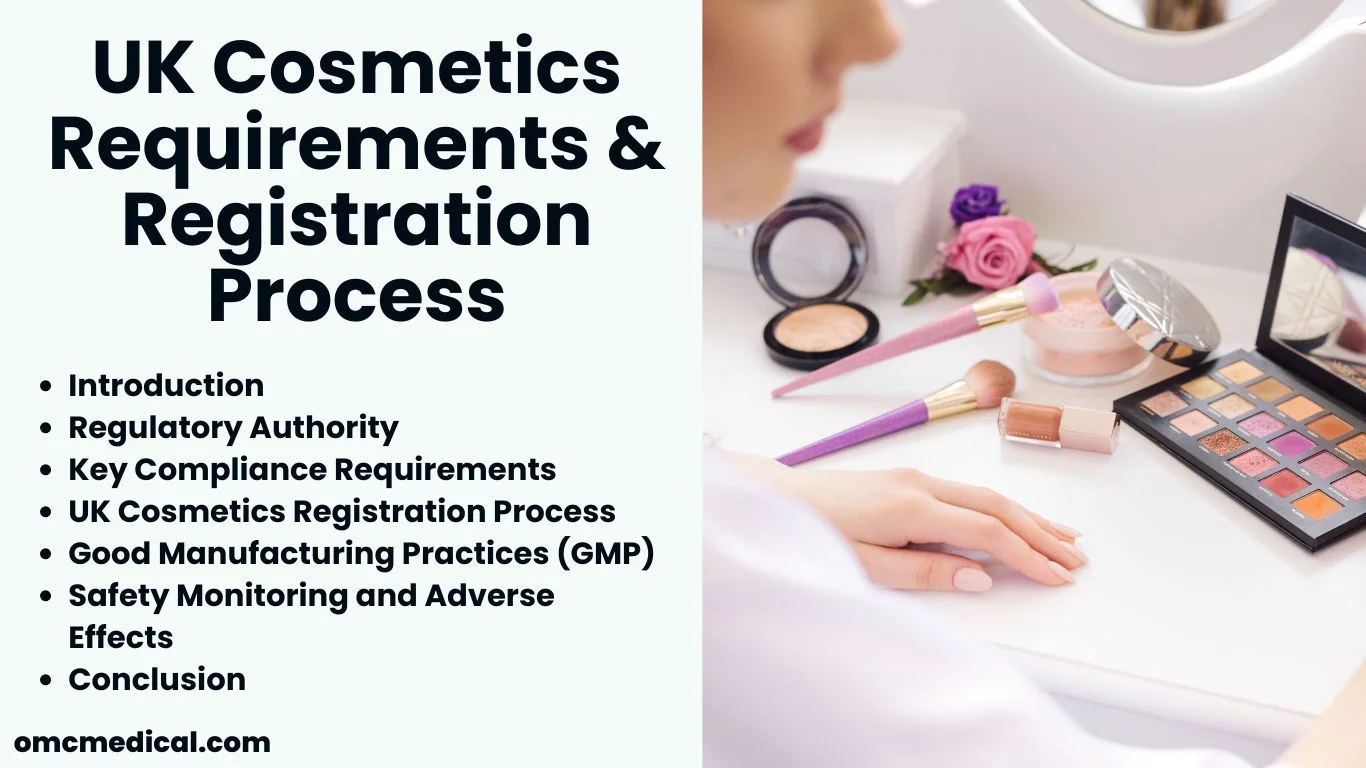
UK Cosmetic Registration: SCPN, the UK Responsible Person, and the 2026 Ingredient Deadlines
Since 1 January 2021, Great Britain (England, Scotland and Wales) and the European Union have operated separate cosmetic regulatory systems. Cosmetic products placed on the Great Britain market require a UK Responsible Person (UK RP) established in the UK, notification through the Submit Cosmetic Product Notification (SCPN) portal, and compliance with the UK Cosmetics Regulation (UKCR). Products placed on the EU or Northern Ireland market continue to follow the EU Cosmetics Regulation and require an EU Responsible Person and notification through the Cosmetic Products Notification Portal (CPNP).
The UK Responsible Person: A Mandatory, UK-Only Role
Every cosmetic product placed on the Great Britain market (England, Scotland, Wales) must have a UK Responsible Person (UK RP) established within the UK specifically. This isn't a role your existing EU RP can simply absorb: post-Brexit, the EU RP and UK RP are legally separate positions, and a brand selling into both markets needs both, appointed independently. There was no grace period when this requirement took effect on 1 January 2021 — products already in circulation needed a UK RP immediately, with no transitional buffer for existing stock.
The UK RP's responsibilities include: submitting the Submit Cosmetic Product Notification (SCPN), ensuring labelling complies with Article 19 of the UK Cosmetics Regulation (UKCR), maintaining the Product Information File (PIF), responding to safety-related queries from the Office for Product Safety and Standards (OPSS), and displaying their name and address on product labels.
SCPN: The UK's Own Notification Portal
The Submit Cosmetic Product Notification (SCPN) is the UK's national online notification system — administered by OPSS, accessed via a GOV.UK One Login. A CPNP notification from the EU side does not carry over to GB; it must be completed separately and specifically through SCPN. Required submission details include the product's category, physical form, packaging type, and name. Upon successful notification, you receive a unique SCPN notification number — the product's official UK market identifier — and a notification report in PDF format, useful for regulatory inspection purposes.
Ready to Streamline Your Regulatory Compliance?
Join hundreds of companies who trust OMC Medical for their regulatory needs. Get expert guidance and ensure compliance across all markets.
Call Now +44 208 066 7260Penalties for Non-Notification Are Real, Not Theoretical
This is worth taking seriously rather than treating as boilerplate legal language: failing to notify OPSS about a cosmetic product can result in a fine and a prison term of up to 3 months. In England and Wales, there's no upper limit on the fine; in Scotland and Northern Ireland, fines can reach £5,000. Selling an un-notified cosmetic is a genuine offence, not just an administrative gap.
Re-Notification for Pre-Brexit Products
If your cosmetic was already being sold in the UK before 31 December 2020, and you intend to continue marketing it after 1 January 2021, it must be re-notified through SCPN — your prior EU-system notification status doesn't automatically transfer or grandfather your product into the new UK system.
The Product Information File (PIF)
The PIF must be maintained and kept available for UK competent authorities, covering product details, manufacturing process, proof of efficacy, and a safety assessment report confirming the product's safety. SCPN notification should only happen once the product has been evaluated as safe — not before. Worth knowing for long-term compliance planning: the PIF has a 10-year expiry; if the product remains on the market beyond that point, a new evaluation is required to update it.
Labelling Documentation Must Be in English Only
A specific, easy-to-overlook distinction from the EU side: CPNP accepts submissions in any official EU language, but SCPN does not — all PIF documentation for the UK market must be in English specifically.
2026's Converging Ingredient Deadlines: Three Things Happening at Once
Several distinct compliance deadlines cluster in 2025–2026, each requiring formulation, documentation, and labelling action. Here they are in the correct order, with the statutory instrument behind each:
- 20 October 2025 - 2 March 2026: under SI 2024/1334 (the Cosmetic Products (Restriction of Chemical Substances) (No. 2) Regulations 2024), 64 additional CMR (carcinogenic, mutagenic, or reprotoxic) substances were added to Annex II. Different groups of these substances carry different sell-through cutoffs depending on when they were placed on the market substances with reference numbers 1680 – 1730 could continue being sold until 20 October 2025 if placed on the market by 20 April 2025; substances with reference numbers 1731 – 1743 could continue being sold until 2 March 2026 if placed by 2 September 2025. New placement after the relevant cutoff is not permitted.
- 31 December 2025: the transitional UK RP labelling provisions end. OPSS had extended this transitional allowance to a five-year period; if you've been relying on it for how your UK RP's address appears on labels, that flexibility runs out at year-end 2025, requiring final label updates to be in place by this date.
- 15 July 2026: under SI 2026/23 (the Cosmetic Products Regulation (EC) No 1223/2009 (Restriction of Chemical Substances and Transitional Provisions) Regulations 2026), two changes take effect together on this date
o A full ban on 4-methylbenzylidene camphor (4-MBC / enzacamene), a UV filter found in many sun care and leave-on products. It's removed from the list of permitted UV filters and added to the prohibited substances list. Products already legally on the market before this date may continue to be sold through until 14 January 2027 (an "off-shelf" date of 15 January 2027).
o The formaldehyde labelling threshold also drops on this same date, from the previous 0.05% limit to 0.001% — a substantial tightening. Products releasing formaldehyde above this new, much lower threshold require specific warning language ("contains formaldehyde").
2. 15 August 2026: also under SI 2026/23, a further and broader set of CMR substance prohibitions takes effect, adding 16 newly classified CMR substances (including TPO, clothianidin, and others) to the banned list.
Given how many of these deadlines cluster around mid-2026, manufacturers should build a transition calendar mapping every affected ingredient group against its specific placement and sell-through cutoff, rather than treating this as a single update applied uniformly across the product portfolio.
Why "EU-Compliant" No Longer Means "UK-Compliant"
This is worth stating plainly given how costly the assumption has proven for brands that got it wrong: the regulatory gap between Great Britain and the EU, narrow in 2021, has widened into a genuine dual-compliance burden by 2026. The UK has enacted independent substance bans, introduced its own allergen labelling thresholds, and imposed Responsible Person obligations with no direct EU equivalent. Brands that built their UK strategy assuming EU approval would serve as a reliable proxy for UK acceptance have been absorbing real costs from that miscalculation — delayed shelf space at best, criminal liability exposure at worst.
Northern Ireland Remains on EU Rules Entirely
Products placed on the Northern Ireland market continue following EU Regulation (EC) No 1223/2009 in full — EU Product Information File, CPNP notification, and an EU Responsible Person, not the UK system at all. A brand distributing across GB and Northern Ireland is, in practice, running both compliance systems in parallel, not a single unified UK approach.
Enforcement Is Active, Not Passive
OPSS, working alongside Trading Standards, can request PIFs, conduct market checks, and enforce stop-sale orders, withdrawals, or recalls for non-compliance — with particular current focus on imported cosmetics and products sold online. Brands need to be able to demonstrate traceability, timely reformulation where required, and accurate labelling on request, not just at the point of initial notification.
How OMC Medical Can Help
OMC Medical acts as UK Responsible Person for cosmetics manufacturers entering the Great Britain market, manages SCPN notification and PIF maintenance through its full 10-year validity cycle, and builds ingredient-specific transition calendars to track the converging 2025-2026 deadlines (RP labelling provisions, CMR substance bans, 4-MBC, and the tightened formaldehyde threshold) well ahead of each cutoff.