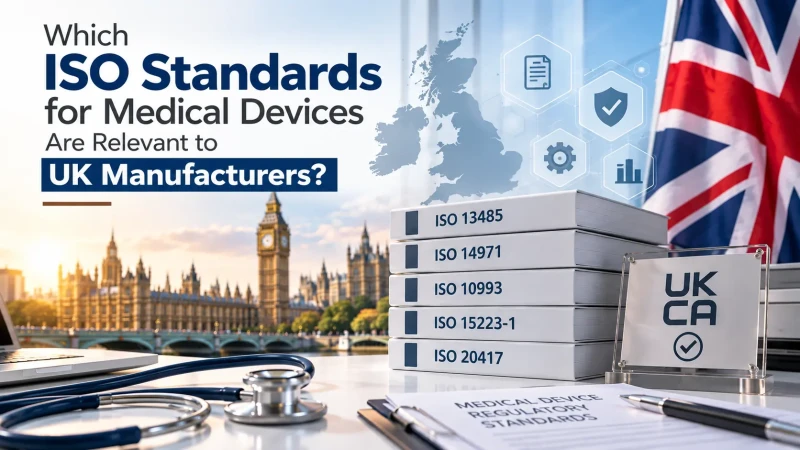
The core ISO standard for medical device manufacturers is ISO 13485, which sets out quality management system requirements specific to the design, production, installation, and servicing of medical devices. Supporting standards such as ISO 14971 for risk management, ISO 10993 for biological evaluation, and ISO 15223-1 for labelling symbols complete the essential framework. UK manufacturers must also align these with UK Medical Device Regulations and the UKCA marking regime.
For manufacturers navigating ISO 13485 and QMS Support, understanding which standards apply at each lifecycle stage prevents costly compliance gaps. The list below maps the standards that matter most in practice.
Standards That Apply Across the Device Lifecycle
ISO 13485: The Foundation for Medical Device ISO Certification
ISO 13485 is the internationally recognised standard for medical device quality management. It builds on ISO 9001 principles but adds regulatory-specific requirements such as documented procedures for design control, traceability, and post-market surveillance. Certification to ISO 13485 for medical devices is typically a prerequisite for placing products on the UK and EU markets.
The standard does not prescribe a specific QMS structure. It requires manufacturers to define processes, maintain records, and demonstrate that the system produces safe and effective devices. Auditors look for evidence that the QMS is live, not just a binder of procedures.
Ready to Streamline Your Regulatory Compliance?
Join hundreds of companies who trust OMC Medical for their regulatory needs. Get expert guidance and ensure compliance across all markets.
Call Now +44 208 066 7260
ISO 14971 Risk Management: A Continuous Obligation
ISO 14971 risk management is not a one-time exercise completed before product launch. It applies across the entire lifecycle, from initial concept through post-market surveillance and eventual decommissioning. The standard requires manufacturers to identify hazards, estimate risks, evaluate acceptability, and implement controls.
A common mistake is treating risk management as a separate document rather than integrating it with design and production decisions. Experienced manufacturers update the risk file whenever a complaint, nonconformance, or design change occurs.
The FDA and ISO Standards: What UK Manufacturers Should Know
The US FDA has historically used its own Quality System Regulation under 21 CFR Part 820. However, the FDA now incorporates ISO 13485 by reference through its Quality Management System Regulation, aligning US expectations more closely with international practice. For UK manufacturers exporting to the US, this reduces duplication but does not remove the need to understand FDA-specific requirements such as medical device reporting, supported by appropriate pharmacovigilance procedures.
UKCA Marking and Global ISO Requirements
Since leaving the EU, the UK has introduced UKCA marking for medical devices as the route to market in Great Britain. ISO standards remain central to demonstrating conformity. Meeting Global ISO Requirements helps manufacturers satisfy both UK and international regulators, but certification alone does not grant market access. Manufacturers must still complete conformity assessment with an approved body and, where applicable, appoint a UK Responsible Person.
Understanding UK Responsible Person requirements is essential for manufacturers based outside the UK who wish to place devices on the Great Britain market. The responsible person acts as the point of contact for the MHRA and holds technical documentation.Companies can also leverage an experienced authorized representative for seamless market entry.
Practical Steps for Implementation
Start with a gap analysis against ISO 13485 before writing or revising procedures. Identify which processes already exist informally and formalise them without over-engineering. Engage notified or approved bodies early, especially for higher-risk device classes. Keep the risk management file and technical documentation aligned, since auditors increasingly check consistency between them.
For specific questions about conformity assessment, device classification, or UKCA marking timelines, contact OMC Medical for tailored guidance.
Ready to Get Started?
Ensuring your medical products meet standards, navigate regulations, and gain market access smoothly. Contact OMC Medical for dedicated medical device registration support.