
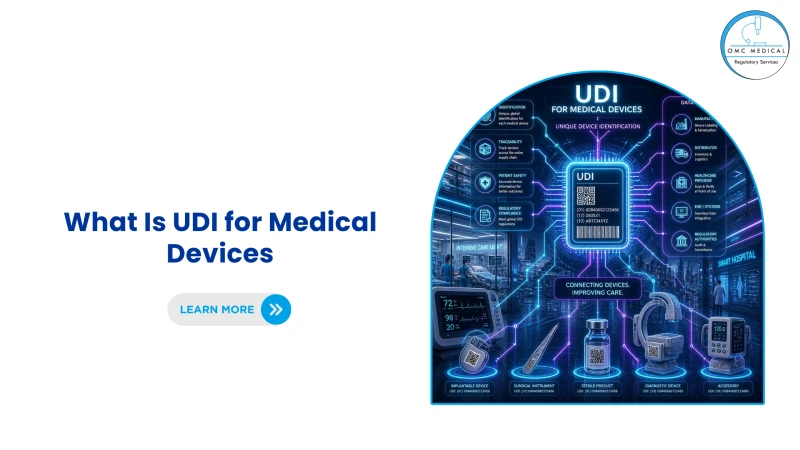
A barcode on a medical device package can look like a string of numbers with little meaning to the person holding it. But that code can help identify the device model—and, when production details are included, the batch or individual unit it came from.
That is the purpose of UDI, or Unique Device Identification. UDI gives medical devices a structured identity that can be used on labels, packaging, and in regulatory databases. It can support identification and traceability from manufacturing through distribution and use.
The basic idea is straightforward:
- UDI-DI: Which device model or version is this?
- UDI-PI: Which production batch or unit is this, when production details are included?
The rules for assigning and using UDI vary by market. A code, label, or database entry that meets one jurisdiction’s requirements should not automatically be assumed to satisfy another’s. FDA and EU rules, for example, each define UDI requirements within their own regulatory systems.
What does UDI mean for a medical device?
UDI refers to an identification system for medical devices. It combines an identifier placed on a device label or package with related device information held in the applicable database.
You can think of a UDI as an address for product information. The code helps point to a device record, while other details—such as the product name, manufacturer, model, or regulatory information—provide context about the device.
A UDI system can help:
- Identify a device model or version
- Link a product to information in a regulatory database
- Distinguish production batches or individual units when PI information is included
- Support inventory checks, complaint investigations, and recall activities
- Help healthcare providers and distributors handle device information more consistently
UDI is an identification and traceability tool. A UDI by itself does not show that a product is approved, cleared, certified, or suitable for every intended use. Manufacturers must still meet the market authorisation, safety, quality, and labeling requirements that apply to the device.
UDI-DI vs UDI-PI: what is the difference?
A UDI has two key parts: the Device Identifier (DI) and the Production Identifier (PI). They answer different questions.
The DI is the fixed part. It identifies the labeler and a specific device model or version. The PI is variable production information, when included. Depending on the device and applicable requirements, it can identify a lot or batch, serial number, manufacturing date, expiry date, or another specified production detail. FDA describes the DI as mandatory and the PI as conditional. See the FDA UDI basics.
A simple example
Suppose a manufacturer makes the same model of patient monitor in three production batches.
- Each monitor model has a UDI-DI identifying that model.
- Each batch may have a different UDI-PI, such as its lot number.
- If individual units are serialised, each unit may have its own serial number within the PI.
The DI lets someone identify the model. The PI can help narrow the identification to a particular production batch or unit. This distinction is useful when a manufacturer investigates a quality issue affecting only one lot.
The example is conceptual. Actual UDI formats and the details encoded in a UDI depend on the issuing system and the applicable market requirements.
What information can appear in a UDI-PI?
The PI can include one or more production details, depending on the applicable rules and how the device is manufactured and controlled. Common examples include:
- Lot or batch number: Links a device to a defined production batch.
- Serial number: Identifies an individual device.
- Expiry date: Indicates the date after which the device should not be used, where applicable.
- Manufacturing date: Identifies when the device was produced, where applicable.
- Software identification: May be relevant for certain software devices or configurations.
The PI is not a generic “extra code.” Its content needs to match the manufacturer’s production and traceability records. If a lot number is printed on the label, for example, the manufacturer should be able to connect that number to the relevant production records.
How to read a UDI label
A UDI can be presented in human-readable text and in a machine-readable form, such as a barcode. FDA calls the machine-readable format automatic identification and data capture, or AIDC. Under FDA requirements, applicable labels and packages generally need both forms.
A label may include several elements close together:
- Device name or product description — tells a person what the product is.
- Model or catalogue reference — may help distinguish a product configuration.
- Human-readable UDI text — allows a person to read the encoded identifier.
- Barcode or other machine-readable carrier — allows a scanner or electronic system to capture the code.
- Production details — such as lot number, serial number, or expiry date, where applicable.
- Other required label information — the applicable regulations may require additional details, symbols, or statements.
The barcode is not the UDI itself. It is a way to carry the UDI information so it can be scanned. The human-readable text provides another way to access the information.
Illustrative label example
The following is a simplified example, not a real device identifier or a complete regulatory label:
Product: Patient Monitor
Model: PM-200

UDI (human-readable):
[device identifier] [lot number] [expiry date]

Machine-readable carrier:
[barcode containing applicable UDI data]
The code structure and label layout will vary depending on the issuing system and market. Do not copy this sample onto a real product label.
For US device labels and packages, FDA specifies a standard date presentation format of YYYY-MM-DD. The actual label must still be checked against the applicable FDA requirements and any relevant exceptions or alternatives. See the FDA UDI basics.
Is UDI the same as a barcode, serial number, or product code?
These terms are related, but they do not mean the same thing.
A product may have a model number and a UDI-DI, but they are not automatically interchangeable. Likewise, printing a barcode on a package does not by itself show that the device has a compliant UDI.
What is the EU Basic UDI-DI?
The Basic UDI-DI is an additional identifier used in the EU regulatory framework. It helps link devices with related regulatory information, such as certificates, declarations of conformity, technical documentation, and EUDAMED records.
It is important to distinguish it from the UDI-DI and UDI-PI:
The European Commission describes the Basic UDI-DI as a main key in the database and relevant documentation. It is a separate concept from the UDI-DI and UDI-PI used in the UDI system. See the European Commission’s UDI information.
This distinction matters during EU registration and documentation. A manufacturer should not assume that the Basic UDI-DI is the barcode value to print on the device label.
What information is stored in a UDI database?
A database links an identifier with device information. The exact data fields and submission rules vary by market.
In the United States, the FDA’s Global Unique Device Identification Database (GUDID) is a reference catalog for devices with UDIs. FDA says GUDID stores the DI portion of the UDI, along with device information. It does not store the PI values themselves, although it contains flags that indicate which PI attributes are included in the UDI. The public can search device information through AccessGUDID. See the FDA’s GUDID information.
In the EU, the UDI system includes a database, and the manufacturer is responsible for assigning UDI information and submitting relevant device information before placing a device on the market, subject to the applicable rules. The EU also uses the Basic UDI-DI to connect device information across regulatory records.
So, a UDI database is not necessarily a batch-by-batch record of every device produced. For example, FDA states that GUDID does not contain the PI values. Manufacturers still need internal records to trace production details such as lots or serial numbers.
How does UDI support traceability?
UDI helps connect device identity with production and distribution records. When a hospital or manufacturer scans a code, the information available depends on the code, the scanning system, and the databases or internal records connected to it.
For example, if a complaint concerns a particular device, a manufacturer may need to determine:
- Which device model was involved?
- Which batch or serial number does the label show?
- Which production records correspond to that identifier?
- Were other devices from the same batch distributed?
- Does the issue require investigation, corrective action, or a recall?
UDI can support these questions, but it does not replace the manufacturer’s quality-management, complaint-handling, or post-market surveillance processes. The code only helps when it is assigned correctly, printed legibly, scanned accurately, and connected to reliable records.
Do UDI requirements apply the same way in every country?
No. UDI requirements vary across jurisdictions. Differences can include:
- Which issuing agencies or coding systems are accepted
- Which device classes or products are in scope
- Which packaging levels need a UDI carrier
- What device information must be submitted to a database
- When requirements apply
- Whether an exemption or alternative is available
For example, FDA requirements include a UDI on applicable device labels and packages and submission of device information to GUDID. EU rules also require UDI assignment and label placement, and include the Basic UDI-DI in the regulatory framework. These systems share the aim of device identification, but they are not identical.
Before using a UDI approach for a product launch, manufacturers should check the specific rules for each target market. Avoid relying on a general “global UDI checklist” without confirming local requirements.
What should manufacturers check before applying a UDI?
A UDI project involves more than obtaining a code. The code, label artwork, production data, and database submission need to match.
1. Confirm the device and its configurations
List the device models, versions, and relevant configurations that will be placed on the market. Check whether different package quantities or configurations require separate identifiers under the applicable rules.
2. Select an accepted issuing system
Confirm which UDI issuing agencies are accepted in the market and which system fits the company’s product and data needs. The FDA directs labelers to an FDA-accredited issuing agency to develop a UDI. See the FDA UDI basics.
3. Define production identifiers
Decide which production data—such as lot, serial number, manufacturing date, or expiry date—will be encoded or presented, as required. Make sure the information corresponds to controlled production records.
4. Review the label and barcode
Check that the human-readable text and machine-readable carrier are present where required, legible, and consistent with each other. Confirm that the barcode can be scanned under expected handling conditions.
5. Align database and product records
Check that the device name, model, manufacturer details, and UDI-DI match across the label, database entry, technical documentation, and internal product records.
6. Verify each target market separately
Check the market’s UDI rules, database expectations, labeling requirements, timing, and any applicable exceptions before releasing the product.
Common UDI mistakes to avoid
Treating the barcode as the UDI
A barcode is a carrier. The UDI is the information it encodes. The label may also need human-readable text.
Confusing the DI with the PI
The DI identifies the device model or version. The PI can identify production details. They support different types of traceability.
Assuming that every database stores the full UDI
Database content depends on the jurisdiction. In the US, GUDID contains the DI and related device information, but not the PI values.
Using the Basic UDI-DI as the device-label identifier
The EU Basic UDI-DI is a regulatory and database key. It is distinct from the UDI-DI and UDI-PI in the UDI system.
Assuming one market’s rules satisfy another market
UDI systems share a common identification goal, but requirements differ. Check the requirements for every destination market.
Allowing label, database, and production data to drift apart
A code is only useful when the associated product information is correct. Changes to a model, package configuration, or production process should trigger a review of the relevant records and labeling.
Plan UDI alongside market entry
UDI connects product identification, labeling, production traceability, and regulatory database information. Manufacturers planning to enter multiple markets should review these elements together and confirm the requirements that apply to each device and jurisdiction.
OMC Medical supports manufacturers with medical device market entry and regulatory compliance planning. Contact OMC Medical to discuss the requirements for your target markets.