The first four EUDAMED modules became mandatory on 28 May 2026, following the publication of Commission Decision (EU) 2025/2371 in the Official Journal of the European Union on 27 November 2025. The mandatory modules are Actor Registration, UDI/Device Registration, Notified Bodies & Certificates, and Market Surveillance. Manufacturers, authorised representatives, importers, notified bodies, and other economic operators subject to these modules must comply with the applicable EUDAMED registration requirements. The remaining two modules – Vigilance and Clinical Investigations/Performance Studies – will become mandatory once they are declared fully functional through a future Commission decision.
Why This Matters More Than It Sounds Like It Should
EUDAMED has been developed in phases since the adoption of the Medical Devices Regulation (MDR) and In Vitro Diagnostic Medical Devices Regulation (IVDR). Initially, its modules were available for voluntary use while they underwent functional verification.
On 27 November 2025, the European Commission adopted Commission Decision (EU) 2025/2371, confirming that the Actor Registration, UDI/Device Registration, Notified Bodies & Certificates, and Market Surveillance modules had met the required functional specifications. Under the transitional provisions introduced by Regulation (EU) 2024/1860, the publication of that Decision triggered a six-month transition period, after which these four modules became mandatory on 28 May 2026.
The Deadlines That Actually Apply to You
| Date | Obligation |
|---|---|
| 27 November 2025 | Commission Decision (EU) 2025/2371 published, confirming the functionality of four EUDAMED modules. |
| 28 May 2026 | Actor Registration, UDI/Device Registration, Notified Bodies & Certificates, and Market Surveillance modules become mandatory. New devices subject to MDR/IVDR registration requirements must be registered through EUDAMED before being placed on the EU market, where applicable. |
| 28 November 2026 | Deadline for registering legacy devices already placed on the market before 28 May 2026, in accordance with the transitional provisions of Regulation (EU) 2024/1860. |
| 28 May 2027 | Deadline for Notified Bodies to upload pre-existing certificate information into the Notified Bodies & Certificates module. |
Who Has to Register
Manufacturers, authorised representatives, importers, and system and procedure pack producers are required to complete Actor Registration in EUDAMED where applicable under the MDR and IVDR. Sponsors of clinical investigations and performance studies also register in EUDAMED for the purposes of those activities, although they are not economic operators under the Regulations.
Ready to Streamline Your Regulatory Compliance?
Join hundreds of companies who trust OMC Medical for their regulatory needs. Get expert guidance and ensure compliance across all markets.
Call Now +44 208 066 7260For manufacturers established outside the European Union, the initial Actor Registration is submitted through their EU Authorised Representative. Once validated by the relevant Competent Authority, the organisation is assigned a Single Registration Number (SRN), which uniquely identifies the economic operator within EUDAMED.
The SRN is used in accordance with Article 31 of the MDR and Article 28 of the IVDR, including on the Declaration of Conformity, applications to Notified Bodies, and the Summary of Safety and Clinical Performance (SSCP), where applicable.
Economic operators are responsible for ensuring that their Actor Registration information remains accurate and up to date. Any changes to registered information should be submitted without undue delay in accordance with the MDR, IVDR, and the current European Commission EUDAMED guidance.
UDI/Device Registration: What Actually Has to Be Submitted
Following successful Actor Registration, manufacturers must register the required device information within the UDI/Device Registration module. This includes the Basic UDI-DI, individual UDI-DIs, device characteristics, intended purpose, risk classification, and the applicable European Medical Device Nomenclature (EMDN) code.
For devices requiring Notified Body involvement, accurate UDI/Device registration supports the subsequent linkage of certificates within the Notified Bodies & Certificates module.
Custom-made devices are exempt from registration in the UDI/Device module in accordance with the MDR. However, Member States may require manufacturers of custom-made devices to provide additional information or lists of devices made available within their territory under applicable national provisions.
Legacy devices subject to the MDR and IVDR transitional provisions must also be registered within the applicable timelines established by Regulation (EU) 2024/1860.
Notified Bodies and Certificates
From 28 May 2026, Notified Bodies are required to record newly issued MDR and IVDR certificates and related decisions in the Notified Bodies & Certificates module of EUDAMED.
Certificate information issued before this date must also be uploaded within the transitional period established under Regulation (EU) 2024/1860, ensuring that historical certificate data becomes available in EUDAMED.
Manufacturers should coordinate with their Notified Body to understand when certificate information will become available within the system.
What “Mandatory” Actually Changes in Practice
Before 28 May 2026, several MDR and IVDR obligations could continue to be fulfilled through existing national registration systems while EUDAMED remained voluntary.
From 28 May 2026, where one of the four mandatory modules applies, the corresponding regulatory obligation must be fulfilled through EUDAMED in accordance with the MDR, IVDR, and applicable transitional provisions.
Practical Registration Steps for a Non-EU Manufacturer
For a manufacturer based outside the EU, the registration sequence typically runs as follows:
- Individuals who will access EUDAMED require an EU Login account — the European Commission's shared authentication service used across multiple EU digital systems rather than a EUDAMED-specific login.
- For manufacturers established outside the EU, the initial Actor Registration is submitted through the EU Authorised Representative. Once the manufacturer has been validated and assigned an SRN, appropriate users can manage and maintain the organisation's registration within EUDAMED.
- Once Actor Registration is validated and your SRN is issued, your AR or your internal regulatory team can proceed to register Basic UDI-DI and UDI-DI data for each device.
- Coordinate with your Notified Body to confirm timing for when your existing and new certificates will be reflected in the NB & Certificates module.
- Build a recurring review into your QMS to identify changes to Actor information, such as company name, address, or contact details, and update the registration without undue delay, helping ensure that EUDAMED remains aligned with your quality management system.
How This Interacts with Switzerland and the UK
If you're also managing Swiss market access, note that EUDAMED registration does not satisfy Switzerland's separate swiss damed obligation, which becomes mandatory on 1 July 2026 — roughly five weeks after EUDAMED. The two databases are not interoperable, and Swiss authorities expect independent registration even though much of the underlying device data overlaps. See our dedicated guide on Swiss medical device registration and the swissdamed deadline for the Switzerland-specific requirements.
The UK sits outside both systems. There is no UK equivalent EUDAMED obligation tied to this timeline, and UK MHRA registration continues to run on its own separate framework. Manufacturers managing EU, UK, and Swiss compliance simultaneously are, in practical terms, running three independent registration and documentation tracks that happen to share a great deal of underlying technical content but are not interchangeable from a regulatory standpoint.
If You Haven't Started Yet
Given the deadline has already passed, the priority sequencing for any manufacturer not yet registered is:
- Complete Actor Registration immediately. This is the prerequisite for obtaining a Single Registration Number (SRN) and is the first step required before device registration activities can be completed.
- Identify every device currently on the EU market and determine which fall under the 28 November 2026 legacy deadline versus needing immediate registration as “new to market”.
- Confirm your EMDN coding is correct for each device — incorrect nomenclature coding is a common source of registration delay and rework.
- Check in with your Notified Body about their own EUDAMED certificate-upload timeline, since this affects when your certificates become visible in the system regardless of how promptly you've registered your own Actor and device data.
Market Surveillance: The Module Built for Competent Authorities
Unlike the Actor Registration, UDI/Device Registration, and Notified Bodies & Certificates modules, the Market Surveillance module is primarily used by Competent Authorities rather than manufacturers. It enables authorities across Member States to exchange information relating to inspections, enforcement measures, non-compliance findings, and other market surveillance activities through a common EU platform.
For manufacturers, the practical impact is indirect but important. Information relating to market surveillance activities can be shared more efficiently between Competent Authorities, improving coordination and supporting more consistent regulatory oversight across the European Union. As a result, manufacturers should expect regulatory issues identified in one Member State to become more readily accessible to other authorities through EUDAMED.
Legacy Devices: Understanding the Transitional Registration Requirements
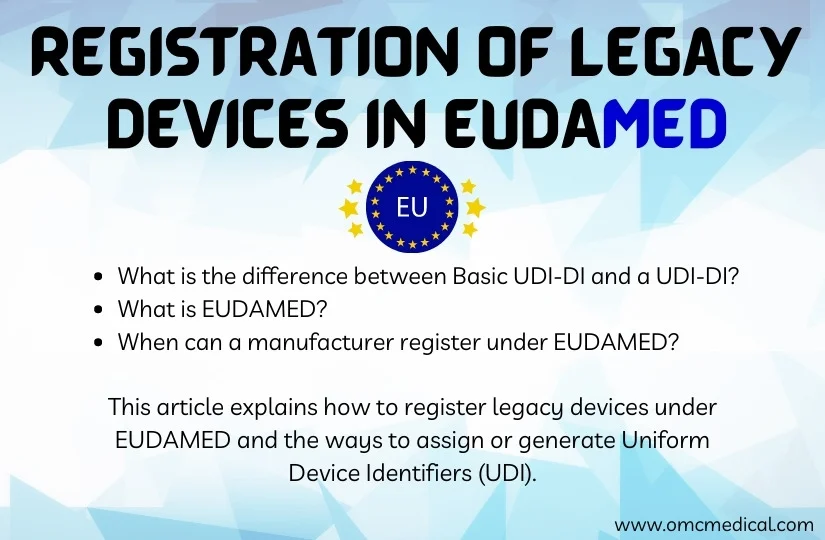
Regulation (EU) 2024/1860 introduced transitional provisions governing the registration of eudamed legacy devices
in EUDAMED. However, manufacturers should not assume that every legacy device automatically requires a separate registration.
The European Commission has clarified that, in certain circumstances, a separate registration of a legacy device may not be necessary where an equivalent MDR- or IVDR-compliant device from the same manufacturer has already been registered in EUDAMED. Whether this applies depends on the specific conditions described in the Commission's guidance and should be assessed on a case-by-case basis.
Manufacturers with large portfolios should therefore review their legacy devices carefully before beginning registration. A documented assessment of the applicable transitional provisions can help avoid unnecessary duplicate registrations while ensuring continued compliance with the Regulation.
A Worked Example: A Manufacturer Catching Up Late
Consider a mid-sized manufacturer of Class IIb orthopedic implants, EU-based, with MDR certification completed in 2023 and a stable distributor network across six Member States. If this company has not yet completed Actor Registration as of the date this article was written, here is what “catching up” actually involves, in sequence: first, Actor Registration for the manufacturer itself, which — being already three-plus weeks past the mandatory deadline — should be treated as the single most urgent open item, ahead of any device-level work. Second, once the SRN is issued, registering Basic UDI-DI and UDI-DI data for the full implant range, prioritising any SKUs with active sales over discontinued or soon-to-be-discontinued lines. Third, confirming with their Notified Body when existing MDR certificates will appear in the NB & Certificates module, since implant-class devices often involve more certificate complexity than lower-risk product lines.
If this same manufacturer also distributes into Switzerland, the swissdamed deadline arriving roughly five weeks after EUDAMED's means the EU catch-up work and the Swiss registration work should be planned as a single combined project with shared but not identical data, rather than two entirely separate initiatives competing for the same regulatory affairs team's time in the same compliance quarter.
The Resourcing Reality Manufacturers Often Underestimate
EUDAMED compliance gets treated, in a lot of internal planning, as a data-entry task — something a regulatory affairs coordinator can handle alongside their existing workload. For a manufacturer with a handful of device families, that's often roughly accurate. For a manufacturer with a broad portfolio spanning multiple risk classes, multiple Notified Bodies, and years of incremental product variants, it's a meaningfully larger undertaking: every Basic UDI-DI and UDI-DI needs to be correctly mapped, every device's EMDN code needs to be accurate rather than approximately close, and any discrepancy between what's in your internal quality system and what gets submitted to EUDAMED becomes a visible, auditable gap rather than an internal inconsistency nobody outside the company would ever see.
This is one of the more consequential practical shifts EUDAMED brings: data quality problems that used to be invisible — a slightly inconsistent device description between two regional distributor agreements, say — become structurally visible once that same device has to be described once, consistently, in a centralized EU database that Competent Authorities, Notified Bodies, and (for public-facing fields) the general public can all query. Manufacturers who treat EUDAMED device registration
as a one-off project to complete and then forget tend to be the ones who run into friction at the next audit, when the gap between their EUDAMED record and their actual technical file resurfaces.
How Can OMC Help
OMC Medical supports manufacturers through EUMDR and IVDR compliance as a combined project, including acting as EU Authorised Representative where needed and managing EUDAMED Actor and device registration directly. Given that the mandatory deadline has already passed, our priority for any manufacturer not yet registered is an immediate readiness check: confirming Actor status, auditing device data for EMDN accuracy, and identifying legacy devices against the November 2026 deadline before it becomes a similarly urgent, last-minute compliance gap.