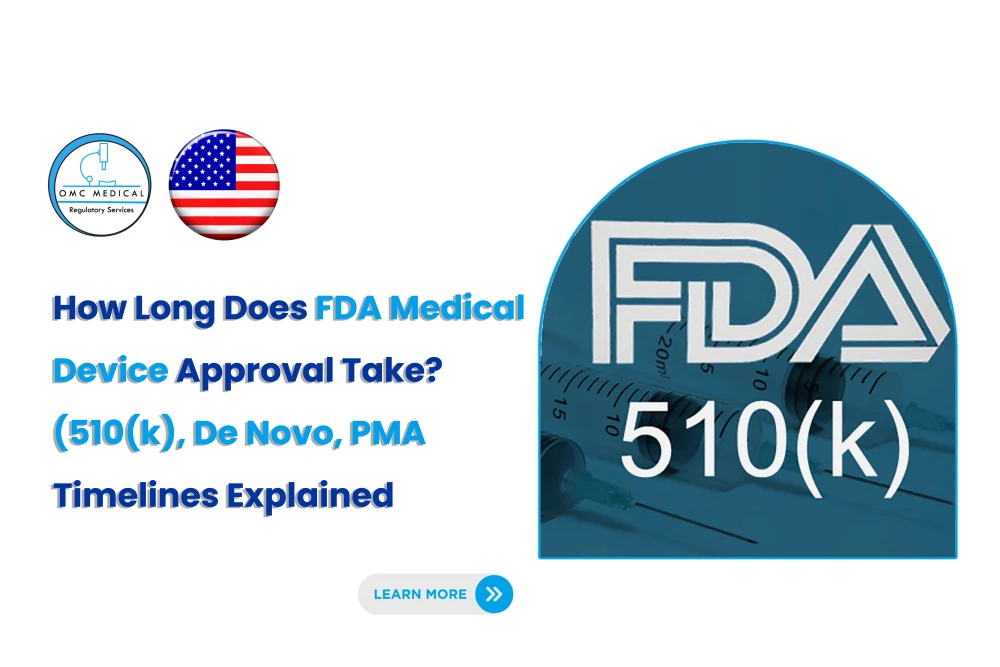
One of the most common questions medical device manufacturers ask is:
👉 “How long does FDA approval take?”
The answer depends on several factors, including your device classification, regulatory pathway, and submission quality.
Understanding approval timelines is critical for: Product launch planning Budget allocation Market entry strategy
Ready to Streamline Your Regulatory Compliance?
Join hundreds of companies who trust OMC Medical for their regulatory needs. Get expert guidance and ensure compliance across all markets.
Call Now +44 208 066 7260In this guide, we break down FDA medical device approval timelines for: --> 510(k) --> De Novo --> PMA
…and explain how to avoid delays and speed up your approval process.
Overview of FDA Approval Pathways
Before diving into timelines, it’s important to understand the three main FDA pathways:
1. 510(k) Submission
Used for devices that demonstrate substantial equivalence to an existing device.
👉 Refer to the 510(k) submission process for detailed requirements.
2. De Novo Pathway
Used for novel, low-to-moderate risk devices without a predicate.
3. Premarket Approval (PMA)
Required for high-risk devices with the most stringent requirements.
👉 Each pathway has very different timelines and complexity levels.
510(k) Approval Timeline
Average Timeline: 3 to 6 Months
The 510(k) pathway is the fastest and most common route.
FDA Review Timeline
FDA review goal: ~90 days
Total timeline (including preparation): 3–6 months
Typical Process
Preparation of submission (4–8 weeks)
FDA acceptance review (15 days)
Substantive review (60 days)
Additional Information (if required)
Final decision
What Can Delay 510(k)?
Poor predicate selection
--> Incomplete documentation
--> Additional Information (AI) requests
--> Weak performance data
De Novo Approval Timeline
Average Timeline: 6 to 12 Months
The De Novo pathway is used when no predicate device exists.
FDA Review Timeline FDA goal: ~150 days Total timeline: 6–12 months
Typical Process
1. Pre-submission interaction (optional but recommended)
2. Submission preparation
3. FDA review
4. Requests for additional data
5. Final classification decision
Common Delays
--> Insufficient clinical evidence
--> Unclear risk classification
--> Novel technology challenges
👉 De Novo requires more data than 510(k), but less than PMA.
PMA Approval Timeline
Average Timeline: 1 to 3 Years
PMA is the most rigorous pathway for high-risk devices.
FDA Review Timeline
FDA goal: ~180 days (review only)
Total timeline: 1–3 years (including clinical trials)
Typical Process
1. Clinical trial planning
2. Conducting clinical studies (6 months to 2+ years)
3. Submission preparation
4. FDA scientific review
5. Advisory panel review (if required)
6. Approval decision
Why PMA Takes Longer --> Requires clinical trial data --> Extensive safety and effectiveness evaluation --> Complex review process
👉 This pathway is typically used for Class III devices.
Comparison of FDA Approval Timelines
👉 Choosing the right pathway is critical for timeline optimization.
Factors That Affect FDA Approval Time
Approval timelines are not fixed—they depend on several variables:
1. Device Classification
Higher risk = longer approval timeline
👉 Learn more in your FDA Medical Device Classification: Class I, II, III Explained blog.
2. Quality of Submission
Incomplete or unclear submissions lead to: --> Additional Information requests --> Review delays
3. Clinical Data Requirements
No clinical data → faster approval
Clinical trials → longer timelines
4. Predicate Device Selection
For 510(k), a strong predicate: --> Simplifies review --> Reduces FDA queries
5. FDA Workload
Review timelines may vary depending on: --> Submission volume --> Regulatory priorities
Common Reasons for FDA Delays
Avoid these common pitfalls:
❌ Incomplete Documentation
Missing required sections or data
❌ Poor Regulatory Strategy
Choosing the wrong pathway
❌ Weak Clinical Evidence
Insufficient data to support claims
❌ Ignoring FDA Guidelines
Non-compliance with requirements
👉 These issues often lead to delays or rejection.
How to Speed Up FDA Approval
✔ Start with the Right Strategy
Correct classification and pathway selection
✔ Conduct Pre-Submission Meetings
Get FDA feedback early
✔ Prepare High-Quality Documentation
Ensure completeness and accuracy
✔ Choose Strong Predicate Devices
Simplify 510(k) approval
✔ Ensure Compliance with Current Good Manufacturing Practices (CGMP)
Avoid inspection-related delays
👉 A proactive approach significantly reduces approval time.
How OMC Medical Can Help
FDA approval timelines depend heavily on expertise and preparation.
OMC Medical provides: --> Regulatory pathway strategy --> 510(k), De Novo, and PMA support --> Predicate device selection --> Clinical strategy guidance --> Documentation and submission support --> FDA compliance and inspection readiness
👉 We help you reduce approval timelines and avoid costly delays.
Conclusion
FDA approval timelines vary depending on the pathway: --> 510(k) → Fastest (3–6 months) --> De Novo → Moderate (6–12 months) --> PMA → Longest (1–3 years)
However, timelines can be significantly impacted by: --> Submission quality --> Regulatory strategy --> Clinical data requirements
With the right approach and expert support, you can: --> Accelerate approval --> Reduce risk --> Enter the US market faster
FAQs
Q1. What is the fastest FDA approval pathway?
510(k) is typically the fastest pathway.
Q2. How long does a 510(k) take?
Usually 3–6 months, depending on submission quality.
Q3. Why does PMA take so long?
Because it requires clinical trials and extensive review.
Q4. Can FDA approval be expedited?
Yes, with proper strategy, pre-submissions, and expert support.