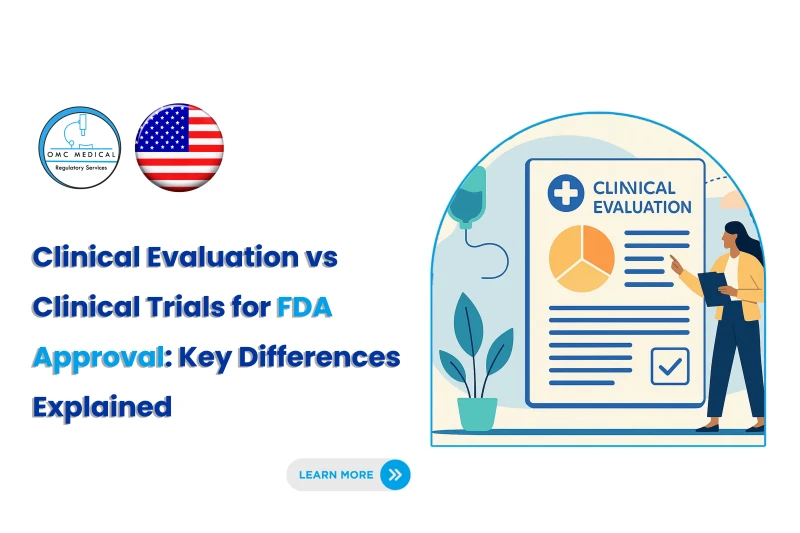
One of the most confusing aspects of FDA medical device approval is understanding the difference between clinical evaluation and clinical trials.
Many manufacturers ask: -> Do we need to conduct clinical trials? -> Can we rely on existing data? -> What does the FDA actually require?
The answer depends on your device classification, risk level, and regulatory pathway.
In this guide, we break down: -> Clinical evaluation vs clinical trials -> When each is required -> FDA expectations -> How to choose the right strategy
Ready to Streamline Your Regulatory Compliance?
Join hundreds of companies who trust OMC Medical for their regulatory needs. Get expert guidance and ensure compliance across all markets.
Call Now +44 208 066 7260What is Clinical Evaluation?
Clinical evaluation is the process of assessing existing clinical data to demonstrate the safety and performance of a medical device.
This includes: -> Published scientific literature -> Data from similar (predicate) devices -> Previous clinical experience -> Post-market data
👉 Clinical evaluation is commonly used for devices submitted through the 510(k) submission process.
What are Clinical Trials?
Clinical trials (also called clinical investigations) involve collecting new data from human subjects to evaluate device safety and effectiveness.
These are typically required for: -> High-risk devices -> Novel technologies -> Devices without sufficient existing data
👉 Clinical trials are often mandatory for Premarket Approval (PMA) applications.
Key Differences: Clinical Evaluation vs Clinical Trials
👉 Choosing the wrong approach can delay approval or lead to rejection.
When is Clinical Evaluation Sufficient?
Clinical evaluation is usually sufficient when:
✔ Device has a Predicate
Substantial equivalence can be demonstrated
✔ Low to Moderate Risk
Typically Class I or Class II devices
✔ Well-Established Technology
No significant innovation or new risks
When are Clinical Trials Required?
Clinical trials are necessary when:
✔ High-Risk Devices
Class III devices with significant impact on patient health
✔ Novel Technologies
No predicate device exists
✔ Insufficient Existing Data
Literature and prior data are not enough
✔ New Indications or Uses
Different intended use compared to existing devices
👉 These scenarios often require a PMA pathway and extensive validation.
FDA Expectations for Clinical Evidence
The FDA expects clinical evidence to be: -> Scientifically valid -> Statistically sound -> Relevant to intended use -> Adequate to support safety and effectiveness
👉 Poor-quality clinical data is a common reason for delays or rejection.
Ready to Register Your Medical Device Globally?
Get expert guidance on FDA, CE Marking, UKCA, and global approvals with OMC Medical Limited.
Book Free Consultation
Ready to Register Your Medical Device Globally?
Get expert guidance on FDA, CE Marking, UKCA, and global approvals with OMC Medical Limited.
Role of Device Classification in Clinical Requirements
Your clinical strategy depends heavily on classification:
Class I Devices: Usually no clinical data required
Class II Devices -> Clinical evaluation may be sufficient -> Sometimes limited clinical data required
Class III Devices: Clinical trials almost always required
👉 Learn more in your FDA Medical Device Classification.
Clinical Evaluation Strategy for 510(k)
For 510(k), the goal is to prove:
👉 Substantial equivalence to a predicate device
This can be achieved through: -> Literature comparison -> Bench testing -> Performance data -> Limited clinical data (if needed)
👉 Strong documentation is key to avoiding delays.
Clinical Trial Requirements for FDA
When clinical trials are required, manufacturers must:
1. Submit IDE (Investigational Device Exemption)
Allows clinical study in the US
2. Design Study Protocol
Define objectives, endpoints, and methodology
3. Ensure Ethical Compliance
Follow regulations for patient safety and consent
4. Collect and Analyze Data
Generate statistically valid results
Common Mistakes in Clinical Strategy
Avoid these errors:
❌ Assuming Clinical Trials Are Always Required
Leads to unnecessary cost and delay
❌ Relying on Weak Clinical Data
Results in FDA rejection
❌ Ignoring Predicate Devices
Missed opportunity for simpler approval
❌ Poor Study Design
Invalid or unusable results
👉 These mistakes can significantly impact timelines and costs.
Cost and Timeline Comparison
Clinical Evaluation
-> Lower cost -> Faster approval -> Less regulatory burdenClinical Trials
-> High cost -> Long timelines -> Complex regulatory process👉 Choosing the right approach saves both time and money.
How OMC Medical Can Help
Developing the right clinical strategy is critical for FDA success.
OMC Medical provides: -> Clinical evaluation report preparation -> Clinical trial strategy and planning -> Predicate device identification -> Regulatory pathway guidance -> End-to-end FDA submission support -> Medical device registration
👉 We help you minimize costs while ensuring full compliance and faster approvals.
Conclusion
Understanding the difference between clinical evaluation and clinical trials is essential for FDA approval. Clinical evaluation → Uses existing data, faster, cost-effective Clinical trials → Generates new data, required for high-risk devices Choosing the right approach depends on: Device classification Risk level Availability of clinical data
A well-planned strategy ensures: Faster approvals Lower costs Reduced regulatory risk
FAQs
Q1. Do all FDA medical devices require clinical trials?
No, many devices—especially Class I and II—do not require clinical trials.
Q2. What is the difference between clinical evaluation and clinical trials?
Clinical evaluation uses existing data, while clinical trials generate new data.
Q3. When are clinical trials mandatory?
For high-risk or novel devices, especially under PMA.
Q4. Can a 510(k) require clinical data?
Yes, in some cases where bench testing is not sufficient.