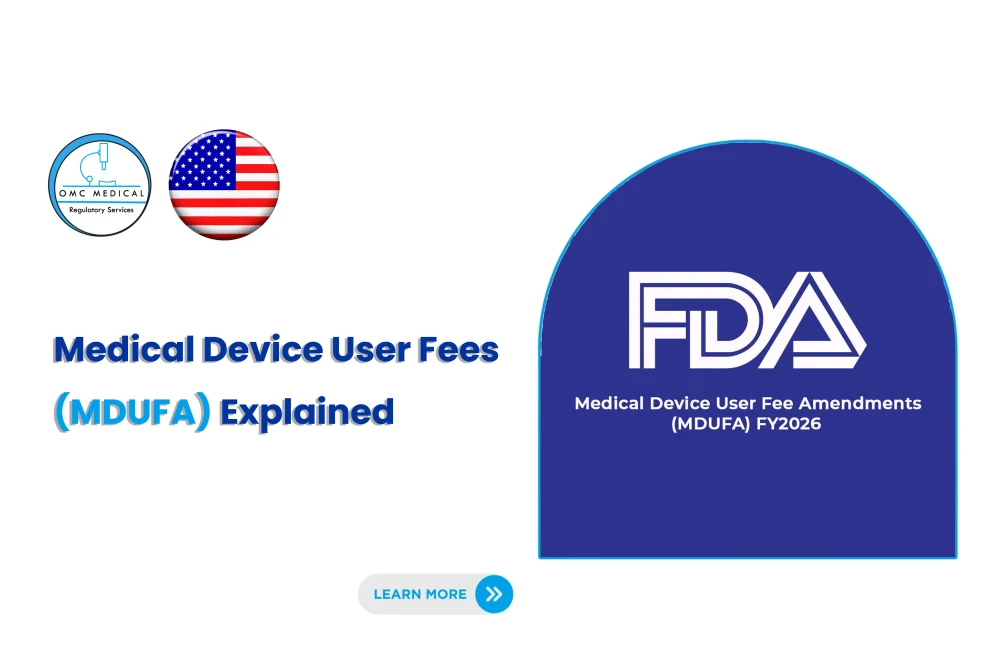
If you are planning to enter the US medical device market, understanding FDA Medical Device User Fees (MDUFA) is essential for budgeting and regulatory planning.
These fees are mandatory payments required by the FDA for reviewing and processing medical device submissions.
Whether you are submitting a 510(k), De Novo, or other applications, MDUFA fees directly impact: --> Your total project cost --> Approval timeline --> Business strategy
In this guide, we will break down: --> What MDUFA is --> 2026 fee structure --> Small business reductions --> Cost-saving strategies
Ready to Streamline Your Regulatory Compliance?
Join hundreds of companies who trust OMC Medical for their regulatory needs. Get expert guidance and ensure compliance across all markets.
Call Now +44 208 066 7260What is MDUFA?
MDUFA stands for Medical Device User Fee Amendments, a program that authorizes the FDA to collect fees from medical device manufacturers.
These fees support: --> Faster review timelines --> Improved regulatory processes --> Enhanced communication with applicants
👉 MDUFA applies to most FDA submission types, including the 510(k) submission process and De Novo applications.
Why MDUFA Fees Matter
Understanding MDUFA fees helps you: --> Plan your regulatory budget accurately --> Avoid unexpected financial delays --> Choose the right FDA pathway strategically --> Optimize submission timelines
FDA Medical Device User Fees (2026 Overview)
Below is a typical structure of FDA user fees (note: exact figures may be updated annually by FDA):
👉 Fees vary slightly each year, so always verify current FDA updates before submission.
Breakdown of Key Submission Fees
1. 510(k) Submission Fees
Applicable for devices with predicate equivalence
Lower cost compared to other pathways
Faster review timeline
👉 This is the most commonly used pathway for Class II devices.
2. De Novo Fees
Used for novel devices without predicate
Higher cost due to detailed evaluation
Requires more data and documentation
3. PMA (Premarket Approval) Fees
Applicable for high-risk (Class III) devices Most expensive and complex pathway Requires extensive clinical data
👉 Not all devices fall into this category, but it significantly impacts budgeting.
4. Annual Establishment Registration Fee
All registered establishments must pay an annual FDA registration fee, regardless of submission type.
👉 This requirement applies alongside appointing a US FDA Agent, which is mandatory for foreign manufacturers.
FDA Small Business Fee Reduction
The FDA offers significant fee reductions for eligible small businesses.
Who Qualifies? Companies with gross receipts below a defined threshold Must apply for FDA Small Business Certification
Benefits: --> Up to 50% reduction in most fees --> Reduced financial burden for startups
👉 This is especially beneficial for companies entering the US market for the first time.
Hidden Costs Beyond MDUFA Fees
Many companies underestimate total regulatory costs.
Additional expenses include: Regulatory consulting fees Clinical testing and validation Documentation preparation Quality system implementation (aligned with Current Good Manufacturing Practices (CGMP)) Post-market compliance
👉 MDUFA is only one part of the total cost—planning holistically is critical.
How to Reduce FDA Costs Strategically
Here are practical ways to optimize your budget:
1. Choose the Right Pathway
Selecting between 510(k) and De Novo correctly avoids costly re-submissions.
2. Apply for Small Business Status
Reduces fees significantly.
3. Prepare Complete Documentation
Avoid delays and additional review cycles.
4. Work with Regulatory Experts
Minimize errors and streamline submissions.
How MDUFA Fees Impact Timeline
Fees are directly linked to FDA performance goals. --> Higher fees → support faster review timelines --> Proper fee payment → avoids application delays
👉 Payment must be completed before submission is accepted.
How OMC Medical Can Help
Managing FDA costs and submissions requires careful planning.
OMC Medical provides: Cost estimation and regulatory planning --> Support for 510(k), De Novo, and PMA submissions --> Small business certification guidance --> Documentation and compliance support --> End-to-end FDA strategy
👉 We help you optimize cost, reduce risk, and accelerate approvals.
Conclusion
FDA Medical Device User Fees (MDUFA) are a critical component of your US market entry strategy.
Understanding these fees helps you: --> Plan your budget effectively --> Choose the right regulatory pathway --> Avoid delays and unexpected costs
With the right approach and expert support, you can navigate FDA requirements efficiently and successfully launch your device in the US market.
FAQs
Q1. Are FDA user fees mandatory?
Yes, most submissions require payment before review.
Q2. Do small businesses get discounts?
Yes, eligible companies can receive significant fee reductions.
Q3. Are fees refundable?
No, FDA fees are generally non-refundable.
Q4. Do I need to pay annually?
Yes, establishment registration fees must be paid yearly.